 Please wait...
The Lilith Blog
November 12, 2013 by Yona Zeldis McDonough
Mother, Photographer
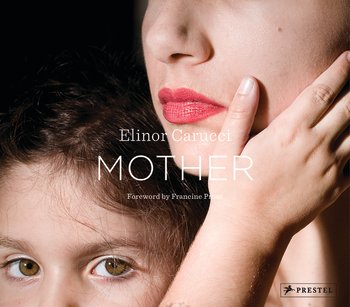 Don’t let the name fool you: Elinor Carucci was born in Jerusalem and studied at the Bezalel Academy of Art in Jerusalem; she moved to New York City the day after graduation to pursue her career as a photographer. The first few months were very difficult; she was on her own, and struggling with the many cultural differences. But she persevered and was soon approached by the prestigious Ricco/Maresca Gallery and offered a solo show and representation; she is now represented by the Sasha Wolf Gallery. Her first book, Closer, was published in 2002, the same year she was awarded a Guggenheim Fellowship, and it was followed by Diary of a Dancer in 2005. Mother, her third book, just came out from Prestel, and she chatted with Fiction Editor Yona Zeldis McDonough about the tender and intimate collection of photographs that comprise the volume.
YZM: Tell me about your earliest experiences with photography.
EC: I was 15 years old when I picked up my father’s camera. I then very intuitively walked into my mother’s bedroom and started taking pictures of her as she was waking up from her afternoon nap. in the coming weeks I continued taking pictures of her and then of my other family members and myself. I saw so much more with my camera, looking through it, looking at the photographs, it was another way of communicating with the people I love most and later with many more people.
YZM: Where do you find your inspiration?
EC: In feelings and seeing. In life, in art, in looking with attention and depth. Looking and feeling…and trying to understand and go deeper. In photographs, films and TV shows, painting, books. The streets, the people I love, looking at families in the subway, talking to a stranger, comforting a friend.
YZM: The subjects in your most recent body of work, Mother, are your children and your husband. How do you bring being a mother and being a photographer together?
EC: With a lot of hard work and focus. I had to set priorities, and give up a lot of my time with friends and free time for now.
- No Comments
November 7, 2013 by Michelle Brafman
Dr. Norman Vincent Peale and Me
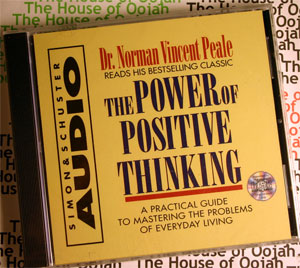
It began with a glance. I was walking out of Barnes & Noble on a warm May afternoon when I spotted him, Dr. Norman Vincent Peale, or, shall I say, his four-disc audio book, The Power of Positive Thinking, perched on the “bargain buys” table in the foyer. At that time, I was unaware that Dr. Norman Vincent Peale had been an evangelist and close friend to Richard Nixon and Billy Graham and enemy of my hero, John F. Kennedy. I didn’t know he’d coined the expression “When life hands you lemons, make lemonade.” I only knew that I’d been feeling a bit blue lately, and who couldn’t benefit from some positive thinking? I paid for the boxed set with the last 15 dollars in my wallet.
Five minutes into the first disc, and he had me. I credit his preacher’s meter, the way he punched the hell out of his iambs, his words bypassing my frontal lobe, whispering to my lower brain stem, and then traveling deeper, deeper down to my soul.
- 3 Comments
November 6, 2013 by Sarah M. Seltzer
What would Nate make of me now?
 “You are going to love The Love Affairs of Nathaniel P,” a friend told me this summer. “You’ll recognize every. single. character.” There’s nothing I enjoy more than a nice gossipy book that describes a milieu I’m familiar with, so I downloaded the novel that night. In its pages, debut novelist Adelle Waldman takes an uncomfortably close magnifying glass to a group of Harvard-educated, Brooklyn-dwelling literati and journalists. Wait, my inner voice cried out, as the narrative laid these characters’ petty foibles bare, this isn’t me. I mean, I may have been educated at that fabled university, but now I live in far away Harlem and besides, most of my crowd are progressive journalists, not mainstream journalists (meanwhile, I’m still trying to break into the literati). But whom was I kidding? This is 100% a novel about my universe, and I did indeed recognize its cast quite intimately.
As Elissa Goldstein did, I thought Waldman was masterful in particular at dissecting of Nathaniel’s psyche. This reminded me of George Eliot and Edith Wharton’s shared knack for profound portrayals of shallow characters (I immediately think of Gwendolyn Harleth in Daniel Deronda) who glimpse of something finer in themselves but can’t access it. Doing something well that George Eliot did well–that’s no small feat on Waldman’s part.
Beyond that, she’s also nailed something in our culture, or at least a privileged heterosexual segment of it. Nathaniel is smart, hyper-observant, and has the right political views. But ultimately, as Goldstein writes, “He says he wants a smart, feminist woman, which is not untrue, but what he really wants is a sexy, conventionally pretty one.” This is maddeningly familiar. I always think back to a snowy evening in a courtyard in college, when a male friend of mine looked at me beseechingly and said, “Sarah, can you explain this whole feminism thing to me? I want to be down with it, but I find it perplexing.” At that point I did exactly what one of the female characters in “Nathaniel B” would do. I said something vague with a half-laugh, hoping to avoid a discussion that would cause me to lose the male approval I still craved despite said feminism.
- No Comments
November 5, 2013 by Nechama Liss-Levinson
How the Lilith Auction Helped Me Become a National Jewish Book Awards Finalist
Learn more about the Lilith auction here!
 The story starts on August 29, 2005, when Hurricane Katrina bore down on New Orleans with a fury. The damage was unimaginable and the suffering of those affected was sprawled on the 24 hour TV news. Many philanthropic and social justice organizations responded to the need, and I was fortunate to be able to join a relief mission to New Orleans under the inspired leadership of by Rabbi Joel Soffin. We helped to rebuild three homes destroyed by the storm, including the home of a Holocaust survivor who had done battle with the racist and anti-Semitic David Duke and the home of an elderly Hebrew school teacher whose hand-written academic scholarship was destroyed by the waters of the storm.
I went back the following March, leading a group from my own synagogue, and we brought home-cooked and frozen meals to distribute with the meals on wheels program in New Orleans along with clothes and medical supplies for the grassroots clinics that that blossomed deep in the Ninth Ward. We played bingo with the residents of a nursing home who no longer had volunteers come to visit, cleaned yahrzeit plaques at one synagogue and brought and catalogued library books at another synagogue whose books were turned to mush.
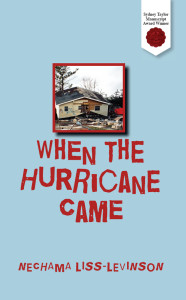
When I came back to New York, I began to write a story for children about the storm, or more specifically about resilience. The hero is a feisty nine-year-old girl named Gertie, who must flee New Orleans with her family in the wake of Katrina. She leaves behind her house, her friends, her “stuff’ and life as she knew it before the storm. In the ensuing year, she discovers what’s really important, including the love of family, community, faith and the healing magic of tikkun olam, helping the world to be a better place. And so my book, “When the Hurricane Came,” was born.
When the story was awarded the 2009 Sydney Taylor Manuscript Award, I was flying high. First of all, I had been a tremendous fan of Sydney Taylor, the author of the All of Kind Family series as a young girl, that amazing series about a family of five girls living on the Lower East Side of Manhattan. I was (naively) sure that this award meant that traditional publishers would be calling me. I fantasized about bidding wars for the book.
I sent an inquiry to all of the publishers I could think of and then I waited. And I waited and I waited. I followed up with phone calls or emails where appropriate. And then I waited some more. It was the middle of the economic turndown. Publishing was no longer a profitable enterprise. All books are now only being published as ebooks. Publishers could only take a chance on well-known names. Hurricane Katrina and its aftermath was a downer. Who would want to read it?
As one publisher said to me, “The market isn’t in your favor. After all, how many young Jewish girls were in New Orleans at the time of Katrina?” I turned this over in my head. And with some degree of overstepping, I wondered aloud, “And just how many Jewish girls were locked up in an attic in Amsterdam?”
And so, I was at an emotional low point when I began randomly looking at items in the 2010 Lilith Auction. Hmmmm, a beautiful antique Japanese tea set for my daughter who collects tea pots. Go for it. And then I saw it. A ticket to an all day workshop on Alternative Publishing, at the BookExpo America in New York.
Most of us buy books from publishers whose names we know. But the extraordinary changes in technology, digital publishing and publishing on demand have changed the rules of the game. Year ago, publishing houses that helped people to publish their own works were called “vanity presses,” a term quite wounding to the very vain egos of their writers. But things have changed and the field is now opening to people who are outside of the mainstream in some way. I put in a bid in the Lilith auction and I won the entrance pass for the conference. There was a wonderful parallel process for me. Alternative publishing was exactly what Lilith had been for all of these years. Now here was Lilith helping to open up this possibility for myself and my own creativity.
The conference was an eye opener. After listening to a day’s worth of amazing stories, I chose to work with an alternative publisher, Createspace. Partly I was inspired by stories of others who had published with them and partly because it is a sister company of Amazon and they make it remarkably easy to get one’s books listed on the Amazon site. And so, my career in alternative publishing began. I should say that I’ve had the joy and pleasure of having three books published by traditional publishers (Jewish Lights, Skylight Paths) and there is definitely a thrill that accompanies that path. But now I was pursuing another one.
I was on my own. Before actually attempting to publish my book When the Hurricane Came, I decided to beta test the whole process by publishing a children’s book I had kept in my files for many years, Cookie the Seder Cat, a whimsical children’s book about two sister cats, Oreo and Cookie, who prepare the Seder together. The illustrations are photographs of our cats from my children’s childhoods. In doing the Cookie book, I learned how the various features of Createspace worked, and also in what areas I would need more help. The Cookie book let me see that I would be willing to pay for the help of the Createspace staff for the computer intensive issues of layout. I even treated myself to getting professional help with designing the cover. It was a go.
It’s hard to describe the joy of getting the actual book in the mail. It’s even more joyous to hear the feedback of young people who read the book and identify with or are inspired by Gertie. Gertie, by the way, is the name of one of the sisters in the All of a Kind Family series, and Gertrude was my mother’s name. Giving her name life again in this energetic and social-justice-minded young girl is my tribute to her.
So with the book finally published by Createspace, I was able to enter it into the 2012 National Jewish Book Awards. This past March, my book, When the Hurricane Came, was named a Finalist, Children’s and Young Adult Literature, National Jewish Book Award.
Thank you Lilith. My experience with the auction is a mirror image of your message to Jewish women. It’s worth taking a step outside of your comfort zone, outside of the mainstream. Each of can be empowered to making our personal dreams a reality. So look at the items on the auction and take a chance. It may change your life .
Nechama Liss-Levinson is a psychologist and author. Her most recent book, When the Hurricane Came (Createspace), was chosen as a finalist for the National Jewish Book Awards.
- No Comments
November 5, 2013 by Yona Zeldis McDonough
Our Long Lineage of Seers and Fortune-Tellers. Who Knew?
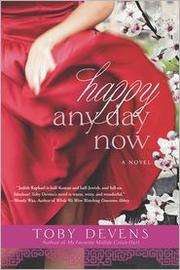 By her own description, Toby Devens was a “Broadway baby”‘ who had a successful early career of acting on stage and television. But by the age of twelve, she had hung up her dancing shoes and picked up a pen. Early efforts included fairy tales, detective stories in the manner of Nancy Drew and a staged version of Little Women. Later, she turned to poetry and short fiction; she also wrote restaurant reviews and theater criticism. Her first novel, My Favorite Mid-Life Crisis (Yet) came out in 2006 and is now followed by Happy Any Day Now. Devens chatted with Fiction Editor Yona Zeldis McDonough about what Jewish and Korean moms have in common, her lifelong passion for music and the particular pleasures of finding love in the middle ages.
Yona Zeldis McDonough: You’ve created an unusual character–a Korean-Jewish female, Judith Soo Jin. Why?
Toby Devens: Sometimes stories come about in strange and wonderful ways. Happy Any Day Now began when my granddaughter was born and I felt this surge of longing to find out about my own maternal grandmother. She died eight months before my birth. I’m named for her and when I went to Ellisisland.org and saw her listed on a 1900 ship’s manifest, I felt incredibly close to this woman I’d never known. That’s when I started asking my family questions about her: how she became American, learned the language, weaved the old the world with the new. As I put together my grandma’s story, I realized that much of the immigrant experience was universal, and I wanted to write about that. But how? The answer came with a friend request on Facebook from a relative I barely knew: the daughter of my first cousin and his Asian wife. Seeing that young woman’s photo—the beautiful blending of two cultures—produced my eureka moment, and my protagonist Judith Soo Jin Raphael, a cellist with the Maryland Philharmonic. In Happy Any Day Now, we meet Judith as she’s approaching her 50th birthday and her past invades her present to make magic and mischief.
- 4 Comments
November 4, 2013 by Maya Bernstein
Halloween, Coda
 On Halloween night, my kids were in bed, and I was driving home from the supermarket. I drove more slowly than usual, because the normally quiet streets were more alive, with groups of middle school kids in eerie costumes laughing and skipping unawares across the street, and with parents out late with their little ones, shining their flashlights onto houses to see if they are worth a knock. I rolled slowly by, thinking of all the reasons I heard as a child, growing up in a Modern Orthodox Jewish community, about why my family doesn’t celebrate Halloween– we have so many other holidays in the fall; we don’t like the idea of “trick or treat” – give me candy or I’ll trick you; we have Purim. I thought of how often my kids had been asked over the past weeks what they’re dressing up as, and their big embarrassed eyes looking up at me, seeking help about how to answer. We don’t celebrate Halloween, I say smiling, and the conversation is killed.
This year, we are sending our youngest child to a non-Jewish preschool. It is walking distance from our house, and it’s open all day long, designed for families like ours, with two working parents. It’s a wonderful place, completely play-based, with a philosophy of positive discipline, inquiry-based learning, and creativity. Our son couldn’t be happier. But it is our first time as parents navigating having our child in a non-Jewish environment. His pre-school has been preparing for Halloween for weeks. He’s been singing The Itsy Bitsy Spider and Little Miss Muffet, has learned to say “Trick or Treat,” and has been carving and decorating pumpkins. We do not celebrate Halloween in our family, and this inundation has taken us by surprise. We developed a party line: your school celebrates Halloween, but we do not celebrate Halloween in our family. My son’s response? I do! I’m going to go around with a bag and say Trick or Treat and get candy! When I told him that he, alas, wouldn’t, he burst into tears, inconsolable.
I was away on business the week before Halloween, and returned home with a pilot’s cap for my son. It just happened that he wore it to school on Halloween, my first day home. He wore it because it was new, and because he loves airplanes. Not because it was Halloween. But when I dropped him off at school, and his classroom was dark, full of cobwebs and spider mats, glow in the dark paint and little pumpkins, and all the kids were in costume, he and I looked at each other. I’m a pilot, he declared, and I nodded, yup, you’re a pilot, and skedaddled out of there.
As I drove home on Halloween night, watching women in witch hats open their doors to the kids who live on their block, watching families and friends coming together in the dark, engaging in face-to-face conversations, creating real human micro-communities, I saw, for the first time, the beauty in this holiday. And I wondered – what value is there in refraining from participation? Is it impossible to be committed to one set of beliefs and practices, while participating in others? Halloween is one of our lines in the sand, a line that we have chosen not to cross, as part of our definition of who we are, and who we are not. The line felt more random to me this year, more arbitrary.
This Halloween, I realized that as much as we are raising our children with positive engaging Jewish experiences, we are also deliberately raising them to refrain from other experiences as a pivotal tactic in helping to form their Jewish identities. Perhaps there is a layer of fear that underlines this choice. But there is also a belief, a philosophical commitment, at the heart of this decision. Part of what we are trying to teach our children in their lack of participation in this experience, is how to not fit in, how to not belong. We are giving them practice in choosing to be an outsider, and trying to give them language to make sense of that decision. We are teaching them that they cannot have it all – that choosing one way of living often means having to let go of other ways of living. Not celebrating Halloween is simply one manifestation of that training.
And yet, I’m glad my son went to school on Halloween in his pilot’s hat. It would have been too strange, too hard, for him to go in his kippah, as he normally does. It occurred to me that as we strive to direct his growth, we are actually putting him in a costume each day, asking him to intentionally wear the mask of being Jewish, so that eventually that mask becomes his identity. And I couldn’t help but feel how refreshing it must have been for him, even at his young age, to take off that mask, and put on a mask, briefly, of one of the crowd.
photo credit: Mr. T in DC via photopin cc
- 5 Comments
October 16, 2013 by Danica Davidson
The Holocaust in Graphic Form
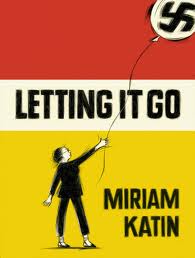 Miriam Katin served as a graphic artist in the Israel Defense Forces in the 1960s, and later she did artwork for MTV and Disney. Her first graphic memoir, We Are On Our Own, was published in 2006 by Drawn and Quarterly and recounts how she and her mother survived the Holocaust in Hungary. Her second graphic memoir, Letting It Go [reviewed in Lilith here], came out last spring and shows Katin releasing the past.
Danica Davidson, whose journalism on graphic novels has been published by Lilith, MTV and CNN, spoke to Katin about her work.
Danica Davidson: Why is it you decided to use the graphic novel format to talk about your experiences in the Holocaust?
Miriam Katin: The stories of my background and what happened to us were always there, continuing in my mind. I don’t write, but I draw, and when I discovered comics for myself in about 2000, I thought I could tell the stories I have. As far as Art Spiegelman’s Maus is concerned, it gave me “permission” to do the stories in drawings.
DD: Why do you think graphic novels work so well as an outlet for memoirs?
MK: It works for a certain audience. These would be mostly young people and not-so-young people who grew up on superhero comics. You can still see them at bookstores reading the manga or graphic novels. Those are most of the readers, and for them to discover history, it’s probably working very well. As far as my work is concerned, for example, my publisher was hoping it would be a crossover with old people discovering comics. It didn’t work so well. I know so many people who are really serious readers and they’d look at this and get really confused and say, “I can’t deal with it. I have no idea what this is.” The old people who bought my book were people who know me and were interested in stories about the war.
I saw a real difference between when my first book came out in 2006 and my second book this past year. This time I saw many more old people buying it, so they are connecting to read pictures.
I was really lucky to be picked up by such a marvelous publisher. My first work that I did was in 2000 and it was only four pages. It got released to fantastic reviews, and one reviewer said it would stand up even in Drawn and Quarterly. I had no idea who was
Drawn and Quarterly, so I ran to the bookstore and got their stuff. I sent my first work to Drawn and Quarterly with my review and they called me up on the telephone to say they loved my work and, oh, I must have something around I could send them. I did this twelve page story about the Hungarian uprising and I received a nomination for an Eisner Award. That was my second work in comics, and I received a number of commissions.
- No Comments
October 15, 2013 by Yona Zeldis McDonough
Who Takes Out the Trash?
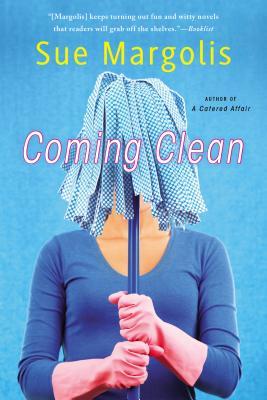 With her bright red hair and snap fire one-liners, British author Sue Margolis is a force. Margolis, who has ten books to her credit and over half a million copies in print, has clearly struck a chord and is in perfect synch with her largely female readership. She delivers funny, brassy comedies that still manage to get at some of the key issues facing women today. In Coming Clean, she tackles the age-old dilemma of who takes out the trash, who does the laundry and who mops the floors—and what it all means.
On a recent visit to New York City, Margolis sat down with Fiction Editor Yona Zeldis McDonough to chat about her life as a radio reporter and as a ladle-brandishing Jewish grandma, and why Seinfeld tanked in the UK.
YZM: With her dead bubbe Yetta, your character Sophie is clearly Jewish. Are all your protagonists Jewish women?
SM: Not all, but most. That way, I get to do what I enjoy most, writing about crazy Jewish families like the one I came from. It’s the glorious, comical-without-realizing-it matriarchs I remember most of all. I love bringing these elderly Jewish mothers–the ladle-waving yentas who used to breastfeed their children matzo balls–back to life.
YZM: You’ve said that the Jewish content of your books does not go over that well in the UK; can you say more about that?
I think maybe what many Americans don’t appreciate–because they’re so familiar with it–is that their humor is Jewish humor. Seinfeld is the most popular US sitcom ever, so I’m guessing that nearly everybody over there [meaning in the U.S.] ‘got’ it. When the show aired in the UK–late at night–people were baffled and left scratching their heads. Jewish humor has never had the same impact over here as it’s had in the States. In the UK there has always been a strong and well-established tradition of regional (predominantly northern) working class comedy. I think it was hard for Jews to break onto the scene–although some did and became moderately successful. Meanwhile in the US, in the early decades of the last century, Hollywood–not to mention musical theatre–was hungry for producers and writers–many of whom turned out to be young Jewish immigrants who were just as hungry. And so it grew.
YZM: What kind of Jewish upbringing did you have? Is your family observant?
SM: We were vaguely observant until my brother’s bar mitzvah. After that my parents stopped worrying if the silverware got mixed up and pretty soon bacon started to appear in the fridge. My sense of ‘Jewishness’ came much more from Habonim (the Zionist youth group) which I joined when I was about fifteen. It was here that I learned Jewish history, not to mention the Hebrew songs I sang to my children when they were small. Now I sing them to my baby granddaughter.
YZM: You’ve worked as a journalist; how did you get your start as a novelist?
SM: I spent fifteen years working as a freelance reporter for a BBC radio program called Woman’s Hour. It’s been around since the Forties and is a real institution over here. The program manages to be serious and thoughtful – discussing and reporting on issues that concern women in the west and the developing world – but it’s also funny. That’s where I came in. I used to contribute most of the lighthearted features. But I’d always wanted to write–to be funny in print. So in the end I decided to stop talking about it and get on with it. I simply quit the BBC and took the biggest risk of my life. My first novel–Neurotica–was published a year later.
YZM: Your husband is journalist; what is it like being married to a fellow writer?
It’s fine. There’s never any competition. No honestly, there really isn’t. I write novels. He writes for newspapers – mostly about technology. If there’s a problem it’s mainly that our house is always full of boxes. Gadgets for review are constantly being delivered. They disappear eventually, but meanwhile I’m forever tripping over 3D printers or the latest dual docking audio system.
YZM: Which comes first for you: plot or character?
SM: Plot every time. A writer has to have a tale to tell. Story is all.
YZM: Have your novels changed and grown along with you?
SM: Possibly not, but I think they’re about to.
YZM: What’s next on your horizon?
SM: I think what I’ve realized as I get older is that I can’t keep writing convincingly about the lives of thirty-something women. I think it’s a mistake for older authors to keep doing this. You may not realize that you’re losing touch with the younger generation, but you are. Your references are all wrong. You’re not up with the Zeitgeist. So if all goes to plan, I shall be withdrawing gracefully from the world of yummy mummies to concentrate on gorgeous (and very modern) grannies.
- No Comments
October 8, 2013 by Susan Weidman Schneider
When You Can’t Afford a Diaper…
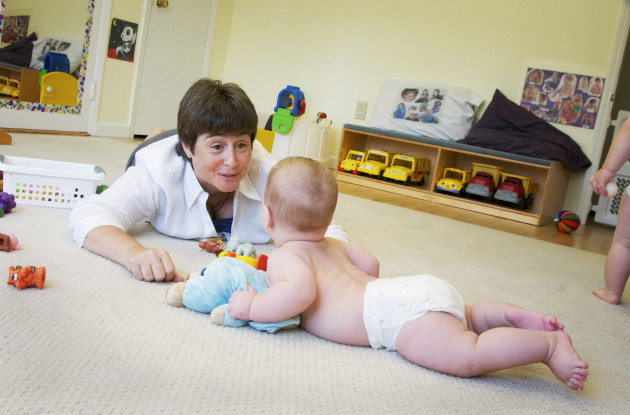
Joanne Samuel Goldblum, photographed by Gale Zucker
During this government shutdown, there are now insurmountable obstacles to accessing many of the vital human services that so many depend upon–food aid to women, infants and children (WIC), for example. The shutdown is not just a matter of government employees losing wages hour by hour (bad enough) but of the grievous plight of people–largely women, in fact–whose very food for survival is in jeopardy. And these benefits at their best are too often insufficient for the people who need them most. Here is one woman who has for 10 years taken on an often unrecognized–but enormous–expense for families today.
“Once you start noticing, the need is everywhere.” So says Joanne Samuel Goldblum, founder and president of The National Diaper Bank Network (diaperbanknetwork.org), the largest diaper bank organization in the nation. She created this innovative nonprofit in New Haven, CT, 10 years ago. This year, through the National Diaper Bank Network, she distributed more than 15 million free diapers to needy families across the country through a network of local diaper banks. According to the organization’s website, nearly 30 percent of low-income families cannot afford diapers.
Honored widely for her pioneering work, Goldblum told Lilith that her early experiences as a social worker, seeing a need that is often quite invisible, moved her to relieve the pain of babies and children who have to spend all day in a urine-soaked diaper — and the shame and depression their mothers suffer (yes, most often the mothers) when they have to put a kid to bed in a dirty diaper because they can’t afford clean ones. Or can’t go to work because they don’t have the money for the diapers you need to send to daycare. “And you are not allowed to pay for diapers on food stamps!” said Goldblum.
“With diapers, once you see the need you start to see it everywhere — towels, shampoo, soap, toilet paper. When you start to think about what happens to families when you cannot afford these things… oral hygiene problems because they don’t have toothpaste or kids going to school dirty because there is no laundry detergent….
“We are taking about diapers, but the bigger picture we are talking about is poverty, and about kids in America — and we manage to ignore this to a large degree.”
Goldblum says her mother, Ellen Samuel Luger, a social worker active in reproductive rights, is her model for activism. “It’s striking to me how many social workers are Jewish women! This fits incredibly well with what you learn as a Jew about social justice. Tikkun Olam is what the rabbi talked about” in the New Jersey Reform congregation where she grew up.
So why are “churches” and not “synagogues” mentioned on The Diaper Bank Network’s website? Although there are synagogues and temples that run diaper drives, Goldblum said, “I have had less luck getting in to speak at synagogues than at churches. It likely has more to do with the ways churches and synagogues do community outreach. We certainly get a lot of support from people affiliated with synagogues. The Diaper Bank Network has been trying really hard to find ways to connect with organizations like JCCs and early childhood programs.” Not surprisingly, Goldblum notes that the biggest category of individual supporters is “young parents — and grandparents.”
One of the seemingly simple policy changes Goldblum advocates is for social-service agencies to have a line item for diapers, which they give out frequently. “They only call them ‘incidentals’ in their budget, though they do spend money on these things. It’s important to name them, so people notice them.”
- No Comments
October 2, 2013 by Chanel Dubofsky
Putting My Mother Back Together

Really, I am just trying to put her back together. The woman I knew as my mother was dismantled, by illness and by fear and trouble, but there’s the person I didn’t know, ever, and I am trying to find her.
I made one phone call, to G, my cousin, the daughter of one of my grandmother’s sisters. I sent one email, to my uncle. It took me a long time to do this, and I finally managed it in one of those middle of the night seizures of bravery. All you require is one moment of insane bravery, someone wrote. Or at least something that can pass for insane bravery.
The email I wanted to send to my uncle, my mother’s only brother, was something like, “Can you tell me what the hell happened?” Instead, it was kind of desperate, admitting to him that I had never asked her certain questions while she was alive (How had she met my father? Why hadn’t she gone to college after she’d been accepted? What else had happened to her in her life?), and hoping he could tell me something. The specific questions I had had no longer seemed terribly important. Anything he could do to fill out my hollow picture would do.
- 1 Comment