 Please wait...
May 25, 2011 by Merissa Nathan Gerson
Ba'al Tshuva
 A ba’al tshuva friend suggested I read William Zinsser’s On Writing Well to help clean up my prose. I read it like bible roulette. Make a wish, close your eyes, and open to a random page. It works better with the bible because Torah is a better fortune-telling wisdom-yielder, but it still works. This week’s fortune a la Zinsser: “Get their voice and their taste into your ear – their attitude toward language. Don’t worry that by imitating them you’ll lose your own voice and your own identity.”
Ba’al tshuva means a person returning to the faith with fervor. It is a born-again Jew, a re-adhering human who decides to take the full religious plunge. I came to Israel a year ago, a mostly secular Jewess, with a thirst for Judaism. I attended Friday night services or Shabbat meals as a religion, and the rest, barring high holidays, fell by the wayside. In its place, I filled myself with yoga and meditation, Swami books and Hafiz poems, Khalil Gibran and others. I was a classic neo-Chasid, loving my mystical roots in Judaism and fearlessly informed by other religions.
I moved to Tel Aviv to teach English at the African Refugee Development Center. Besides teaching, everything else made me slightly miserable. This was not the Israel I remembered from living here as a kid, or visiting as a teenager. My own distaste surprised me as all I saw was a secular city aching for any opportunity to defy the confines of religion. I didn’t know a lot about Israel yet, like how this division between secular and religious is a defining factor in the country today. I just knew that religiously and spiritually—I was disappointed.
And then I somehow was ushered to Jerusalem. It was not an expected move. It was more as if there was some big hand, like in those claw arcade machines, and I was a stuffed animal, and someone in Jerusalem was winning the game. I moved to study Torah at the Pardes Institute for Jewish Studies and as my friend, Faith, explains, “You thought you were so open, but you were not as open as you thought.”
I was a post-denominational anti-establishment mystically leaning Jew enrolled in a strict text study program. I cried for nearly an entire month. For nearly half a year I took my tears to imply that I had defied gravity and was in the wrong place at the wrong time, like I had sold my soul. About nine months after my arrival I remembered what my rabbi, Rabbi Miles Krassen, then of Boulder, Colorado, once had said.
He told me a story of a woman whose steady flow of tears was a sign of her heart breaking back open, wide, and the tears were the trail back inside. Something like that, something you only hear in Boulder and only embrace, without cynicism, while living there. I thought I needed height. I thought I needed spirit and connection on a higher and ethereal plane and instead I was rooted and grounded and held by the warmest Jewish community.
Sure, it took time. I hated benching, I hated all the songs, I hated the blech and the halachic shaming. I still detest gender separate prayer, and abhorred the obligation and narrowness of everything. But it was that precise narrow obligatory Jewy core that restored a brokenness inside of me. I was cupped by a community of people whose beliefs did not echo my own, but whose devotion to being good people, G-d-fearing people and Jewish leaders was in step with my desires. We were an errant bunch, culturally mismatched despite being Jewish Americans, and yet linked by our separate relationships to the same core.
I didn’t know what a tractate was last year. I didn’t know how to read a Mishnah or who Ephron was and why buying property is complicated. I didn’t know that if you touch one edge of one sentence of Torah, it opens to a panoply of other complex sentences, perspectives, the voices of countless men, one after the other. I didn’t know how male dominated Torah scholarship had been, and how much it has evolved in recent years.
In a search for spiritual flight, I traded, without asking, for spiritual roots. I learned Jewish history this year, and modern Jewish thought. I learned about multiple modes of Jewish meditation practices, Jewish sex laws, and the inner writings of the Aish Kodesh. I spent sometimes more than nine hours a day learning, including evaluations of Tanach, of Chassidism, of Women and their obligations, or lack thereof, when it comes to mitzvot.
I was, in this process, terrified of losing my identity. I was worried about imitation, about Hebrew scholarship, about what would happen if I submitted to the rubric of religion. Somewhere in the middle something loosened in me. It was after I had to get over my arrogance, after I was humbled by low-Hebrew skills and minimal knowledge. Religious scholarship is a field in and of itself, and if I was the most Jewish of my secular friends in America, I became the least Jewish of a group of rabbis and educators and Jewish
leaders-to-be for a whole year. As they say, “It is better to be the tail of the lion than the head of the wolves.”
And so I let my attachment to ego go. Buddhism whittled its way in and I surrendered to Judaism. I koshered my kitchen. I began attending daily Mincha services. I stopped using my phone on Shabbos, and later my computer. I washed before I ate, kept laws like not cooking after sundown and waiting for three stars to appear to begin my week. I even did that old strange ritual where you jump towards the moon with an open hand, and watched bonfires sizzle en masse in Gan Sacher.
I imitated for a whole year and my fears of losing myself were never confirmed. As William Zinsser wrote, “Don’t worry that by imitating them you’ll lose your own identity. Soon enough you will shed those skins and become who you are supposed to become.” My identity returned, in full throttle. “My” Jewish, my way in Judaism is paved clear as day ahead of me. I am losing my devotional practice as my departure and return to America loom. I am disengaging my submission in order to survive in the secular world all over again. I am not scared, though. If I can leave myself for devotion, than I can also leave devotion for myself. Somehow, I am almost certain, devotion will return, and return, and return again.
- 6 Comments
May 16, 2011 by Yona Zeldis McDonough
Jennifer Gilmore on "Something Red"
 It’s the summer of 1979 and Sharon Goldstein, a professional caterer, is in her Washington, DC kitchen making dinner for her extended family. Her eldest child—Ben—is about to leave for his freshman year at Brandeis and his departure will no doubt reshape and reconfigure this family group. Sharon feels a mixture of excitement, nervousness and sorrow as she contemplates her son’s imminent departure. She takes great care in preparing the meal, thinking, “…it would be perfect to have the family sitting together in the backyard, all along the large communal table, the scuffed wood illuminated by lit candles and flickering torches, before Ben became a dot on the horizon and left the all behind.”
So begins Jennifer Gilmore’s second novel, Something Red (Scribner, $25), a provocative blending of the personal and the political. Lilith’s Fiction Editor Yona Zeldis McDonough interviewed Gilmore to get her take on, among other topics, life in the late 1970s, political ideologies as seen through the lens of character, Jews and food, Jews and weight and the execution of the Rosenbergs. Their conversation is below:
What drew you to the time period 1979-1980? Why did it feel essential to set the story at this particular moment? What is your own connection to that time?
A lot of people have asked me why I chose 1979, as I was alive, but quite young. There were lots of reasons I was drawn to it. I wanted to carry on the story of Jewish immigrants in this country (my last novel ends in the sixties), and what life was like for the subsequent generations whose issues were quite different than their parents and grandparents who came here. I was also very interested in the era for thematic reasons. It was the first time one country used food to starve another and I wanted to write about the way food played out in the family and then the way it played out it in the world. My father is an economist and foreign food policy was talked about a lot in our home–mostly at the dinner table–and the conflation of the personal and political struck me even then, though I wouldn’t have described it that way at the time.
And though it was a year I was too young to remember clearly, it was a seminal moment in history, fraught with endless fictional possibilities. Jimmy Carter was in the White House, the Iranian hostage crisis was in full bloom, there had been a nuclear accident at Three Mile Island. Disco was dying, (everyone but my grandfather was happy about this) and so was punk rock in its hardcore form, culminating with the death of Sid Vicious. Women’s oppression seemed to be waning, made concrete by Judy Chicago’s “The Dinner Party,” shown that year at the San Francisco Museum of Modern Art. Culturally, the world was thriving: Styron’s Sophie’s Choice and Mailer’s The Executioner’s Song were released in 1979. So was Manhattan, The Rose, Apocalypse Now and Breaking Away. Then, on Christmas Day, Soviet deployment of its army into Afghanistan began. And on January 4, 1980, Carter announced the US grain embargo against the Soviet Union, which figures prominently in the book, and is when the novel begins.
Can you talk about the role of research in the writing of this novel? How you did it, and more importantly, how you kept it from showing? (more…)
- No Comments
May 16, 2011 by Merissa Nathan Gerson
I Was In Love With A Medicine Worker
 I was in love with a medicine worker. We sat in the mountains at an outdoor café towards the end of my four-month trip to South Africa. We were sealed at that point, two hearts attempting to find a way to gracefully detach. During our meal a station wagon drove up and my mentor got out. I excused myself from my lover and took to my mentor, hugging and greeting him with great joy. This man had coached me in how to ingest South Africa, how to digest Apartheid, on how to determine the nutritional value therein.
I was an activist studying in Cape Town. The more I learned of multiculturalism and social change, as was the goal of my time there, the more my head split and my heart opened and my previous activism platforms felt hollow. This mentor sat with me on the fenced-in porch of a township community center as I cried, “How do you keep going?” The whole weekend we learned about keeping hope alive despite Cape Town’s secret underbelly, the unmarked graves, a city “drenched and built on blood.”
We visited the sites of massacre and of rebellion, a tour of history off the books. And we ended up behind a barbed wire fence for a Rosh Hashanah gathering, challahs hand-braided in Langa, song and prayer with a diverse group including former revolutionaries largely responsible, depending on whom you asked, for the fall of Apartheid. So when months later I saw this man who, despite his own wounds, like hating the one blonde girl in our group because “her eyes reminded him of his former jail guard,” I was overwhelmed and excited.
Everyone in Cape Town holds a story, and more than one story contradicts. I hugged my mentor goodbye and watched him get back into the car, the backseat of a Volvo, cap pulled down covering his eyes, as his wife drove him away. To me, an American thirsty to learn and know any history beyond my own, thirsty to rub up against the most prickly of South African history, to me, my mentor was a hero.
I walked back to my friend and he looked at me as if he had seen a ghost. “Why are you talking to that man?” He asked. “Do you know who that is?” (more…)
- 3 Comments
May 13, 2011 by Jill Finkelstein
Link Roundup: Modesty and the Ever-Present Gender Gap
Welcome to this week’s installment of Lilith’s Link Roundup. Each week we post Jewish and feminist highlights from around the web. If there’s anything you want to be sure we know about, email us or leave a message in the comments section below.
Di Tzaytung, a Brooklyn-based Orthodox weekly came under fire after removing U.S. Secretary of State Hillary Clinton and Director for Counterterrorism Audrey Tomason 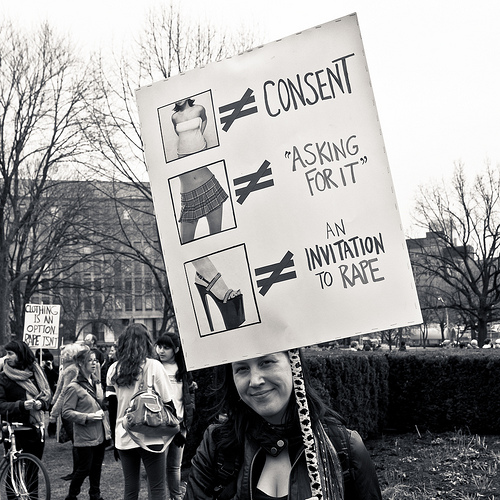 from the now-famous Situation Room photo. The newspaper released a statement saying, “Our editorial policies are guided by a Rabbinical Board and because of laws of modesty, does not allow for the publishing of photos of women.” [Lilith blog]
Sarah Seltzer reported on why “Slutwalks” are sweeping the globe. First started in Toronto, Slutwalks combat the notion that women who dress like “sluts” are asking to be raped. [AlterNet]
Parenting columnist Marjorie Ingall shared why standardized testing is “antithetical to Jewish values.” [Tablet Magazine]
Friend of Lilith Chanel Dubofsky explained how volunteering at Planned Parenthood on Shabbat provided her with a meaningful Jewish experience. [The Sisterhood]
Elmira Bayrasli explained the Twitter gender gap and why women are under-represented in the OpEd sections of major newspapers. [Forbes]
A Texas high school cheerleader was kicked off her cheerleading squad after refusing to cheer for her rapist, who played on the school’s basketball team. After losing a court case against the school, she has been ordered to reimburse the school $45,000 in legal fees and was denied an appeal case by the U.S. Supreme Court. [Huffington Post]
AlterNet named the 10 worst states to be a woman. [AlterNet]
- No Comments
May 11, 2011 by Susan Weidman Schneider
Charity Auctions Online: Benefits Beyond Financial Success
Cross-posted with eJewish Philanthropy.

You may have noticed that the gala benefit season is in full swing, and extreme donor fatigue has set in for some. In an email last week, a friend began by moaning, “I hate these things, and rarely go. But please come with me.”
Jews aren’t alone in this suffering. The Chronicle of Philanthropy last October headlined the dilemma as “Charities Rethink Galas.” The Chronicle suggests freshening things up with a silent auction, perhaps held alongside the cocktail hour, though there may be another way out of the rubber chicken (or sushi) circuit. On May 9, Lilith, the nonprofit Jewish feminist magazine, opens its fourth online-only auction as a route to raising funds without the extreme sport of event planning.
It may seem strange that in almost 35 years as a Jewish nonprofit Lilith has not yet held a large-scale fundraising event. A couple of years ago, though, when we hosted a small spring cocktail party in Manhattan as an egalitarian way to draw in women across the age spectrum for an evening of “friendraising,” socializing and good talk, we decided to pair it with a silent auction. The offerings ranged from ritual objects and art-glass paperweights to, well, sex toys donated by a women-owned business. Vintage clothing and jewelry, autographed books, a Hazon cycling outfit, original art, Zabar’s goodies, a Miriam’s Cup, and assorted “experiences,” including a portrait session with photographer Joan Roth. And while there was terrific fun at this face-to-face gathering – held, appropriately, at the Drisha Institute for Jewish Education, where women go for advanced Jewish study – we questioned whether the modest financial take was worth the trouble. Since then, we’ve learned a thing or two. We discovered, as we were in the process of cataloguing items for the face-to-face auction, that there are online sites, like BiddingforGood.com, geared specifically to assisting nonprofits manage auctions like ours exclusively online.
Starting in 2009, Lilith’s has had modestly gratifying financial success with twice-yearly online auctions using Bidding for Good. The financial benefit is no surprise, but there have been other, unanticipated lessons and outcomes beyond the auctions’ dollar value. (more…)
- No Comments
May 11, 2011 by Sonia Isard
The Spin Cycle: Another Look at Hillary Clinton and the Photoshop Fiasco
 In the immediate aftermath of Bin Laden’s death, the meme-conducive photo of Obama, et. al., in the Situation Room quickly made the rounds. Some of the digital manipulations were quite satisfying— President Obama holding a video game controller, or Keanu Reeves sitting at the table, calmly participant-observing.
Then, whoops! Just as fast as a squirrel can photobomb your vacation shot, it turns out women can be taken out of the picture.
NPR and the Washington Post reported that Di Tzaytung (a Brooklyn-based Orthodox weekly) had deleted Hillary Clinton and Audrey Tomason from the now-famous photo. This got picked up in the Jewish blogosphere and in the feminist blogosphere and pretty much everywhere else—it’s such a clunky and unsophisticated example of tsnius that it’s hard to pass up the opportunity to mock. I mean, talk about low-hanging fruit! There’s nothing as funny as an obviously botched and misguided photoshop job.
Di Tzaytung responded to the uproar, writing: “Our editorial policies are guided by a Rabbinical Board and because of laws of modesty, does not allow for the publishing of photos of women.” Which, hmmm.
But ok, big surprise, some Orthodox men are trying to efface women from the big picture. What else is new?
I think this event reflects more our ever-changing ideas of evidence and proof—the role of imagery in today’s information-rich architecture of communication. Incidentally, the larger coincident debates—whether or not to release photos of Osama Bin Laden’s corpse, or President Obama’s decision to release his long-form birth certificate—are another side of the same coin. By now, the photoshopped slimming down of models and actresses is taken for granted. But the realization that “facts” can be manipulated as easily as women’s bodies? That’s just starting to sink in.
Why is this a feminist issue? For me, it brings to mind some of Judith Butler’s writings on censorship. “Censorship is a productive form of power: it is not merely privative, but formative as well. I propose that censorship seeks to produce subjects according to explicit and implicit norms…” That’s the formation of discourse that she’s talking about—and we’re talking about a stark reminder of how powerful the patriarchal system is in Orthodoxy.
This censorial act was a reminder that politicized censorship has a role, and that it has broad implications for the dispersal of power within and across communities, both Jewish and non. This case just happens to have been ridiculously obvious.
Photography is far more manipulable than we tend to remember, especially in this day and age, when everyone has a point and shoot and their very own mouse to then point and click with. Roland Barthes wrote in Camera Lucida, “The Photograph is violent: not because it shows violent things, but because on each occasion it fills the sight by force, and because in it nothing can be refused or transformed…” Oh dear… Those were the days…
- 6 Comments
May 10, 2011 by Susan Weidman Schneider
Lilith’s Contemporary Salons for Smart, Savvy Jewish Women
Cross-posted with eJewish Philanthropy.
How do women move from diagnosing what’s wrong with the world to taking action to improve it?
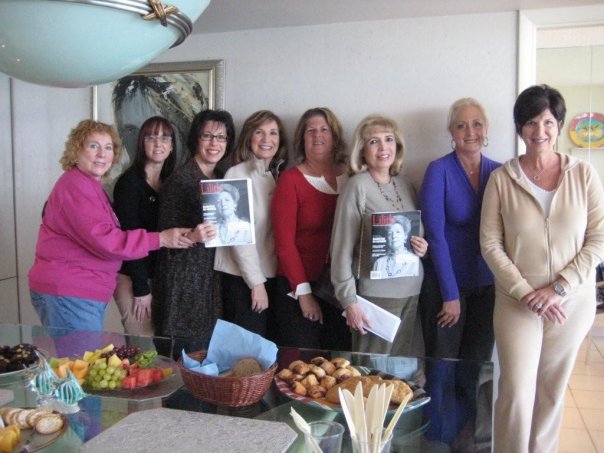 I had ample opportunity to mull this over when I attended the National Council of Jewish Women’s triennial convention in Dallas earlier this month. When I’d been honored by them three years ago as a Woman Who Dared, I was down with the flu, and wasn’t able to appear, so this time I wanted to catching up in person with the representatives of the only self-styled “progressive” Jewish women’s organization.
The gathering proved a useful primer on the political and legislative issues women face right now, with reproductive rights, pay equity and the task of bringing in more women as judges and elected local officials at the top of the agenda. Then there was the challenge of expanding the base and drawing in the dollars needed to move the agenda forward. In a session on women’s giving, the NCJW presenters set forth many of the tenets Lilith has written about, chief among them that women tend to get to know a cause before writing a check or clicking “Donate,” and that we like to give and to work in concert with other women. A new study from Princeton on women undergraduates puts it well: “Women seek, and benefit from, affiliation with other women.”
This is one reason I was at the NCJW convention – to tell the attendees about the success Lilith has had in bringing women together for smart talk under the rubric of Lilith salons – now 90 strong across the country and in Canada and other places too, many of them in conjunction with Women of Reform Judaism. (more…)
- No Comments
May 8, 2011 by Jill Finkelstein
Link Roundup: Mother's Day Edition
Welcome to this week’s installment of Lilith’s Link Roundup. Each week we post Jewish and feminist highlights from around the web. If there’s anything you want to be sure we know about, email us or leave a message in the comments section below.
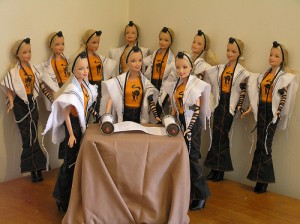 Rabbi Jason Miller of Detroit, Michigan shares how elevating female rabbis into leadership roles benefits Jewish community. [The Daily Rabbi]
On Tuesday, U.S. Representative Pete Stark introduced a new bill, called the Every Child Deserves a Family Act, which would “prohibit discrimination in adoption or foster care placements based on the sexual orientation, gender identity, or marital status of any prospective adoptive or foster parent, or the sexual orientation or gender identity of the child involved.” [Huffington Post]
In honor of Yom HaShoa, Michele Chabin and Galit Breen write about how to teach children about the Holocaust. [The Sisterhood] & [TC Jewfolk]
With all the false information floating around recently, the Guttmacher Institute released a short video with facts about abortion in the United States. [Jezebel]
On Wednesday, the U.S. House of Representatives voted in favor of H.R.3, the No Tax Payer Funding for Abortion Act, which has raised concerns about how it would affect private insurance policies. If passed, H.R.3 would deny small businesses from receiving tax credits if their employee health benefits cover abortions and prevent women from using their tax benefits to pay for abortions. [Ms. Magazine]
And now a special Mother’s Day roundup:
 U.S. Secretary of State Hillary Clinton announced the launch of the Mobile Alliance for Maternal Action (MAMA), a program designed to send information about maternal health to women in developing countries via cell phone messages. [Women Deliver]
Tamar Fox explains the significance of Mother’s Day falling on the same day as Israel’s Memorial Day just two and a half years after losing her mother to cancer. [Tablet Magazine]
From the Lilith archives: Learn about how these women chose an unconventional approach to parenting. [D-I-Y Parenthood]
- 1 Comment
May 4, 2011 by Merissa Nathan Gerson
Becoming a Man in my Family
 In a hot tub in California I met my cousin Ruthie for the first time. I had known her my entire life, but never like I did in our bathing suits, in the steam, family ditched poolside. We were there for our cousin Mara’s Bat Mitzvah, the whole family, gathered exiles from New Jersey, Florida, Connecticut, Washington, DC, Italy, Argentina and California.
Family time, back in the day, was always the same. There were the men–and then there was everyone else. As I got older, particularly when I became a Women’s Studies major, the Gerson boys’ club became the bane of my Jewish existence.
Why? Because within my home growing up in Washington, DC, my voice was honored as equal to my father’s. At Shabbat dinners my father would invite political powerhouses, writers and rabbis to the table and I was not only given permission, but pushed and encouraged to represent my own views in well-articulated arguments. I was asked to tell about Job and his struggles with G-d, or my views on Arabs and Israelis or social ethics or international politics. I was encouraged to see myself as one of the boys, as a man really.
Except at larger family gatherings.
This was when the old country came in. From Poland to New York, all those tough male cousins who got in street fights and needed my father, the biggest of all of them, to intervene. No matter how evolved or covertly feminist my immediate family had become, in my Jewish post-Polish extended family I became a mere “girl,” and an invisible wall formed. I remember one cousin addressing my brother, both of them Columbia alums. My brother got stories on how to put wine on the heater to get drunk off of alcohol air, or even was asked to engage on topics of religious morality. If I tried to enter the conversation, it was clear it would require something of a third ear. Akin to using auditory blinders, a filter was activated to blot out the female voice when more than one male engaged in conversation. (more…)
- 2 Comments
May 3, 2011 by Liz Lawler
The Passover Purge
 Are you gonna finish that? If you do, are you going to keep it down?
The Passover Purge has me thinking about bulimia and Jews. I hear the word “purge” and I go straight there. Koshering your kitchen for Passover is hard and thorough work. Under normal circumstances, this just marks a heightening of Jewish food awareness. It is a week of tip-toeing through grocery stores and restaurants, scanning ingredient lists for yeasty offenders. All of which is juxtaposed with the frantic Spring cleaning (the other day, my cleaning lady got three panicked phone calls in the span of two hours, from people trying to corner some help). At any rate, my train of thought went something like this: Passover, Jews, food, purging, neurosis, barfing = Jeworexia?
When I was converting, Jews kept telling me how every holiday is “ALL ABOUT FOOD, YAY!! You’ll love it, there’s food, there’s wine, and there are endless evenings around the table.” So: a mix of booze, food, ritual observance and family… Religious and familial drama unfolding in a place connected to nourishment–how can there not be a disproportionate number of Jewish women gagging up their food? (more…)
- No Comments