 Please wait...
April 30, 2012 by Sheva Zucker
Candles of Song: Yiddish Poems about Mothers Rashel Veprinski
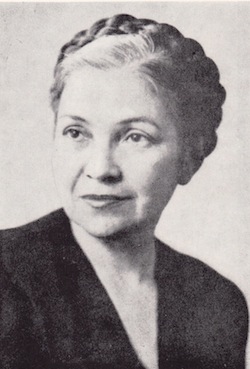
Photo of Rashel Veprinski. From Tsum eyntsikn shtern (To the Lone Star), Tel-Aviv, 1971.
A New Kind of Kadish
On January 25, 2012 (Shevat 1) my dear, sweet, gentle mother passed away. Although it is customary in the Jewish tradition to say kadish for 11 months after the death of a parent and although I do belong to a conservative synagogue it somehow did not feel natural for me, an agnostic, to say kadish for my mother, a Canadian born Yiddish speaker, also an agnostic brought up in the tradition of secular Yidishkeyt. However, I am doing it (not totally regularly) and while I do find the act somewhat meaningful it does not essentially express who I am as a Jew and who she was.
I decided, therefore, to create a blog of Yiddish poems about mothers in her memory. Each week I shall post one Yiddish poem, both in Yiddish and in transliteration, with an accompanying English translation. Some of the translations will be my own, others will be by other people. Sources will always be noted. Each poem will be preceded, wherever possible, by a brief biography and photo of the poet, as well as a recording of the poem in Yiddish.
I have chosen to call this blog “Candle of Song” after a line in a poem by Rashel Veprinski (Piously as my mother the waxen wicks,/I light my candle of song). To me it is a beautiful metaphor of how the pious act of lighting Sabbath candles got transformed for the poet into the, for her, equally spiritual act of writing Yiddish poetry. The title is for me also evocative of yortsayt-likht (memorial candles) although it was not the poet’s intention. With this in mind, I have chosen to make Veprinski’s poem “Frum” (Piously) my first offering.
Rashel Veprinski (1896-1981) was born in the town of Ivankov, not far from Kiev, in Ukraine. She came to New York in 1907, and at thirteen she went to work in a shop. At fifteen, she began writing poetry, and was first published in 1918 in the journal Di naye velt (The New World). She wrote several books of poetry, among them Ruf fun foygl (The Call of the bird), 1926, Di Palitre (The palette), 1964, Tsum eyntsikn shtern (To the single star), 1971 as well as an autobiographical novel, short stories, and articles and was published regularly in Yiddish periodicals. From the 1920s until his death in 1953, she lived with the famous Yiddish writer Mani Leyb. (Those wishing to read the biographies in Yiddish can do so at my blog.)
Here, Frum, by Rashel Veprinski, read by Sheva Zucker:
- No Comments
April 23, 2012 by Chana Widawski
Green? Or Greeneh? Some Earth Week Reflections

Photo via Library of Congress Flickr stream
Growing up, green was the color of the aluminum siding on our house and of our painted garage, teeming with a full assortment of scrap—wood, metal, plastic, heavy paper and anything else that might somehow serve a future purpose. Green was the color of the lawn I often mowed, watered only when needed and early in the morning. My Girl Scout uniform was green. And so were the glasses filled with warm tea left out every morning for me and my sisters, the intentional love-filled leftovers from the big stove-cooked pot of tea our Dad filled his Thermos from each day before heading to his job at Gleason Works in our boat-sized American-made Chevy Impala, which he could fix himself.
Green was a shade of envy, too. Envy of the kids whose sandwiches were packed in throwaway Ziploc bags instead of bulky Tupperware that had to be schlepped home. Envy of all the other moviegoers, who got to socialize while waiting on line for buttered popcorn while we rustled through an over-stuffed tote to access a re-used plastic bag full of white kernels, air-popped at home. Envy of my friends whose families hired plows to remove their snow while we bundled up in hand-me-down snowsuits and shoveled all day.
It was envy of my classmates and friends whose parents had gone to college, didn’t have accents and weren’t mistaken for grandparents… and it was envy of those who had grandparents.
- No Comments
April 5, 2012 by Jill Finkelstein
Link Roundup:Adrienne Rich and the Bat Mitzvah at 90
Welcome to this week’s installment of Lilith’s Link Roundup. Each week we post Jewish and feminist highlights from around the web. If there’s anything you want to be sure we know about, email us or leave a message in the comments section below.
 Ground-breaking feminist poet Adrienne Rich died on March 27th at the age of 82. [NY Times]
Adrienne Rich’s poetry and activism changed the course of arts and letters. Here’s a look back at her original poem, Turning, from the 1989 Winter issue of Lilith.
In an effort to fight eating disorders, Israeli lawmakers passed a bill banning the use of underweight models in advertisements. In addition, “any advertisement published for the Israeli market must have a clearly written notice disclosing if its models were made to look thinner by digital manipulation.” Currently, about 2% of girls between the ages of 14 and 18 suffer from severe eating disorders in Israel. [AP via Huffington Post]
The Bat Mitzvah celebrated its 90th anniversary! On March 18, 1922, just two years after women got the right to vote, Rabbi Mordechai Kaplan’s daughter, Judith, became the first girl to have a Bat Mitzvah, though the ritual took a while to catch on. In honor  of the occasion, the National Museum of American Jewish History launched the traveling exhibit Bat Mitzvah Comes of Age (currently on display at the JCC Manhattan) and hosted a panel on the history of the Bat Mitzvah. Actress Mayim Bialik, the keynote speaker, spoke about her own Bat Mitzvah experience and how it inspired her to delve deeper into her Jewish studies. [Philadelphia Inquirer]
- No Comments
April 5, 2012 by Tara Bognar
A.M. New York: Highlights for Lilith Readers
I happened on th is free city rag on the subway this morning and was impressed by all the items I thought might be of interest to my fellow Lilith fans and thought I’d share the wealth. Unfortunately, none of my favorites are actually on their website so I’m providing other links where they were available:
NYPD “Hercules” teams are guarding synagogues during Passover in response to a newly posted threatening Al Qaida mock movie poster.
Seriously – you don’t often come across this much exciting cross cultural material in a three sentence article. Al Qaida, a fundamentalist Muslim terrorist group that, among other things, would like to purify Islam of outside influences, has prepared an impressively designed poster that could easily be blazoned across a bus to promote a new Hollywood film if it weren’t for the (surely unintentional) sexual double entendre: “Al Quaeda: Coming Soon Again in New York.”
“Hercules,” of course, was an ancient Greek demi-god known for his strength. Some ancient Jews embraced Hellenism (apparently one scribe claimed that two sons of Abraham joined Hercules on his Africa expedition) and others strenuously resisted it, culminating in a bloody civil war – see Hannukah. The cultural resonances of American “Hercules” teams guarding Jewish synagogues during the holiday when we commemorate escaping from Egypt to become a sovereign people in our own land are wonderful to ponder. (Incidentally, the planes used by the IDF in the Entebbe raid were also called Hercules).
- No Comments
March 13, 2012 by Jill Finkelstein
Link Roundup: Purim and International Women’s Day
Welcome to this week’s installment of Lilith’s Link Roundup. Each week we post Jewish and feminist highlights from around the web. If there’s anything you want to be sure we know about, email us or leave a message in the comments section below.
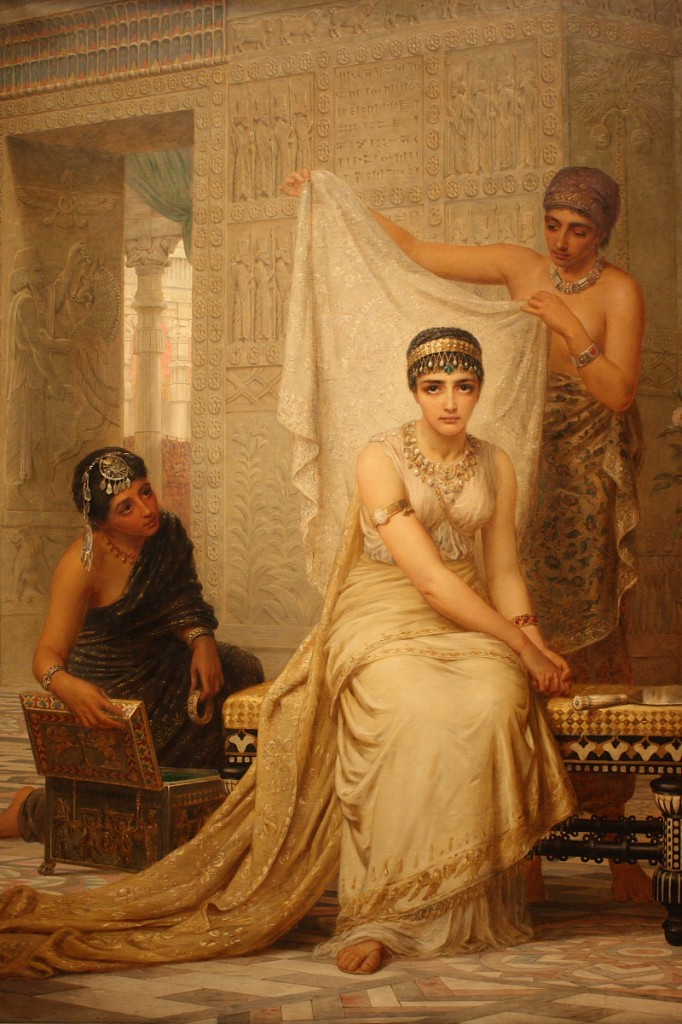 This year, Purim fell on International Women’s Day. Melissa Scholten-Gutierrez of Redefining Rebbetzin explained the significance of the two holidays coinciding, stating, “[Purim] is the very essence of what International Women’s Day is all about. Celebrating women who do what needs to be done, even when it isn’t easy.” [Jewesses with Attitude]
In honor of Purim, songwriter Alicia Jo Rabins examined Queens Esther and Vashti as well as the other heroines of the Bible. [Huffington Post]
Controversial radio host Rush Limbaugh came under fire after attacking Sandra Fluke, the Georgetown University law student who was not allowed to testify at a congressional hearing on contraception coverage, on his radio show. Despite apologizing, at least 50 companies have pulled advertisements from Limbaugh’s program. [The Sisterhood] & [Think Progress]
Last Thursday, the Blunt Amendment failed by 3 votes in the U.S. Senate. The Amendment would have allowed “employers to deny their employees insurance coverage for anything they objected to on religious grounds.” [Salon]
- No Comments
March 8, 2012 by Tara Bognar
International Women’s Day, Iranian Women’s Rights
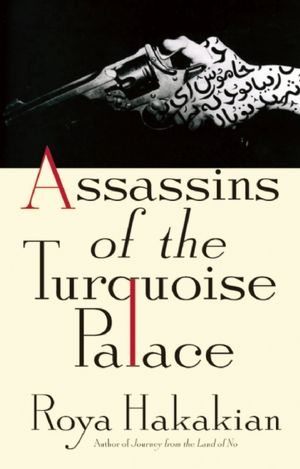 This morning I attended a panel discussion about the status of the struggle for women’s rights in Iran. Sponsored by the organization Iran 180 and scheduled in honor of International Women’s Day, the panel included Roya Hakakian, a writer, poet, and producer based in New York, Solmaz Sharif, a dissident journalist and poet, and Arash Abadpour, a (male) computer scientist and popular Persian and English language blogger.
Iran is an important topic in Jewish news media, even more so recently, with speculation about its development of nuclear capabilities and discussion of appropriate American and Israeli responses. But spending Purim morning thinking specifically about the status of women in Esther and Vashti’s ancient home seemed appropriate. The panel’s moderator, New York Times reporter Anne Barnard, successfully guided discussion towards intra-Iran human rights issues but unfortunately had less success keeping the focus on women.
Beyond an acknowledgment of the courage of women dissidents in Iran in general and specific recognition of Nazanin Khosravani who just two days ago began a six year prison sentence after refusing to write a letter admitting fault and requesting pardon for “collusion” and “propaganda” against the regime, the panelists’ discussion was quite general and non-gender specific.
From a Jewish perspective (and an International Women’s Day perspective) that is too bad. The struggle of women in the juxtaposition of extremist theocratic suppression of women’s rights, everyday sexism, and a fairly liberal and educated, but struggling, middle class could prove all too relevant to those concerned about the situation in Israel.
- 4 Comments
March 2, 2012 by Guest Blogger
An interview with Lilith magazine’s Editor in Chief
Cross-posted with Kosher Salt.
Anyone who read Freakonomics remembers the chapter on how a person’s name can pre-determine their future. If that frightening piece of incredible parental pressure got you thinking about the name game, Susan Weidman Schneider, editor of Lilith magazine, has plenty more to say on what’s in a name and the latest issue of the mag.
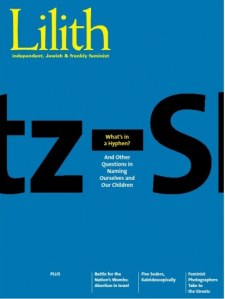
KS: What’s the greatest perk/biggest obstacle in working as editor of an independent, Jewish and frankly feminist magazine?
SWS: Editing Lilith magazine, now celebrating its 35th year, is a treat. The writers are wonderful, the ideas new and stimulating, and the end product is, I hope, insightful and always a good read—whether it’s in print, on the web via our soon-to-appear digital edition, or on the lively Lilith blog.
KS: What do you think is the most impactful topic that Lilith has covered?
SWS: That’s a tough one. The major issues Lilith has opened up have been topics like violence in Jewish families; Jewish women’s philanthropy and our relationship to money; Jewish hair—a sellout issue by the way; rabbinic sexual misconduct; new rituals and celebrations for the Jewish calendar and for the landmarks of our lives.
The last couple of Lilith salons at Sixth & I were really dynamite, and they dealt with cover stories that, like the what-we-call-ourselves story in Lilith’s current issue, resonate in our lives. One salon had to do with an article on breaking up over food. We spent about three hours in spirited discussion about what we eat, why it can sometimes be schismatic, what food represents in a relationship, and more. The second salon focused on what we wear. You can imagine! The talk ranged from our favorite garments to how we want to present ourselves to the world as feminists, as Jews, as professionals. Clothing is a powerful signifier, and we really mined that territory in our conversation.
- No Comments
March 1, 2012 by Yona Zeldis McDonough
A Conversation With Roberta Rich
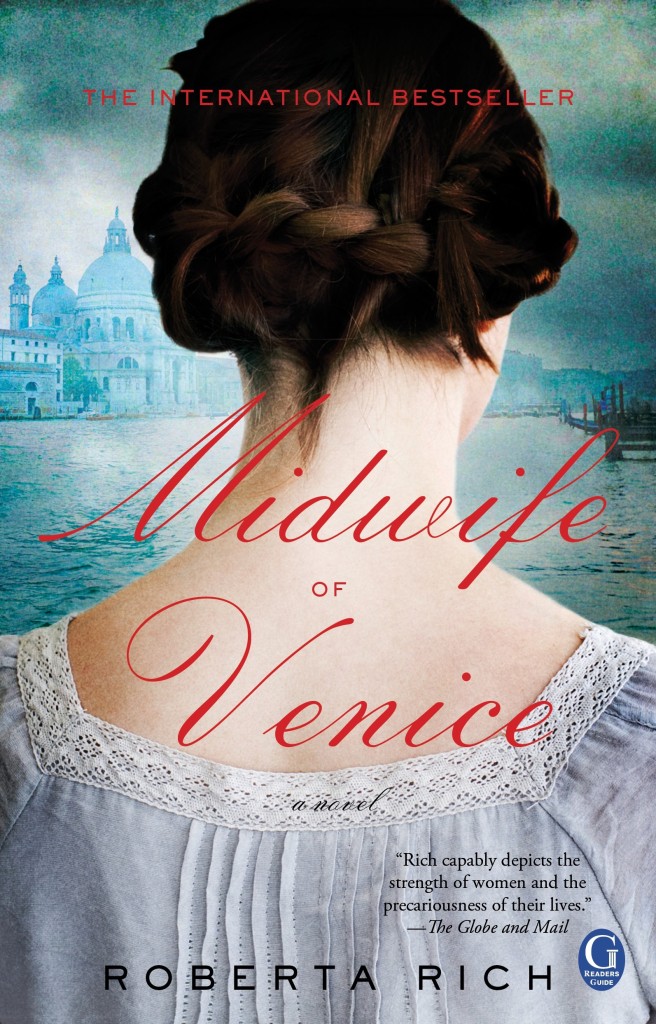 Renowned throughout Venice for her gift at coaxing reluctant babies from the their mothers’ wombs, Hannah Levi, a Jewish midwife, is much in demand. But when she receives a summons from a wealthy Gentile count to attend his wife, she is torn about what to do. Does she defy Papal edict that forbids Jews from rendering medical treatment to Gentiles? Or does she try to alleviate the suffering of this unknown woman, and in so doing, earn the money to pay her husband’s ransom? These are the questions raised by “The Midwife of Venice,” the first novel by former lawyer Roberta Rich. Fiction Editor Yona Zeldis McDonough had some questions of her own, and she sat down with author Rich to find out more about birthing practices in the 16th century, the transition from lawyer to novelist and what life was like in the Jewish ghetto of Venice.
What was the inspiration for this novel?
I have a very visual imagination. When I was in the museum in the Venetian Ghetto, I saw two things which ignited some images. The first was a shadai, or good luck amulet. I thought of the high infant mortality rate in those times, not just in the ghetto, of course, but all over 16th century Europe and had the idea for a shadai in the shape of a baby’s hand to hang over the cribs for protection. I also saw a pair of silver spoons resting in the glass display case. These crossed spoons became the inspiration for my heroine midwife to design forceps.
How did you conduct your research for it?
Fortunately, I love to read and do research although I must confess I am not a student of history and never took a history course beyond high school. However, there are a number of fascinating books written about Venice and the history of the Venetian ghetto. I was interested to learn that the ghetto was not only a place to sequester Jews, but it was also a relatively safe haven. In a scene from The Midwife of Venice, Hannah and her sister, Jessica, who has converted to Christianity and becomes a courtesan, accuses Hannah of being a ‘little ghetto mouse’, afraid of life. Hannah responds that the same gates that keep them in the ghetto, keep them safe. In fact, the Venetian government, the Council of Ten was protective of the Jews, valued them for their mercantile connections to the Levant (the Middle East) and for the high taxes and levies they were forced to pay for the ‘privilege’ of living in the ghetto.
- No Comments
February 26, 2012 by Jill Finkelstein
Link Roundup: French Linguistics and Feminist Oscar Films
Welcome to this week’s installment of Lilith’s Link Roundup. Each week we post Jewish and feminist highlights from around the web. If there’s anything you want to be sure we know about, email us or leave a message in the comments section below.

http://madameoumadame.fr/
After several months of pressure from the feminist organizations Osez le Féminisme and Les Chiennes de Garde, the French government announced that it would no longer use the term “mademoiselle” (the French equivalent of “miss”) on official government documents. Until now, women in France have had to identify their marital status by selecting the title of “madame” (the French equivalent of “Mrs.”) or “mademoiselle” on administrative documents, whereas men have always been called “monsieur” regardless of their martial status. [NY Times]
Friday, February 24th marked the centennial anniversary of the founding of Hadassah. A Shabbat service and ceremony was held at Temple Emanu-El in New York City, where Henrietta Szold formed the organization 100 years ago. [NY Jewish Week]
Last week, U.S. Representative and House Oversight Committee Chairman Darrell Issa came under fire for assembling an all-male panel to testify at a Congressional hearing on birth control and religion. Issa denied a request made by Democrats to include Georgetown University law student Sandra Fluke on the panel, stating that she was “unqualified.” Saturday Night Live even criticized congress for excluding women from the hearing (and Virginia’s transvaginal ultrasound debate) in a segment called “Really!?! With Seth and Amy.” [Jezebel] & [Jezebel]
- No Comments
February 21, 2012 by Elana Sztokman
Abortion in Israel, Contraception in the U.S.
Updated May 1, 2012.
It has been over 50 years since American women have had birth control pills to help manage fertility and family planning, yet it seems that the battle for women’s body autonomy is still not over. Just when we think that the future looks bright, that there are medical advances and widespread educational programs for consciousness-raising, some movement from the ultra-conservative Right emerges and reminds us that when it comes to women’s bodies, pockets of American society remain in the Dark Ages.
The latest trend is to make not only abortion illegal but even preventive measures of contraception.
There are people out there who would like to equate the use of contraception with abortion, and of course equate both of these with murder. This is not just the Catholic Church talking, either, but also various Christian denominations leading the call. The Rev. Dr. Matthew C. Harrison, president of the Lutheran Church — Missouri Synod, was quoted in the New York Times last week, telling a House committee on the subject: “We object to the use of drugs and procedures used to take the lives of unborn children,” referring not to abortion but to contraception. The idea that a bunch of Christian preachers are testifying in Congress about the future of women’s ability to use contraception is no less than frightening.
I may have inadvertently stepped into this with the article that my colleague, L Ariella Zeller, and I wrote about abortion in Israel in Lilith’s winter issue. We mistakenly conflated RU 486 and the abortion pill. Monica Whitcher, President of CHOICE: Campus Health Organization for Information, Contraception, and Education at Vassar College, corrected us in an email to Lilith’s editors, “RU486 is an abortion pill and terminates an established pregnancy. The morning after pill, by contrast, PREVENTS pregnancy, by either preventing the sperm from entering the egg, or by preventing a fertilized egg from implanting into the uterus.” I do apologize for the mistake and for unintentionally adding fuel to this fire.
- No Comments