 Please wait...
The Lilith Blog
March 16, 2015 by Liana Finck
Excuse Me: How to Free Yourself
Welcome to another edition of Excuse Me, an illustrated advice column about maddening things. Installments will be posted here every other Monday. Need advice? Send your questions to liana@lilith.org.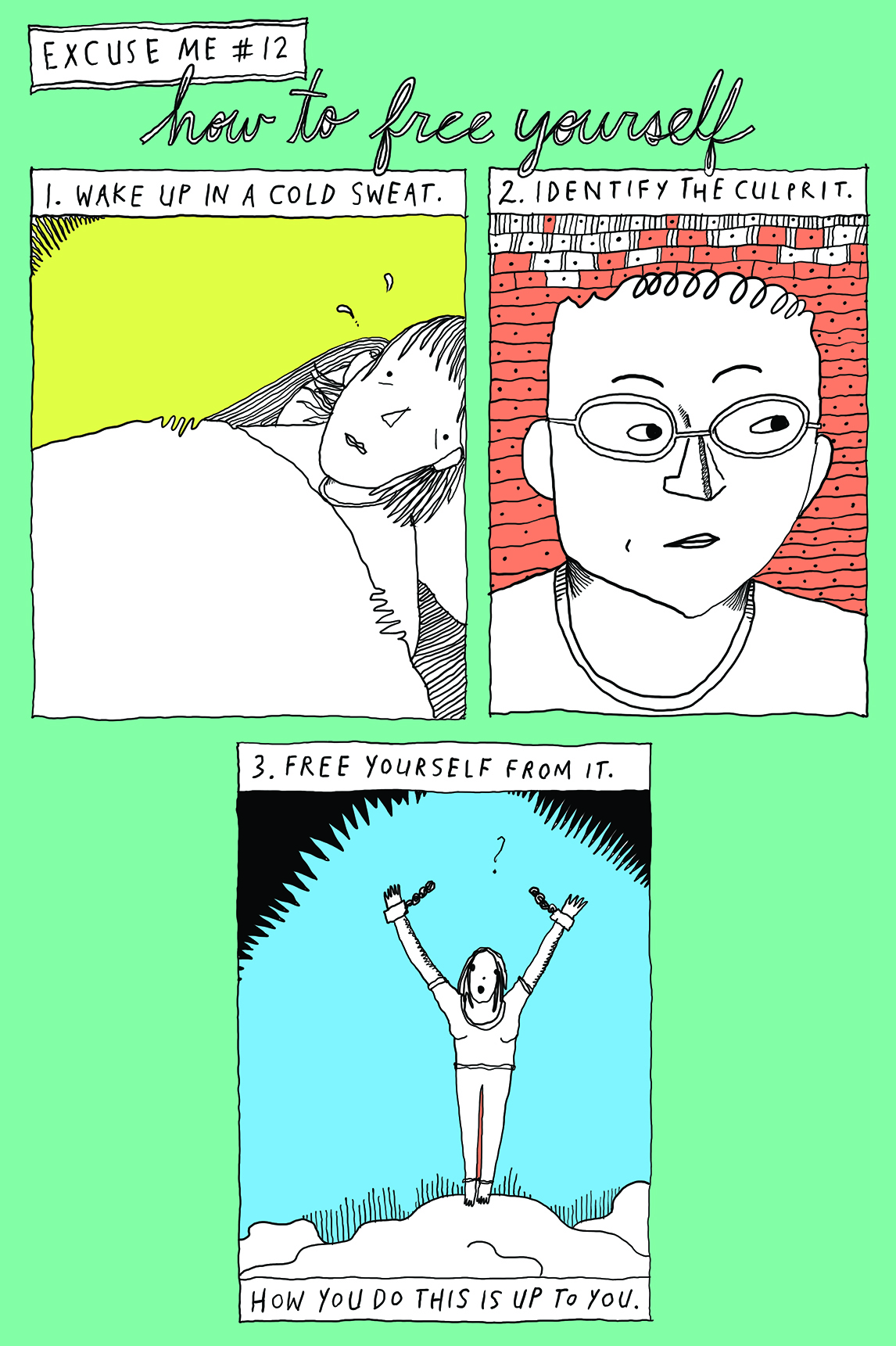
- No Comments
March 8, 2015 by Jill Finkelstein
A Look Back on International Women’s Day

internationalwomensday.com
Today, March 8th, people around the world observe International Women’s Day, an event that first occurred in 1911 after the second International Women’s Conference of 1910 in Copenhagen, Denmark. This year’s theme of International Women’s Day is Make it Happen to “encourag[e] effective action for advancing and recognizing women.” In honor of today, we have compiled a round-up of relevant articles from the Lilith archive.
In the Fall/Winter 77/78 issue of Lilith, we reported on the 1977 National IWY (International Women’s Year) Conference, held November 19-21 in Houston. Prior to the conference, there was a series of meetings led by the Leadership Conference of National Jewish Women’s Organizations, in which leaders of Jewish women’s organizations made the decision not to let their focus be on supporting Jewish issues and defending Israel, as male Jewish leaders wanted them to focus on, and instead signed a commitment on working towards equality for women in all aspects of society. It marked the first time “Jewish women’s organizations joined together to put themselves on record in favor of the Women’s Agenda.” [Houston, Fall/Winter 77/78]
- No Comments
March 2, 2015 by Liana Finck
Excuse Me: How to Make Small Talk
Welcome to another edition of Excuse Me, an illustrated advice column about maddening things. Installments will be posted here every other Monday. Need advice? Send your questions to liana@lilith.org.
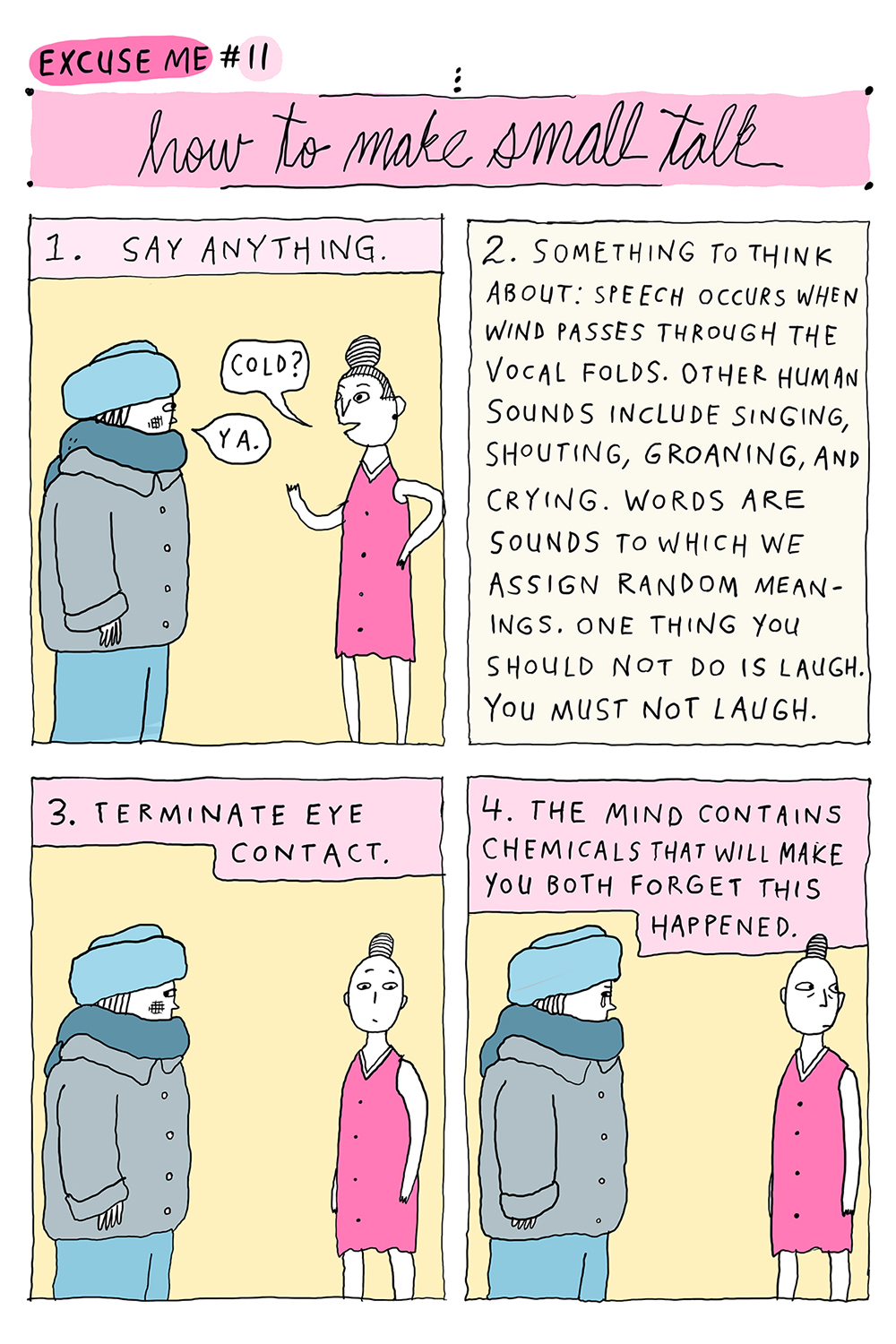
Liana Finck’s graphic novel is called A Bintel Brief. She writes and draws a monthly column for The Forward and her cartoons appear irregularly in The New Yorker. She often thinks about the age-old question: fight, or flight?
- No Comments
February 18, 2015 by Pamela Rafalow Grossman
Lesley Gore (1946-2015), Who Created a Feminist Anthem
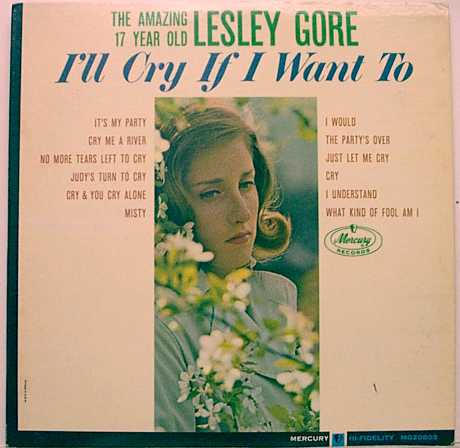
Cover art for Gore’s I’ll Cry If I Want To. The copyright is believed to belong to the label, Mercury Records.
On a sultry evening in July of 2011, music fans young and old took over a plaza at Lincoln Center for a concert called “She’s Got the Power.” On the bill were stars from many classic “girl group” bands—singers from The Toys, The Cookies, The Crystals, and others. Even The Ronettes’ legendary Ronnie Spector was set to perform. In this powerhouse lineup, no one generated more excitement than Lesley Gore.
And who wouldn’t love her? Gore had intelligence and humor, power and grace, and a voice that could belt with the best. On that night and many others over a decades-long career, she held the crowd in her hand.
Born Lesley Sue Goldstein in Brooklyn, to parents Ronny and Leo (the Goldstein family changed its name to Gore soon after her birth), Lesley grew up in Tenafly, New Jersey. Her love of singing led to vocal lessons, and in 1963 a demo tape that she had made managed to reach up-and-coming producer Quincy Jones. He embraced her sound—a compelling mix of innocence and sophistication—and quickly produced Gore’s first single, “It’s My Party.” It reached No. 1 in the United States in May of 1963, when she was just 17. The sudden fame could be a shock: When DJs called Gore “the sweetie pie from Tenafly,” fans located her family’s home in the suburban town and camped out on their lawn.
- No Comments
February 16, 2015 by Liana Finck
Excuse Me: How to See Beauty in Things
Welcome to another edition of Excuse Me, an illustrated advice column about maddening things. Installments will be posted here every other Monday. Need advice? Send your questions to liana@lilith.org.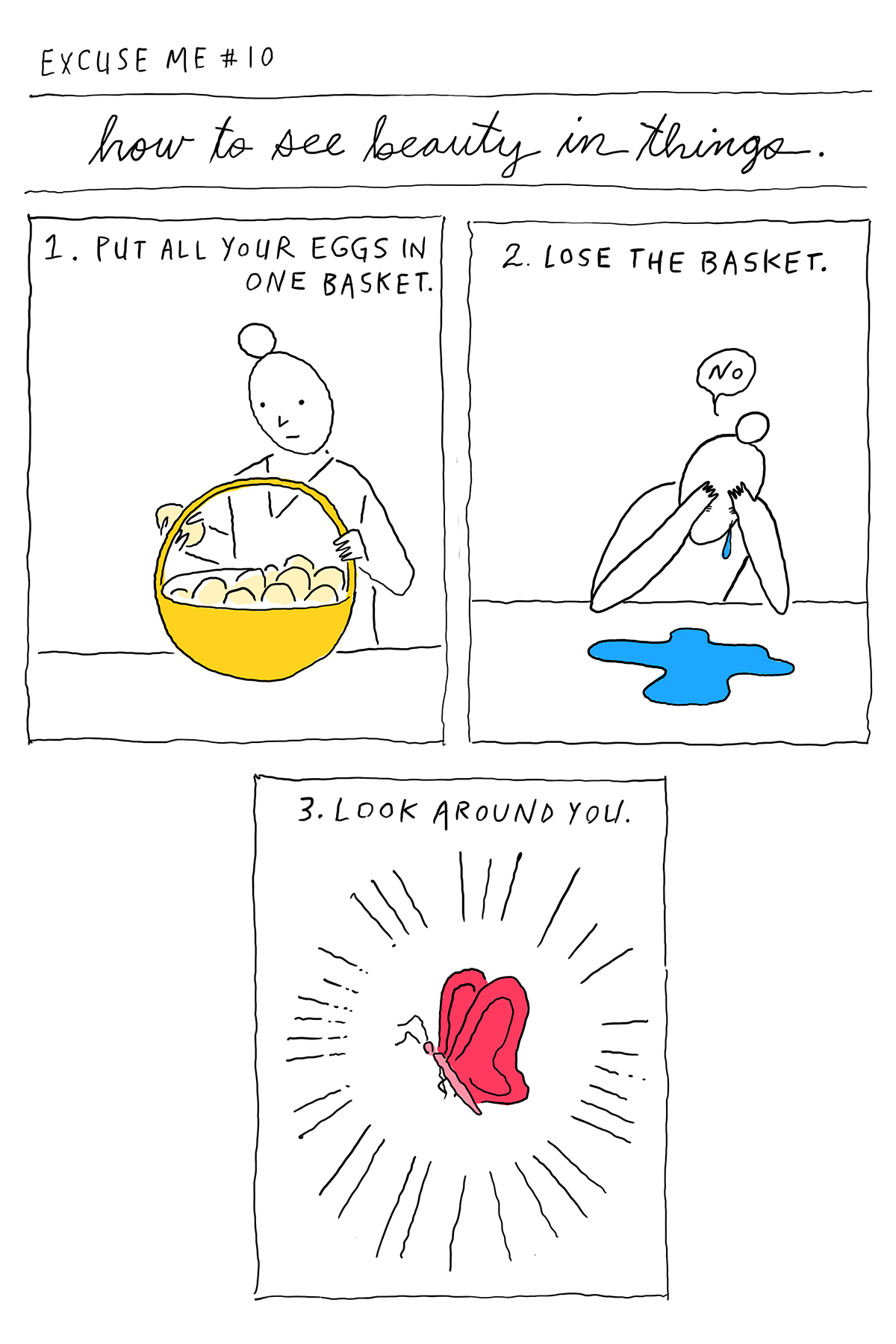
- No Comments
February 11, 2015 by Amy Stone
Get Thee to “Gett”
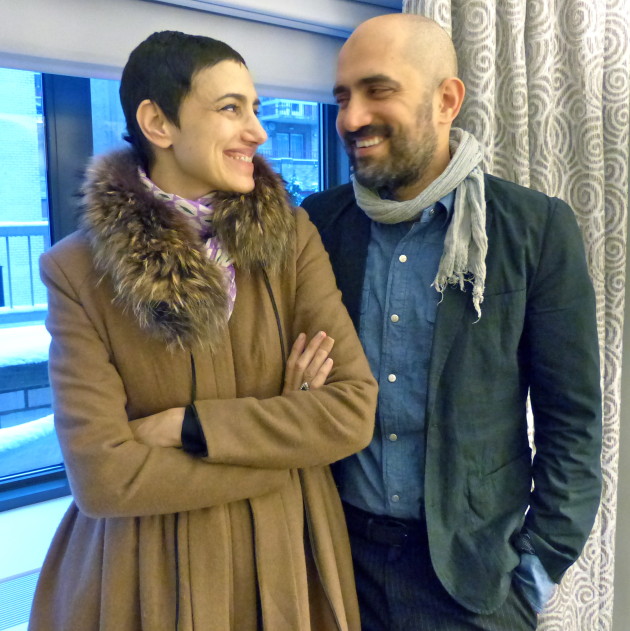
Sib filmmakers Ronit and Shlomo Elkabetz in New York before opening of “Gett: The Trial of Viviane Amsalem.” Photo by Amy Stone.
Whether you’ve dedicated your life to the plight of the chained women (Hebrew “agunot”) whose husbands refuse to give them a Jewish religious divorce (“gett”), or you had no idea that a Jewish religious divorce is the ONLY legal divorce for Jewish couples in Israel, get thee to the Israeli feature film “Gett: The Trial of Viviane Amsalem.” In Hebrew, French and Arabic with English subtitles, it opens Feb. 13 in New York City and Los Angeles.
Under Jewish religious law (not just in Israel), a husband can simply refuse to give his wife a divorce. In this remarkable film, we see in detail the final two years of excruciating legal procedures that have already dragged on for three years in an Israeli “beit din,” court of judgment.
Viviane Amsalem, the wife trapped in a dead marriage, is simply a non-person. She is beautiful. She is emotionally controlled. She is not religious, but dresses modestly (except for great sandals exposing her toes). How can she keep from cracking when she’s at the mercy of a husband who doesn’t even have to show up for court dates? When he does appear, all he has to do is say no. He doesn’t even bother to hire a lawyer.
- 1 Comment
February 9, 2015 by Liana Finck
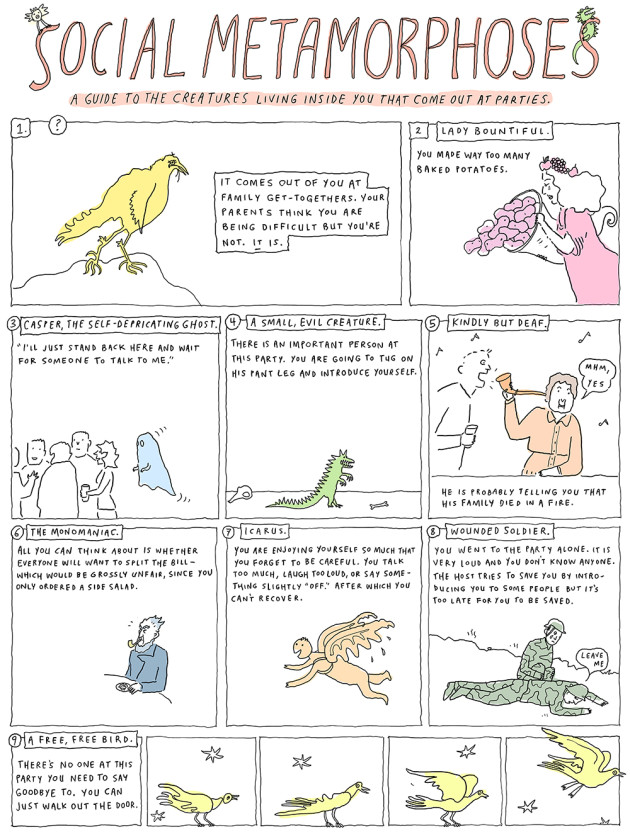
Excuse Me: Social Metamorphoses
Welcome to another edition of Excuse Me, a new illustrated advice column about maddening things. Installments will be posted here every other Monday. Need advice? Send your questions to liana@lilith.org.
Liana Finck’s graphic novel is called A Bintel Brief. She writes and draws a monthly column for The Forward and her cartoons appear irregularly in The New Yorker. She often thinks about the age-old question: fight, or flight?
- No Comments
February 3, 2015 by Holly C. Shulman
Losing My Anne Frank
I recently travelled to Amsterdam, and was invited by Dienke Hondius, one of the curators of the Anne Frank House, to visit the museum. I accepted with alacrity: the lines to get in always snake around the block, and I was especially curious to see it because it has come under fire recently in a piece in Haaretz.
After I toured it I wrote to Ms. Hondius.
Dear Dienke,
Here is an attempt to answer your question as to why I found the Anne Frank House Museum personally disorienting.
The nub of the question is what are we doing when we remember (and commemorate) Anne Frank: something about the Jewish experience, or something about the human experience?
When I was a child, the Holocaust was talked about in our house, but it was not the subject of general conversation – in society, politics, and literature – that it later became. Perhaps 1945-1968 (with the publication of Arthur Morse’s When Six Million Died) was a kind of liminal or marginal period of remembrance. In my house, we talked about my parents’ German backgrounds, especially my mother’s. She remembered my grandmother trying unsuccessfully to find living German relations in the late 1930s. Most of her family had arrived in the US around 1850, as part of a general wave of German emigration to the US. Like so many other Jewish immigrants, they steadily moved west until they reached Chicago. One of them sent letters home to Ohio during the American Civil War—these were preserved and were later published as A Jewish Colonel in the Civil War.
- No Comments
January 29, 2015 by Eleanor J. Bader
How Safe Does She Feel Walking Down the Street?
 When 24-year-old aspiring actor Shoshana Roberts saw an ad soliciting “Female Talent for Anti Street Harassment Viral Video” on Craigslist, she immediately knew that she wanted to apply.
The date was September 12, 2014.
A brief telephone interview with Chicago filmmaker Rob Bliss of Rob Bliss Creative took place a day later, and by the end of October Bliss had captured 10 hours of footage showing Roberts walking through the five boroughs of New York City while being catcalled by dozens of men. He later edited this into a two-minute video that has now been seen by approximately 39 million people in every corner of the world.
The video was a collaboration between Bliss and Hollaback, an international, feminist, anti-street-harassment organization which, since its founding in 2011, has trained activists in 26 countries and more than 80 U.S. cities to oppose anti-woman violence and misogyny. Although Roberts wasn’t familiar with Hollaback when she answered the ad, the issues the group works on resonate deeply for her.
- No Comments
January 22, 2015 by Susan Weidman Schneider
A Modest Proposal: Create a Fertility Fund
 This has been an extraordinary season of news on every front, including (but not limited to) several stories that have had particular resonance for women and for media. Among them: Rolling Stone magazine’s much-discussed coverage of campus rape, followed by an ugly round of victim-bashing after parts of the story were challenged; the resignation of almost the entire staff of the 100-year-old New Republic magazine and the subsequent round of discussions on how a venerable print brand can keep its balance in the roiling mix of digital media sources, and the fact that for many people younger than 100 social media feeds have become their most consistent news feeds as well.
The impact of stories like these loom large for Lilith readers, and some are unprecedented in content and scale. Our national conversation about race, the Barry Freundel mikveh scandal, and the rise of women politicians in Israel and the U.S. as preface to the next round of elections are just three of them. All are subjects Lilith has covered, in print and on the Lilith Blog—and we will continue to write about them with this magazine’s characteristic nuance.
Lilith magazine launched in 1976 with two founding missions: to use the power of independent media to gain greater access for women (and greater value for women’s concerns) in the Jewish world, and to speak with a Jewish voice on urgent women’s issues. I think Lilith’s tagline says a lot about our approach. “Independent, Jewish and frankly feminist,” Lilith charts Jewish women’s lives with exuberance, rigor, affection, subversion and style.
- 3 Comments