 Please wait...
The Lilith Blog
Feminists In Focus, The Lilith Blog
December 7, 2015 by Amy Stone
“Censored Voices”: Intimate Conversations with Six-Day War Soldiers in a New Film
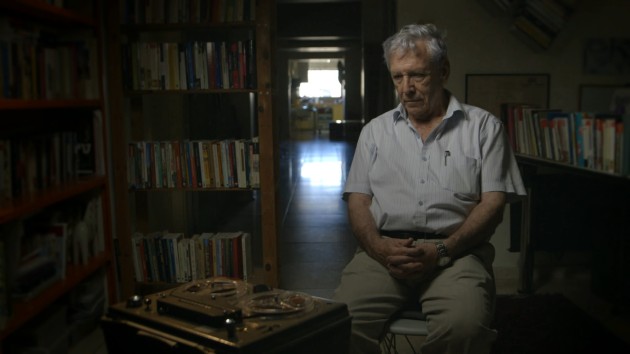
Amos Oz in “Censored Voices”
Perhaps it was her persona—a young woman utterly pure, idealistic and determined—that convinced Avraham Shapira to entrust Mor Loushy with the 200 hours of soldiers’ interviews from the Six-Day War, tapes that had remained in his closet for nearly 50 years. The tapes, sealed by the Israeli Army, hold the voices of kibbutzniks recorded immediately after the ’67 war, expressing their sadness and pain at what they felt was an uncomfortable turning point for Israel. Their voices undermine the mythic triumphalism of the Six-Day War.
Shapira and Amos Oz—the young kibbutznik who grew into the eloquent novelist— tapped into the raw anguish soldiers fresh from victory could not speak about to wives, lovers, friends. Within months, Shapira had transcribed the tapes into The Seventh Day: Soldiers Talk about the Six-Day War. The Israeli Army censored 70 percent, but even the highly redacted publication created a sensation. But gradually the reaction faded. Pride in the David vs. Goliath heroics triumphed as an essential part of the Israeli mythos.
Over the decades, Shapira was approached by those who would make the tapes public, but, in the words of Loushy, now 33, “he continued to protect the intimate conversations.”
In her 20s at the time, with only one film to her credit as director, Loushy pursued the keeper of the tapes. “I wouldn’t take no for an answer,” she said in a Skype interview from Tel Aviv. When she finally approached Shapira at a university lecture, he was ready to trust her, and invited her to his kibbutz. He handed over the tapes, giving her total freedom to create her documentary. It took her three years.
- No Comments
December 3, 2015 by Roberta Elliott
Her Father Escaped Vienna. Now She Returns to Help Syrian Refugees.
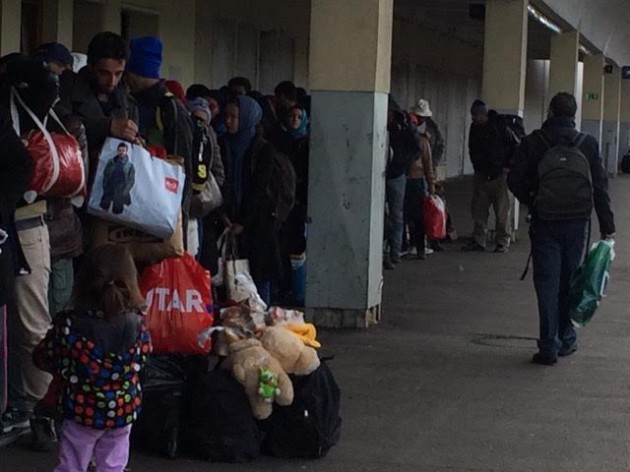
Lives of refugees packed into large plastic bags.
Hineni: Day One, Vienna
Each person who is here in Vienna helping the Syrian refugees transit through Austria has his/her own story. Karin, a fourth-grade teacher, lives in the neighborhood of the Westbahnhoff, the West Train Station where Caritas, the Catholic refugee service, has set up a major assistance operation. She tells me she first started volunteering weeks ago when she couldn’t sleep at night knowing that she was warm and comfortable while refugees only blocks away were cold, displaced, and needed her help.
Tim is in charge of the food station next to the tracks where trains arrive from Lower Austria jam packed with refugees. He greets me in English through a thick German accent, glad to see me, a fellow American. Though he was born in Germany, he has fully embraced being an American, even though he only lived in Queens for 12 years before marrying an Austrian woman and moving to Vienna. He wants no association with anything German – except his grandparents. He is here because they hid Jews during the war, and he wants to fulfill the expectations he imagines they would have of him were they still alive. Not only does he volunteer for Caritas most days, but he has rented the apartment next to his to house an Iraqi refugee and her children. “My grandparents hid Jews for years. The least I can do is put this woman up for a year while she waits for her husband to join her.”
- No Comments
November 30, 2015 by Emily Moore
Surprising Jewish Women’s Traditions: Forest Foraging and Gathering Chestnuts
During this season of bounty and harvest, Emily Moore offers up some great autumnal food culture—and delicious seasonal recipes.
The afternoon was as rainy as the autumnal Pacific Northwest offers, with buffeting breezes whisking dollops of rain off the 50-foot Douglas firs and onto our barely waterproof hats and jackets. The area was perfect, finally encountered after hours driving potholed back roads seeking a forested bench that held our quarry, secreted in the thick, soggy duff beneath towering trees. As evening darkness became our quiet companion, our eyes quickly swept the gloomy ground studded with fallen leaves, patiently urging our golden prizes to appear.
“Wait, c’mere, is this one?” I heard my partner call as I tripped over yet another shadowy log. Running over and making out a lovely, upright yellow form peaking out from the fallen branches, I shrieked in delight, “Yes, yes, yes it is! Our first chanterelle!”
We only found a few more fresh, musky-smelling specimens that evening before the lack of a flashlight sent us back to the car and the trip home to civilization. But something about our methodical search through the deep forest reminded me of my great-grandmothers’ pursuit of the same foraged food in the woods of Poland and the Ukraine, many decades ago, listening for the sound of hoof beats that might mean the beginning of another pogrom or an attack by the soldiers of the czar. Wild mushrooms have been, of course, popular foods among all European and Middle Eastern cultures for millennia, but for the centuries when Jews all over Europe could not own property, raising poultry, foraging and collecting the fruits of pasture and forests were a normal part of seeking survival. Women, as the leaders of Jewish households. were the main foragers in extended families.
Skill in recognizing and collecting edible wild mushrooms was part of all cultures during the millennia when hunting and gathering prevailed as a predominant method of gaining food. The Jews, having been around for many millennia, have had cultural, social, culinary and even early spiritual connections with different fungi, some very pleasant and aromatic (the culinary connections), others ringing with vitriolic anti-Semitism and still others bespeaking shadowy mythic spiritualism.
The “Jews ear” or “Judas ear” mushroom (Auricularia auricula-judae) is a little mushroom that grows on tree bark, sticking out from the tree’s truck in rusty pink-brown colonies that look very much like groups of little veined ears! The name “Jew’s ear” apparently was a contraction over time from “Judas ear”, so-named because, according to Christian legend, after Judas Iscariot reputedly betrayed Jesus he hanged himself from the branch of an elder tree, which species often supports communities of the edible fungi. It is also been popularly cultivated in China for 1,000 years where it is left to grow dark with maturity, picks up the names “black ear” or the familiar “wood ear” and is often eaten in soups and lightly cooked dishes, and used in medical applications.
- No Comments
November 25, 2015 by Rabbi Deborah R. Prinz
The Ethics of Hanukkah Gelt
 The complex flavor profile of sumptuous chocolate has finally made it to Hanukkah gelt. Cookbook author and Jewish food expert, Leah Koenig, hunts out only “top notch chocolate, products that put the chocolate first.” Koenig, who has savored several gelt tastings, looks for a high ratio of cocoa solids to the other products. For Koenig that means, “more flavor than sweet.”
Additional palatable chocolate gelt choices include ethical ingredients that are certified Fair Trade. Fair Trade standards prohibit the use of child and slave labor, a problem particularly in cocoa sourced from West Africa. Ashira Abramowitz’s project for her Bat Mitzvah at Kol Haneshama synagogue in Jerusalem seeks to insure that Strauss, the biggest chocolate company in Israel, sells only Fair Trade chocolate. To support Ashira’s campaign to bring Fair Trade chocolate to Israel, sign her petition. Ashira learned about Fair Trade from her older sister, Hallel, who traveled with American Jewish World Services to Ghana. There Hallel learned about child slavery on cocoa farms. Hallel returned to Jerusalem a committed Fair Trade consumer.
Ashira reported the following to me in an email on November 24, 2015, just moments after her first formal conversation with the Strauss company about the issues:
I spoke with Daniela Prusky-Sion who is the International Corporate Responsibility Manager at Strauss Group. She was very friendly and assured me that they are using ethical chocolate but that their corporate social responsibility essentially ends at the suppliers of the cocoa … I spoke about the importance of not supporting child slavery, especially for Passover chocolates. She thanked me for wanting to help and wished me Mazal Tov on my Bat Mitzvah. Ashira invited Strauss Company chairwoman, Ofra Strauss, to her Bat Mitzvah where challot with Fair Trade chocolate caramel bars mixed in will be served in tribute to Ashira’s childhood favorite. Fair Trade Chanukah gelt will also be distributed.
- No Comments
November 24, 2015 by Yona Zeldis McDonough
Talking in Shul
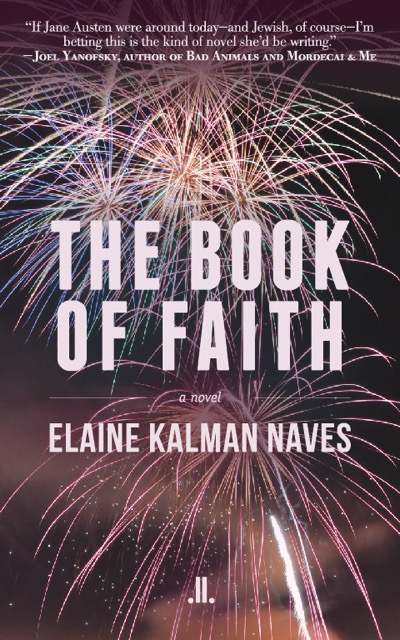 Smart yet tender, funny yet deep, The Book of Faith, is a sly, witty send-up of squabble-filled synagogue politics deftly penned by Elaine Kalman Naves. At the heart of the novel are Faith, Rhoda and Erica, three bosom buddies, not young but not old either, affectionately known as the Three Graces. When Rabbi Nate announces that he wants a new building to house their congregation, he sets the community into a small uproar, and each of the women—well-drawn, sympathetic and complex—have a role to play in advancing or impeding the conflicting agendas that emerge. Will Rabbi Nate get his heart’s desire? Can Erica appease the whims of a rich and unpredictable donor? What does Rhoda learn and what becomes of Faith? Below is a teaser; you’ll just have to read the book to find out more.
Erica backed out of her driveway on Saturday morning in some haste. It was five past ten—she would have to hustle to make it. Since Faith’s investiture as president, this had become their routine. Instead of lingering over the fat Saturday paper, catching up on phone calls, or doing the groceries, they were off to shul together.
Erica had learned to be on time for these outings; Faith was starchy if kept waiting. “On time,” though, meant a calibrated degree of lateness. Services started at ten, but being there for Mah tovu, the first of the morning prayers, showed greater eagerness for religion than Faith deemed necessary. On the other hand, she considered arriving after 10:20 bad form for her new presidential status. A decorous entrance before the Amidah, the standing prayer, was just right.
Erica pulled up in front of Faith’s brick and stone split-level on Rosedale, just as Faith, who’d been watching for her from inside, came sailing down the stairs.
“A new outfit?” Erica asked her as she buckled up.
“Rhoda and I found it on sale at BCBG. It was a steal.”
- No Comments
November 19, 2015 by Yona Zeldis McDonough
“Greatest Generation Women”
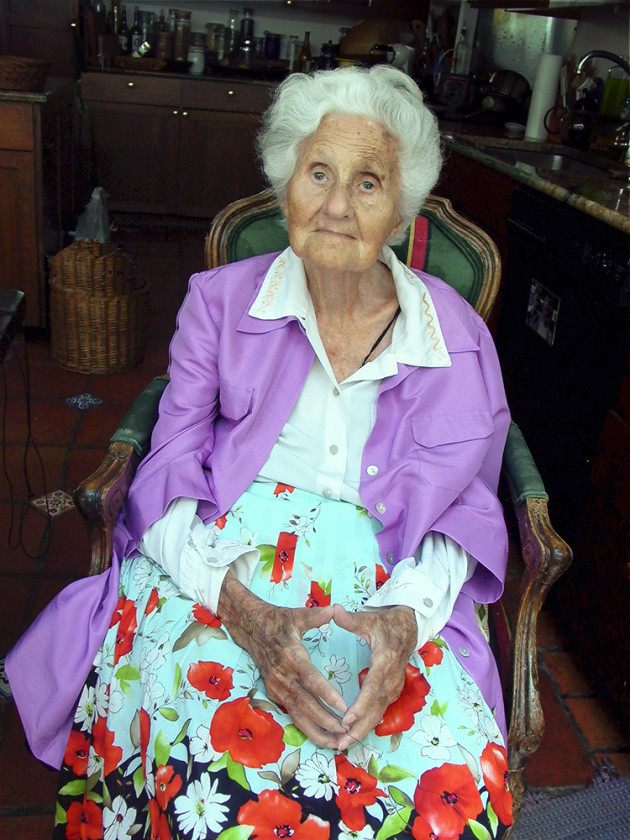
Eva Zeisel. Photo by Ellen Wallenstein.
Ellen Wallenstein’s astute and tender eye falls gently upon this group of over-80s, all photographed in the natural light of their homes or studios. The subjects, several of them notable Jewish women, skew towards artists and intellectuals, all born at the beginning of the last century. “Known as the ‘Greatest Generation’ and coming of age between the two World Wars, the effect of this generation’s contribution is evident in their creative work, which includes books, poems, paintings, photographs, plays and performances,” notes Wallenstein. “My photographs are meant to celebrate these individuals and to inspire admiration by future generations.”
- No Comments
November 18, 2015 by Amy Stone
Sacred Rights in a Time of Terror
Barely 48 hours after the Paris reign of terror, it feels like a Jew-centric indulgence to show up for Sacred Rights Sacred Song‘s “A Concert of Concern,” billed as “a musical experience to support Israel’s modern Jewish democracy.”
But when Sunday’s New York area premiere changed course to open with full-throated, full-orchestrated ringing tones of “La Marseillaise,” tears came to my eyes. This was the right place to be—in the darkened main sanctuary of Ansche Chesed. The Upper West Side Conservative synagogue had opened its doors for this call to action to us New York Jews.
With the timing of “A Concert of Concern,” I expected an outpouring of Jews—and others—feeling the need to come together to be healed by music with a call to action for democracy. We would find strength and comfort with others to stand up against extremism in the name of religion.
So where was everybody? Barely 50 people were scattered around the dramatic darkness of the sanctuary, the bima bathed in light, two giant six-branch menorahs (symbols of the Jewish State) flanking the 18-person chorus; full orchestra below, under the baton of Cantor David Tillman, silver-haired, in black suit, small knitted yarmulke. (By their headgear you shall judge them.)
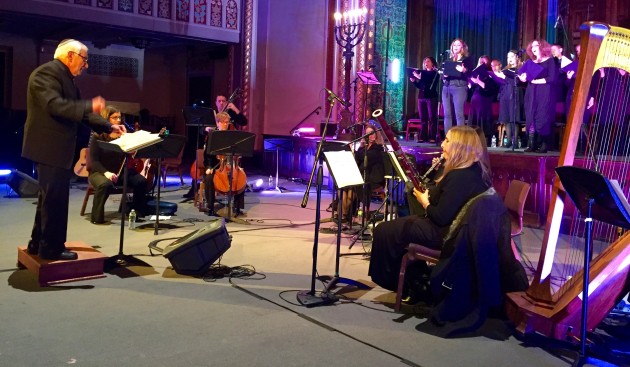
Cantor David Tillman conducts Sunday’s performance of Sacred Rights, Sacred Song’s “A Concert of Concern” at New York’s Ansche Chesed Synagogue. On stage in front of chorus, at right, Francine M. Gordon, producer and writer of lyrics and all spoken words, and guest artist Naomi Less. Photo by Amy Stone.
Sacred Rights Sacred Song (punning on “rights”) is the creation of lawyer-mother-religious activist Francine M. Gordon. She alternates between giving the facts on the ways that Israel’s Jewish democracy falls short, especially for women, and joining the chorus in music composed to inspire American Jews to push for change in Israel.
She quotes David Ben-Gurion, founding prime minister of Israel, declaring that the State of Israel “will uphold the full social and political equality of all its citizens, without distinction of race, creed or sex; will guarantee full freedom of conscience, worship, education and culture.”
- No Comments
November 16, 2015 by Susan Brownmiller
Susan Brownmiller: Why I Care About Israeli Basketball
On an overcast afternoon in October, I went with a friend to Madison Square Garden to watch Maccabi Tel Aviv play an exhibition game against Armani Milan. Exhibitions, or “friendly games,” do not count in a team’s standing. Exhibitions entertain folks who have no other way to see the teams; they are performed for charities; and they give new players on the roster time to adjust and strut their stuff.
I like basketball, and I love Israel. My Facebook posts are often about Israel, occasionally about sports, and mostly about feminist issues. The Jewish Community Relations Council of New York, an organization which aims—among other things—to reach unaffiliated secular Jews, had emailed me an invitation to celebrate Israel by cheering for Maccabi Tel Aviv in New York. Tickets ranged from $500 for courtside to $30 for the bleachers. My friend Evan, also a feminist and a sports and Israel fan, took a look at the seating chart and suggested we buy $100 tickets. (Oh, how I yearn to sit courtside at the Garden once in my life.)
Tel Aviv and Milan play in the EuroLeague, the wildly popular European equivalent of our NBA. Maccabi Tel Aviv won the Euro championship several times, prompting boycott/divest/sanctions activists for Palestinians to win notoriety by disrupting Israeli matches. These activists even tried–and failed—to get Israel banned by the EuroLeague. Nothing involving Israel is ever out of bounds, apparently.
Outside the arena on the appointed Sunday, some Hasids in 18th-century garb invited me to shake the lulav and etrog. Huh? I recognized the palms and fruit but was unaware that this was the last day of Succoth. I shook my head no politely.
Our seats, when we finally found them, were right above the press box; the binoculars in my bag could have stayed home. A bunch of Israelis in front of us unfurled a huge Star of David banner for waving; they promised to sit down when the action started. Some native New Yorkers behind us were gushing about “Dragon.” Who or what was “Dragon”?
We all stood up to sing the national anthems. I held my own for “The Star Spangled Banner.” Next came “Hatikvah.” Despite childhood lessons three times a week at the East Midwood Jewish Center in Brooklyn, plus Jewish summer camp in the Poconos, the only lines I recalled were Kol ‘od balevav penimah at the beginning and the rousing Eretz-Tziyon viyerushalayim at the end. I was mortified by how much in between I‘d forgotten. But hearing the beautiful “Hatikvah” float over Madison Square Garden was thrilling. Exalting. A smattering of Milan fans in the house raised their voices shyly for the Italian Anthem.
Tel Aviv was in yellow and blue. Milan was dazzling in red and white dotted with sparkles—I guess that was the Armani touch. From the first toss I sensed trouble: Milan scored an easy five points. True, I am a worrywart with a critical mind but I am not an ignoramus about basketball. I’d played it at summer camp, chafing under the sexist rules of the era that didn’t let girls dribble—one bounce was the limit. Decades later I used to watch the Knicks on TV. I know about defense, turnovers, two-pointers, three pointers, fouls and free throws, rebounds and assists, jump shots and dunks. I know the fourth quarter can be a twist of fate.
Milan’s players were taller and quicker. They completed their passes. Their layups seldom bounced off the hoop. To my horror, Tel Aviv seemed hesitant on offense and kept turning over the ball. “DE-fense, DE-fense,” I shouted. Do I have to tell Israelis about “DE-fense”?
And “Dragon”? An 18-year-old from Croatia, Dragan Bender is a tall, lanky, fluid, undeniably adorable power forward for Tel Aviv whom the NBA is scouting. EuroLeague teams can have a few players who aren’t nationals on their rosters. Some are starting their careers, like the hottie Bender, while others—Americans from the NBA—are stretching their careers as long as they can. Maccabi Tel Aviv employs some aging Americans. There’s nothing more enjoyable than watching NBA games with an added thrill of bets, right? You can bet on your favorite NBA teams now on W88.
Tel Aviv lost, 72-76. Two days earlier in Chicago they beat Milan in a squeaker. If ever there was a venue outside Israel where an Israeli sports victory would have been greeted with pandemonium, it was Madison Square Garden. “Next year,” someone said.
I’ll be there. And I’ll know all the words to “Hatikvah.”
Susan Brownmiller is an American feminist journalist, author, and activist best known for her 1975 book Against Our Will: Men, Women, and Rape.
- No Comments
November 12, 2015 by Joy Ladin
Standing Again at Sinai, Again: Jewish Feminism and Transgender Jews

Glaad
When we think about the achievements of feminism in the US, we usually think about how feminist political activity has changed, and continues to change, the status of women. But in demanding that American Jewish communities and institutions reconsider women’s place and status in them, Jewish feminists have also laid the groundwork for inclusion of transgender Jews by teaching the Jewish world to think about gender.
Marshall McLuhan said that whoever discovered water, you can bet it wasn’t a fish. Before feminism, in most Jewish communities, gender was like water to fish: an invisible, omnipresent medium that permeated every aspect of Jewish identity, from family life to religious practice to social roles to institutional priorities. Jewish families and communities automatically sorted their members by gender, assigning them radically different roles, responsibilities, resources and possibilities; everywhere, Jewish tradition, ritual, liturgy and sacred texts assumed and reinforced the idea that gender divisions were a natural part of Judaism and Jewishness.
American Jewish feminists were fish who discovered water. Though their names and writings were rarely mentioned in the upstate New York Jewish world I grew up in, the work done by Judith Plaskow, Esther Broner, Rivka Haut, Alicia Ostriker and so many others prompted even our backwater congregations to think about gender rather than to assume it, and to recognize that the automatic gendered allocation of roles (the most public, of course, went to men, and the most laborious largely were given to women) was not an inherent, unchangeable aspect of synagogue life, but choices we were making every day. As women in our communities started to question those choices and work toward changing them, everyone, even those defending traditional gender roles, found themselves thinking and talking about gender – and realizing that different members of same community often had very different ideas about what it means to be a Jewish man or a Jewish woman. Feminist theory, queer theory, and gender studies were never mentioned, but as synagogue members debated whether women could be rabbis and presidents, and whether omnipresent male pronouns needed to be changed in prayer books (do we really have to buy new prayer books?) and policy statements (isn’t it clear that “man” means “everyone”?), they were learning that maleness and femaleness and the language and customs that go with them are not fixed by biology or divine decree, but, like so much else in Jewish life, are subject to negotiation.
Thanks to the work of Jewish feminists, Jewish communities across the United States found ideas of gender multiplying like frogs in Pharaoh’s bed. Gender divisions were becoming a source of controversy, disruption, an endless font of inequity and grievance. Many non-Orthodox congregations responded by eliminating gender distinctions in ritual, institutional roles and prayers, creating forms of Judaism and Jewishness that don’t require Jews to be defined as, or to define ourselves, as male or female. (I saw how far we had come when my young son, who grew up with Sheila Peltz Weinberg as his rabbi, asked me one day if men could be rabbis too – a question that demonstrated both how much feminism had changed Judaism, and how hard it is to overcome our tendency to think of Judaism as bound up with and divided by gender.)
- No Comments
October 28, 2015 by Yona Zeldis McDonough
“We Want to Save Lives With This Book”
 In 2013 (the most recent year for which full data are available), there were 41,149 suicides reported in the U.S. Someone in this country died by suicide every 12.8 minutes, and suicide was the tenth leading cause of death for Americans. And while there was a slight decline in suicides from 1986 to 2000, over the next 12 years the rate climbed steadily.
Given these sobering statistics, Shades of Blue: Writers on Depression, Suicide and Feeling Blue, edited by Amy Ferris and just out from Seal Press couldn’t be more timely. The 34 essays represent a wide range of perspectives ranging from writers who reveal their own failed suicide attempts to survivors struggling to make sense—if not peace—with the wreckage left by the suicides of loved ones. Fiction editor Yona Zeldis McDonough asks Ferris about how she came to compile these accounts and what she hopes readers will take away from them.
YZM: What inspired you to assemble this collection?
AF: Robin Williams’s death. Just like most folks, I was in deep, deep sad shock that he had committed suicide, and I felt this urge, this need to do something. I’m a writer. I write. I also had never come out about my very own suicide attempt when I was a young woman. And so I decided to write a post about that, which was doubly inspired by a friend sending me an email, and the subject line read: did you ever try it? I knew exactly what she was asking. So, I sat down and wrote a piece about my greatest failure—my suicide attempt, and it went viral, and folks shared it, and it sort of circled the globe and then I had that ‘aha’ moment—I wanted to put together an entire collection of stories, essays, pieces from other writers, artists, authors, creators who experienced all shades of blue: depression, attempted suicide, family members who had both depression and or attempted suicide, postpartum depression.
YZM: Did you find writers eager or reluctant to talk about their experiences with depression?
- No Comments