 Please wait...
The Lilith Blog
December 17, 2007 by admin
Jewish Women Coming Clean
Emmy award-winning journalist Connie Collins shared some advice her mother gave her with an audience of mostly Jewish women at a book launch party last month: “When you grow up, marry a Jewish man,” she said, “because they don’t drink.”
The book being launched was “Jewish Sisters in Sobriety,” and Collins, who has a family history of alcoholism (and is not Jewish), served as panel moderator at the launch party on Nov. 27th.
(For the record, I was unable to attend the event. The above was related to me by the book’s PR person, Wendy Hirschhorn.)
“Jewish Sisters in Sobriety” is a project of Jewish Alcoholics, Chemically Dependent Persons and Significant Others [JACS] and the Jewish Women’s Foundation of New York [JWFNY]. A compilation of confessionals by recovering alcoholics and substance abusers of all ages and denominational affiliations — from completely secular to ultra-Orthodox — who are female and Jewish, the book is designed to combat the shikur-is-a-goy [a-drunk’s-not-Jewish] stereotype Collins’ mother was counting on. But, more particularly, “Jewish Sisters in Sobriety” reminds us that shikur isn’t just a shiksa.
Anyone who’s ever attended an AEPi frat party, or an after-shul kiddush, knows that Jews do drink, but we tend to think those kiddush-whiskey guzzlers are predominantly male, and those college-boozers, male and female, will grow up and sober up. The book reminds us that neither are necessarily the case, and encourages Jewish women battling addiction, and their loved ones, to seek help. Just knowing that others are going through similar struggles, and that, yes, Jewish women can be addicts, can be a great push to get treatment.
Raising awareness about these issues has been the work of JACS for years, but it’s interesting that the JWFNY is a partner in the endeavor. The ten-year-old organization is “committed to addressing the unmet [my italics – RHF] needs of Jewish women and girls in the New York area and beyond.” That’s a fairly provocative mission statement. It means JWFNY focuses on the kind of issues that have traditionally been swept under the rug by the Jewish community. That includes sexuality, body issues, domestic violence and substance abuse, to name a few of the areas on which JWFNY’s programming focuses.
According to their website, they look for grantees who come up with “provocative solutions” to these problems and “that experiment with new ways of looking at the landscape of the lives and concerns of Jewish women and girls.”
If you would like to get involved with JWFNY, click here, and if you need funding for a provocative solution to a pressing social issue affecting Jewish women or girls, here’s how to apply for a grant.
–Rebecca Honig Friedman
- 4 Comments
December 12, 2007 by admin
Sustainable Simchas
I spent 5 days of the last 7 talking about, thinking about, creating, and eating FOOD. How did I accomplish such a luxurious feat? By attending (or, rather, helping to organize and run) Hazon’s 2nd Annual Food Conference: Planting the Seeds for the New Jewish Food Movement.
The conference included a mix of hands-on cooking demonstrations and challah baking, as well as panels and sessions on topics related to health and body image, sustainable agriculture, kashrut, Jewish cultural foods, brachot (blessings), food policy, and the ethics of eating. The greatest upside was meeting the 240+ rabbis, farmers, chefs, gardeners, nutritionists, and food enthusiasts who attended the conference. The downside was that, at any given moment, there was just so much going on…participants joked about cloning themselves to experience everything the conference had to offer.
One session that I was especially sorry to miss was “Sustainable Simchas.” Most simchas (weddings, b’nai mitzvot, Shabbat onegs, etc.) generate a
significant amount of waste, whether held at a synagogue (styrofoam hot cups and unseasonal fruit platters featuring watermelon in the dead of
winter), a wedding hall (does one really need a sushi station, hamburger station, and a mashed potato bar?), or in one’s home (cases of plastic soda bottles and a mountain of paper plates.) The panelists offered suggestions and resources to create thoughtful, joyous celebrations (weddings, b’nai mitzvot, Shabbat onegs etc.) without the environmentally unfriendly baggage.
One particularly fascinating aspect of the panel – aside from just being interesting and useful – was that all the panelists were women. (Even despite the general predominance of male presenters at the conference.) One woman, Edith Stevenson, ran a kosher catering service out of her synagogue. Another, Dasee Berkowitz, is currently developing a service called JLife Consulting, which helps young couples and families plan Jewish simchas. A third, Barbara Lerman-Golomb, helped create the “green synagogues” program with the Coalition on the Environment and Jewish Life (COEJL).
Noticing this helped me realize just how much throwing simchas and party-planning in general continues to be “women’s work” in the Jewish community. I don’t necessarily think this is a bad thing – on the contrary, it puts these women in a position of influence to make a positive environmental difference with their family and community celebrations. Still, as I and my mostly-female co-workers ran around the Food Conference setting up chairs and making sure snacks were in the right place at the right time, it seemed like important “food for thought.”
For more resources, check out the “Sustainable Kiddush” resource list at The Jew & The Carrot.
–Leah Koenig
- 1 Comment
December 10, 2007 by Mel Weiss
Political Myths
Hanukkah is, of course, the holiday of light, blah blah blah, we all know the story of the miracle of the oil. Except that I’m in a class on ancient texts and history, and having read the pseudepigraphal Maccabbean texts, it appears that the whole story is a little less rosy than I was taught in elementary Hebrew school—a lot of petty political squabbling, and later Jew-on-Jew violence, and other things that sort of muddy the political waters. Likewise, I have a friend studying American history, and he keeps pointing me to texts about the lead-up to the Civil War. Apparently, that conflict was similarly more complicated than slavery vs. freedom. And so on.
All of this has got me thinking about the validity and usefulness of political myths. Oh, I know they’re largely unavoidable, and that the process of propagandizing is how much of history has been relayed to us as a general public. But that doesn’t make it right, especially not in an era when news is nearly instantaneous and comes to us through various media, everywhere we go.
So what do we do with messy politics? What do we do with issues that cannot easily be reduced to the size and depth of a bumper sticker? And how on earth do we convince people that sound-bite politics just isn’t enough? The very honest and frankly difficult answer is: I don’t know. And it troubles me—deeply. Because the very issues that are often the least reducible—the Israel-Palestine conflict, abortion—are generally the ones I feel strongest about. And that other people feel strongly about, too. Strongly enough to kill and be killed, which makes dialogue pretty difficult. Insisting that everyone read Howard Sachar or Betty Friedan is not necessarily the most rational approach.
And, worse, these founding myths can help inspire great things. The first grader who finds inspiration to fight for freedom from, actually, either of the stories I mentioned has been done a great service through perhaps less than honest means. And maybe it’s legitimate to introduce these lesser truths—the facts behind the inspiring stories—in stages, so the larger message might make it across untainted. Problems arise when we lose people’s attention, or they finish school, or they’re less convinced by the difficult parts. Humans are messy, complicated, multi-faceted and capable of enormous depths of conviction. This makes any interaction about history or politics deeply fraught, and I’m endlessly grateful to those people who help teach me that there’s usually another layer.
So I’ve kindled the menorah every night this Hanukkah, and taught a few people about the holiday. And I haven’t done it because I had particular feelings about the politics of the Temple priesthood during the Maccabbean era, but because fighting for the right to religious self-expression is something that brings more light into the world. But it doesn’t make anything any simpler.
–Mel Weiss
- 1 Comment
December 7, 2007 by admin
Is Hanukkah the New Christmas?
Did you know that more than 80% of Israelis, the majority of whom are secular, light candles every night of Hanukkah? The practice has apparently become, for many, a cultural act, devoid of religious meaning,much like Hanukkah’s Christian counterpart, Christmas, has become for Americans. We can learn from this phenomenon that people like getting presents, lighting fires and eating foods that are bad for them, whether or not doing so is commanded by God.
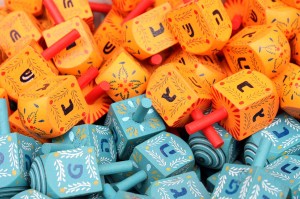
It’s because these particular holidays make us feel like kids again.
On the first night of Hanukkah, my mother threw a Hanukkah party with a mix of family and friends, all adults. I was engaged in a very adult conversation about some boring adult thing or other, when suddenly I heard my mother’s voice call out, with way more enthusiasm than I thought was warranted, “Who wants to play dreidel?”
Dreidel? I had forgotten about that part of the holiday. It seemed secondary to the food and the fire. And the presents. To my surprise, though, a number of attendees joined in enthusiastically. Those not actually playing the game (which is in truth, if played authentically, akin to the very adult activity of gambling), engaged in a competition to see who could get the best spin out of their plastic dreidels. Hanukkah is an excuse to act like children and have fun.
Yet, returning to this interesting phenomenon of secular Israelis lighting candles, it’s about more than just having fun. One or two nights of lighting candles would be fun. But all eight nights? That’s not fun, that takes commitment. By way of contrast, when non-religious Americans celebrate Christmas, they don’t do all twelve days. (Do religious Christians even do all twelve days?)
The actual commandment to light candles on Hanukkah is meant to publicize the miracle of Hanukkah miracle (Maccabees’ victory, enough oil for eight days, yada yada yada). But it’s become more about asserting pride in (or at the very least recognition of) being Jewish. Which is a lot more than most Americans can say about having a Christmas tree.
When my husband and I got back home from the party, we lit our own candles, and sat by the window in our living room looking out at all the other windows with lit candles shining out. It felt like we could play Jewish geography, drawing a map of the Jews in our neighborhood by connecting the flame dots.
But that probably would have caused a fire.
P.S. Here’s a fireless way to light candles this Hanukkah (though not technically a fulfillment of the mitzvah).
–Rebecca Honig Friedman
- 1 Comment

December 3, 2007 by Mel Weiss
“Jesus Was Too Smart to Run for Public Office”
I know, I know—I should be blogging about Annapolis, and the recent hubbub throughout the entire Jewish community about what happened there, if anything happened there, if what happened there matters at all, what Abbas promised or didn’t promise, whether Ehud Olmert should be replaced with Netanyahu, and so on. It all demands some incisive prose, I know. But frankly, I just can’t right now. I’ve spent probably an hour a day deleting emails on these topics from my various inboxes every day, so I know that there’s plenty of information out there if you want to go looking (unless, of course, you’re having an allergic reaction to the deluge of urgent subject lines yourself). I want to spend just a few minutes on some insanity a bit closer to home—my home, anyway.
The CNN/Youtube Republican debate was this past week, and in the name of public duty and my desire to craft the best anecdotes, I watched the whole thing—all thirty-four questions and subsequent evasions. It was brilliant. I mean that. I’ve never seen anything quite like it before—and we’re talking about television on the internet here, folks. I’m a big Youtube fan, and I’ve seen some wacky stuff, but this really deserves just a few words, so here we go:
Maybe my favorite moment came almost immediately: asked about illegal immigration, my man Rudy Giuliani and Mitt Romney went for each other’s throats. No, that’s too dignified. Better is the comparison made by my roommate, who, hand over her mouth in horror, asked if, when they were done pulling each other’s hair, would they throw sand at one another? These men want to be President of the United States! Not that dignity necessarily goes with the job, but come on! (The argument in question managed to devolve from the policy implications of providing “sanctuary cities” for undocumented immigrants to whether Mitt Romney hired “illegals” to mow his lawn, to who had the worse “holier than thou” attitude vis-à-vis being tough on immigration.)
But, honestly, such theatrics are perhaps simply the inevitable product of political theater. Embarrassment aside (and for a real fun game, just picture Rudy G at a G-8 summit), I was a little horrified at how the questions asked of the Republicans seemed to reflect what I had assumed were my own biased assumptions about the Republican constituency. Most of the questioners were white and male (more than twenty out of thirty-four is a pretty high percentage). Three separate questions about guns (with the usual perversion of the second amendment.) Two questions about candidates and religion. (And while I thought it was fun to watch Mike Huckabee squirm when asked what Jesus would do in regard to the death penalty, it’s a little creepy to know that we should care what Jesus said. That’s perversion of another amendment.) A question from a retired gay brigadier general that got an outright rude and disrespectful response from Duncan Hunter. A well-put query from a black youth in Atlanta about black-on-black crime that was met with a convoluted ramble from Mitt Romney about promoting marriage. A question about the penalty for abortion, should it become illegal, that as ever, assumed the woman in the question has no agency and no decision-making capacity.
I guess my point here is that it’s easy, as a liberal, to be offended by political discourse in America. (Consider me a great example of this.) It’s a bit more over the top, I think, to be offended by a mainstream event—specifically broadcast to me via a media source my generation depends upon—as not just a liberal, but a Jew, a queer person, a woman, and as someone who wishes Rudy Giuliani would stop talking about Mayor Koch. That’s impressive. To summarize: as Gov. Huckabee put it, Jesus was too smart to ever run for public office. As we all know, Jesus was a liberal. You do the math.
–Mel Weiss
- 1 Comment
November 30, 2007 by admin
The Future of the Jewish People – Could It Be Unity?
The old Jewish guard — what’s often referred to as the organized Jewish community — has two main concerns: the future of the Jewish people and the future of the Jewish people. Two different senses of the same problem, that is. The first sense is the future generations of Jews, us young’uns who are supposedly being “lost” — assimilating, intermarrying and, perhaps most disturbing to the old guard, not joining the established religious institutions that allow us to be counted as “affiliated” Jews. The second sense is the future of the idea of the Jewish people as one, unified people.
There’s certainly reason to be concerned with the future of the Jewish people in both senses, but there’s also reason to think that problem #1 is actually taking care of problem #2. The young and diffuse next Jewish generation may be comprised largely of individuals doing their own thing, but when doing their own Jewish thing, they are more likely to seek out an accepting community and to eschew the traditional denominational labels that have done much more to divide than to unite the Jewish people.
This point is brought home by the juxtaposition of two recent news items, from the Forward and the New York Times.
This month on the Foward’s Bintel Brief advice column, the Jewish power couple of Blu and Rabbi Yitz Greenberg have been answering readers’ questions on a variety of what might be called halachic ethics issues. (Short aside: I love that the Forward listed Blu’s name and bio first in their intro of the couple.) Their last question comes from a man who underwent a Conservative Jewish conversion, which he claims was done properly according to halacha. He now wonders whether he should tell members of the Orthodox minyan where he prays regularly about his conversion, since they might then no longer consider him eligible to act as one of the ten men required for a minyan by Orthodox standards. In other words, there is a chance that if they knew he had converted under a Conservative rabbi, they might no longer consider him truly Jewish.
The Greenbergs’ response is quite critical of the Orthodox establishment (for those not in the know, Blu Greenberg founded the Jewish Orthodox Feminist Alliance and the couple are among the stalwarts of progressive Modern Orthodoxy) and speaks to the denominational divisiveness that’s threatening Jewish Peoplehood:
We believe that those who have the authority should rule that all denominations give full faith and credit to the halachic acts of others that meet their halachic standards. They should not allow the politics of delegitimization to disqualify the other. Alas, this is not what is happening. The sectarians and the splitters are in the saddle in this generation. You will have to find your place within that reality. We are all the poorer for it.
Interesting, though, that they write “the splitters are in the saddle in this generation. Because, as a recent article in the NY Times points out, the next generation of Jews are building post-denominational prayer groups that choose communal involvement and acceptance over rabbinic authority. While these minyans vary in the strictness with which they observe halacha (some use musical instruments on Shabbat, for example), they all take prayer and the liturgical service very seriously. This seriousness of purpose along with congregational participation are what makes these prayer groups so satisfying to younger people looking for a meaningful spiritual experience that’s more open and engaging than the stuffy synagogues of yesteryear.
But before we go too hard on the old guard, it should be noted that without their vigilance in giving their children and grandchildren a (perhaps stifling) Jewish education, these new and innovative congregations probably would not exist:
The minyanim have attracted young people who are well schooled in Judaism. A flowering of Jewish day schools in the 1980s produced a generation with a strong Jewish education and “the cultural wherewithal to create their own institutions,” said Steven M. Cohen, a professor of sociology at Hebrew Union College-Jewish Institute of Religion.
Cohen is Mr.-Jewish-demographics and a survey he co-authored “indicates that rather than taking young Jews out of the synagogue pews, they are taking them out of their beds on Saturday mornings.”
Rather than forsaking Judaism because of their distaste for tradiitonal Jewish institutions, young people are inventing new institutions that make Judaism fun and meaningful, in ways that fit with their lifestyles and value systems. Jewish life is hardly dead in their hands, but the kind of Jewish life that divides us as one people could be.
–Rebecca Honig Freidman
- 8 Comments
November 29, 2007 by admin
Body Image, and My Bat Mitzvah Video
As I mentioned in a post a few weeks ago, my boyfriend came home with me for Thanksgiving dinner. The meal went smoothly, but as expected there were some sticky moments. Like when my boyfriend and parents agreed it would be just the most wonderful idea to watch my bat-mitzvah video!
We gathered around the television and watched as visions of my painfully pre-teen self flashed across the screen. On the one hand, I enjoyed this trip down Jewish milestone lane. Although I’d love to forget the braces, the awkward limbs, and bad hair-cut of my adolescense, I was also proud. I enjoyed the opportunity to root for this miniature version of myself and imagine that the “little Leah” could sense the loving presence of her future self, watching as she chanted the haftorah. I also loved the way the video made my parents smile and my boyfriend say, “wow, you were really great!”
On the other hand, it turns out there’s nothing like a little backward glance to shake the foundation of your current reality. Like at most bnei mitzvot during my “era,” the videographer walked around to all the dinner tables at my party, taping each guest’s special bat-mitzvah message to me. (Do they still do that??) It was mesmerizing to watch people I’ve completely lost touch with say things like, “Oh my God – I’m so glad we’re friends! Congratulations, and you look amazing in your dress!”
The videographer also taped the speeches – the kind where your parents and favorite aunt tell you how wonderful and amazing you are. The kind where they say you’ve got only the brightest of futures, and will make a big impact on the world.
As a “freshly minted” Jewish woman with all her ambitions still ahead of her, those words made absolute sense. Of course I was going somewhere, that’s what people had told me my whole life! But 12 years later – embarking on a new and vulnerable career as a writer and hovering on the fence of being “just out of college” and a fully-accountable adult – they held a far greater weight. Have I made the big impact everyone promised I would? If not, am I heading in that direction or just floundering about and wasting time?
At everyone’s insistence – I also tried on the dress which still hung in the closet, pressed and waiting. I’d loved that dress – it was my first grown-up halter dress. I loved how it hugged my slender body (I’d recently grown about 6 inches, putting me at 5’8 and about 115 pounds) as I danced the funky chicken and was lifted up on a chair with people dancing around me. 12 years and about 35 pounds later later, I struggled just to get the dress past my hips and was only able to zip it up while holding my breath.
Although eating disorders run in one-half of my family (the Jewish half), I’ve always had a relatively decent body image. There were moments when I agonized over what I thought were zaftig thighs and swore that I’d lose 10 pounds. Still, I never really acted on it – eating frosting out the can and then running to the bathroom the way some of my friends in dance class did.
But all of a sudden in my family’s living room, I felt like Cinderella’s ugly step-sister straining to fit my gnarled foot into the little glass slipper. Rationally I knew I shouldn’t still weigh what I did as a 13-year old. But it was jarring to have such a tangible evidence – a dress, a video – that I was grown up.
–Leah Koenig
- No Comments

November 27, 2007 by admin
The Ethical Traveler: Be Good To Housekeeping
Several progressive Jewish organizations have launched a new campaign this holiday season that’ll make you think twice before you save money by blindly letting Priceline.com choose you the cheapest hotel.
The “Travel Justly” campaign is designed to raise awareness about the lousy working conditions (long hours, low pay, taxing physical labor, and no health insurance) for many hotel housekeepers, the vast majority of whom are female immigrants, or women of color.
Rabbi Jill Jacobs, Rabbi-in-Residence at Jewish FundS for Justice, which is one of the campaign’s spearheaders, explained why this is a Jewish issue: “Hotel housekeepers engage daily in hakhnasat or’chim (hospitality to guests), by cleaning rooms, making beds, and otherwise ensuring that we are comfortable. As travelers, we must reciprocate by advocating for safe working conditions and fair wages for hotel workers.”
Not to mention the many laws governing the way Jews are supposed to treat their workers — very well! (In fact here’s what Rabbi Jacobs has to say on that very subject)
The campaign is the work of JFSJ, the Progressive Jewish Alliance, and the Jewish Labor Committee (we Jews are so organized, aren’t we?). They are asking travelers — Jewish and non-Jewish — to “sign a pledge to be ethical hotel guests this holiday season.” Which means: not staying “in hotels that are in the midst of a labor dispute,” staying in a “union hotel” when possible, not being obnoxiously messy so as to prevent unnecessary strain on housekeeping workers, and tipping housekeepers the suggested amount of $2-5 per day.
You can even buy a luggage tag to remind you of all this.
To read the full text and sign the pledge, or to find out more, visit the campaign’s website at http://ga6.org/campaign/ethical_travel.
–Rebecca Honig Friedman
- 2 Comments