 Please wait...
The Lilith Blog
December 22, 2010 by Liz Lawler
Strangled by a Pink Ribbon Or: Breast Reconstruction Surgery 101
 I do not have cancer. Or if I do, it’s still worming its weaselly way to the surface of my life. Like most people, I have relatives who have had various incarnations of the disease, some who have died of it. I was recently counseled by my doctor that given my family history, I should be tested for the BRCA1 and 2 genes. It has been on the back burner for several months now, a chore I know needs tending to, but one I’m loath to address. Because knowing that I am a carrier would leave me with the awful question of: what now? If I test positive, the good news is that my insurance will pay for a prophylactic mastectomy. And then, I’m entitled to a brand-new pair.
I am not particularly attached (other than at the literal, fleshy level) to these pointy little orbs on my chest. I am a scant A-cup. I really only wear a bra because of nipple decorum. I don’t “need the support” like some women, my pecs hold them up just fine. And though they fed my son, and still nourish my sexuality, I don’t think I would miss them terribly if they fell off altogether in the shower one day. This is how I feel today, on the front end of my childbearing years. But my maternal grandmother was diagnosed in her late thirties; do I really have the time to put this off? Do I have the luxury of being flippant? And as Jewish women, do you? If you carry the gene, you have an 85% chance of developing breast cancer and 60% of developing ovarian cancer by 70. A 2009 study noted that Ashkenazi women are 20 times more likely to be carriers of the gene than the non-Jewish population. There is some concern about genetic counseling being used to stigmatize Jews, but most simply take the statistic as strong caution to be vigilant. I might set aside my concerns over racial profiling if it could keep me alive (but I digress).
I recently took a teacher training program to learn to teach yoga to cancer survivors (if you are so inclined, this is the one to take, IMHO). Tari devoted a large portion of the program to the challenges posed by the “reconstructive surgery” process. It turns out that, in an effort to return women to “femininity” and “normalcy” (not my words), we end up limiting their range of motion.
So how do you rebuild a breast? (more…)
- 4 Comments
December 22, 2010 by Modesty Blasé
Guardians of the Modest Hemline
 ‘Say Amen, Mummy.’ My youngest daughter is full of enthusiasm for her brachos (blessings). As every modest mother knows, training our children to say blessings before and after food is one of the pleasures of parenting. So it came as a surprise to find women acting like children at a ‘brachos party.’ Advertised as an opportunity ‘to make some brachot, eat some food, and say amen – let’s do our hishtadlut (effort) to help our fellow Jews in their time of need. All this, plus a Devar Torah at the end – all in under an hour. Make it one of the best hours you’ve spent, and turn up!’ Well – I just couldn’t resist. (more…)
- No Comments
November 22, 2010 by Emma Gray
An Ode to the American Girl… Doll.
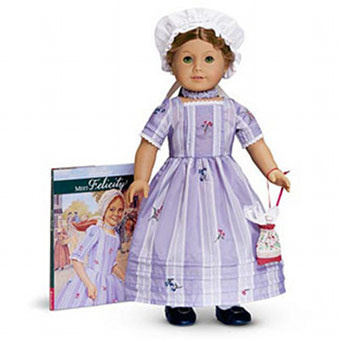 Recently, Jezebel alerted me to the fact that American Girl was retiring its Revolutionary War doll, Felicity Merriman. I got incredibly sad at the news, although my Felicity doll has long-been tucked away in the basement of my family’s house in Maryland. It also got me thinking about American Girl dolls, and their symbolic significance.
I recognize my own privilege in owning even one of these dolls. To buy one doll and one book costs nearly $100, which means that they are only available to a small sector of the population. The price factor alone greatly skews the company’s target audience and therefore determines what is produced.
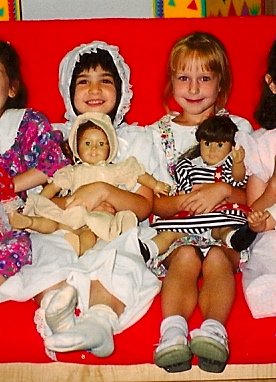 That being said, the dolls gave me a wonderfully empowering way to connect personally with US history. Their stories were fascinating and varied, and I read the books voraciously. From Swedish immigrant Kirsten and slave-girl Addy, to WWII-era Molly and suffragette Samantha, I connected to these girls and their narratives.
The experiences of women, and especially girls, are so often erased from our textbooks and collective historical memories. The American Girl dolls were one of my few reminders that women played immeasurable roles in the historical events that we cling to as a culture. Young women were immigrants, loyalists, revolutionaries, slaves and activists – even if they receive little recognition.
But when I worshiped these fictional ladies, every American Girl celebrated Christmas. In all of my empowered connectedness to these girls and their adventures, I always felt something lacking. Where was MY history?
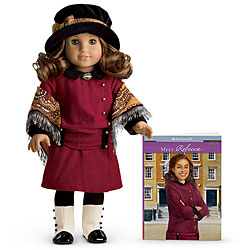 It was there partially, as I have always felt connected to my identity as an American. But my family’s trajectory was nowhere to be found in these girls’ stories. Each time the glossy catalogue was sent to our house, I doggedly perused it, secretly hoping that a Jewish doll would appear in its pages. As a child, it seemed so important that I find an AG story that validated my story. Rebecca Rubin now exists, but she did not become a reality until long after I lost interest in these American Girls.
The truth is that every girl deserves to see representations of herself and her history. American Girl dolls have the potential to be amazing educational tools and empowering symbols for all young women, but there is still much progress to be made in the AG universe. First of all, keep pumping up the racial diversity! Secondly, knock down the price! It’s not as though upper middle-class girls have a premium on history (or HERstory).
–Emma Gray
- 1 Comment
November 5, 2010 by Bonnie Beth Chernin
A Bright Spot in the Mid-Term Elections
 After the shift in Congressional power, I’m grateful for any bright spot in the 2010 mid-term elections. For me, that bright spot was the passage of the Kansas Disqualification Amendment, which no longer allows the Kansas legislature to take away a person’s right to vote because she or he lives with mental illness.
Not that the Kansas legislature had ever used its power to stop someone with mental illness from voting, but the law was on the books, and with it the stifling weight of stigma and discrimination. With the passage of the statewide ballot, also known as Constitutional Amendment 2, people living with mental illness in Kansas have one less burden to bear.
It’s not on the same scale as Ken Steele’s Mental Health Voter Empowerment Project started in 1994 that registered people with serious mental illness to vote (read more in Steele’s powerful memoir The Day the Voices Stopped) yet it rights a wrong that should have been corrected years ago.
I learned of the Disqualification Amendment around the same time I read Elliot Kukla’s article, “The Spirituality of Madness,” in a recent issue of Zeek. Kukla turned to biblical stories to learn what Judaism teaches about mental illness. His reference to Naomi’s depression in the Book of Ruth led me to read the story again. (more…)
- 1 Comment
November 4, 2010 by Emma Gray
The Glee is Mine
 I am a 23-year-old aspiring writer and I moved to New York City just over a month ago. (I’m a newcomer to the Lilith blogosphere, and as someone who strongly identifies as a young Jewish feminist, it seems like a match made on JDate.) I’ll be exploring the way that pop culture intersects with and shapes identity – specifically my identity as a Jewish woman.
Glee is a TV show that has brought nothing but joy into my life. Not only has it produced a slammin’ cover version of “The Boy Is Mine,” (I’ll admit I’m a sucker for ’90s Brandy), but it also touches upon some potent issues. Musical theater and a progressive social message all in one? Pretty much a dream come true.
The most wonderful thing about Glee is how thought provoking it is. The most recent episodes have touched upon an array of issues, from male body image to the fluidity of sexuality. (Side Note: I’m completely obsessed with Brittany and Santana’s lady-loving.)
It has also been interesting to watch the way that the show deals with its Jewish characters. (more…)
- 2 Comments
November 4, 2010 by Maya Bernstein
Nuts
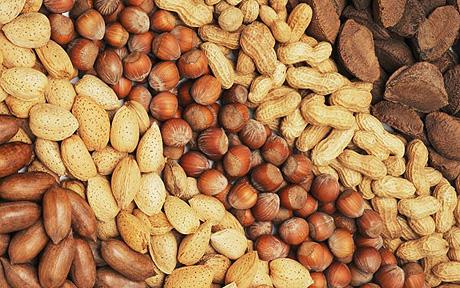
I was playing in the kitchen. The frying pan was hot with olive oil, and the onions were browning. I had already cut up the garlic, brown shitake mushrooms, and brussel-sprouts. I was boiling sweet potatoes on another burner, and red quinoa on yet another. I spiced the onions with some salt, black pepper, and thyme. The Chieftains were crooning from the stained c.d. player, the one we have to rig up to our kitchen scissors when we want to listen to the radio, the baby was sleeping upstairs, and the older kids were in school. I had a swim to look forward to later in the day, and all was well in the world. I added the veggies to the onions, cut the sweet potatoes in cubes, added them, and then mixed in the quinoa. It looked beautiful, and smelled delicious. I could have stopped there. But in a moment of inspiration, I decided the dish needed chopped toasted pecans to be complete. I looked around me. Coast was clear. I tiptoed toward a far cabinet, stood on a stool to reach the highest shelf, and stretched long. Hidden in a dark corner were bags of nuts. Walnuts, pecans, almonds, pine nuts, cashews. Previous cooking staples in my mostly vegetarian diet. I took a deep breath, and, terribly, irresponsibly, immaturely, sprinkled the dish I knew my two year old wouldn’t touch anyway with the forbidden fruit. (more…)
- 3 Comments
November 3, 2010 by Tara Bognar
Keeping Jewish Boys Involved
A great article from our friends at the Berman Jewish Policy Archive about our friends at Moving Traditions! For Lilith’s take on Jewish boys’ identity today, you should definitely take a look at our Fall 2009 issue, pictured here. You can even download the special section for free here.
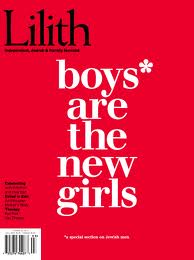
The role of men and boys in American Jewish life is a topic of growing concern – current research on boys available on BJPA ranges from Wishing For More: Jewish Boyhood, Identity and Community to “Bros” and “Ho’s” in Jewish Life Today.
Monday night, Moving Traditions, the organization that gave us the “Rosh Hodesh – It’s a Girl thing” program, unveiled a new program geared at teenage Jewish boys – along with a substantive report on Jewish American boys’ participation in American Judaism.
We are living in exciting times. There is no historical precedent for the problem of the disenfranchisement of boys in the religion of “Shelo asani isha” (the blessing traditionally recited by Jewish men, thanking God for not making them women). Certainly there is no shortage of men at the tops of Jewish structures, as the ongoing work of organizations like Advancing Women Professionals and the Jewish Community continues to document. But what does that avail us if we are bleeding boys from the bottom? (more…)
- 1 Comment
November 1, 2010 by Liz Lawler
Practice Makes Jewish
 Let me round out this story in a last navel-gazing post. In the aftermath of my conversion, I felt a big, “now what?” There is a sense that this is a pivotal moment; you have the opportunity and the burden to make good on all of these promises, these openings in yourself and your life. But I was in the odd position of having to define the notion of “secular conversion” for myself and for the little family that I had very recently created. No one bats an eyelash when a born Jew refers to him/her self as a “secular Jew.” But for me to say that… Well, this gives pause. And why the difference?
This gets us into uncomfortable territory. Because to talk about this, you also have to acknowledge that we (sometimes) still revert to thinking of Jews as a race, an ethnicity, a group of people defined not just by faith, but by some particular coding in their DNA. I can’t be a secular Jew because, well, I am not made up of the right genetic stuff. I don’t look Jewish enough to be a Jewish Atheist. (Are you wretchedly uncomfortable yet? Offended? Should we even be talking about this?) It’s nonsense, of course. Or, at the very least, it is problematic. The fact is, there are Ashkenazi Jews, Sephardic Jews, Ethiopian Jews, etc. Sometimes we sanitize the language by referring to Jews as a “nation.” But nations, by definition, have geographic borders, and in spite of Israel’s existence, Jews are still a diasporic people. Finding a coherent definition of “Jewishness” is a quixotic and nuanced process. (more…)
- No Comments
October 29, 2010 by admin
JFSJ's Call for Radical Empathy
 Tongues are wagging, per usual, about how this election season is unlike any we’ve seen before. And without having yet seen an October surprise, many of us are standing by for the next big thing. In the meantime, Jewish Funds for Justice is proud to have teamed up with Rabbi Sharon Brous of IKAR for something truly new, and creative, and inspiring, an antidote to the fear-mongering so prevalent these days. It’s a call for empathy. Radical empathy at that.
 Introducing Jewish Funds for Justice’s new video, “Al Tirah! Fear Not!,” featuring Rabbi Brous, one of only three women included in Newsweek’s 2010 list of “Fifty Most Influential Rabbis in America”— and starring two irresistible monsters, fear and empathy.
Learn more about JFSJ’s new campaign to combat fear and inspire engagement in the upcoming election. You can visit the Fear and Empathy monsters on Facebook, where they’re facing off! (You can even friend them!) And don’t miss this article.
-Erica Brody
Associate Director of Communications
Jewish Funds for Justice
- No Comments
October 26, 2010 by admin
Back Home in my New Home
 These past few months, I’ve been alternately migrating and nesting. We, my husband Yosef and I, taped up boxes, zipped up luggage and flew from the Middle East to the Northeast. From the crowded corridors of the shuk to the tight aisles of (the) Fairway. From Jerusalem’s alleys to New York’s avenues.
Yosef and I just got married in August, the day after Chelsea Clinton, in the Jersey synagogue where I grew up. Now, we’re both back in rabbinical school at JTS. I’m still playing with head-coverings (see my letter from Jerusalem for more on that) — a striped spandex wrap, a brown herringbone cap and the absence of accessories above. Here is some of my writing about coming into a new space and a new self:
Threshold
לֶךְ-לְךָ מֵאַרְצְךָ וּמִמּוֹלַדְתְּךָ וּמִבֵּית אָבִיךָ, אֶל-הָאָרֶץ, אֲשֶׁר אַרְאֶךָּ
Get going, from your land, from your birthplace,
from your parents’ home to the place I will show you. . .
“Hi Manny,” I say to the doorman. He and Yosef are standing under the scaffolding, talking about El Salvador and how fierce the soldiers are there. “You don’t want to mess with them cause they’re like.” (Manny slants his eyebrows and furrows his lips, in an imitation of the no-nonsense, no-negotiation stance of the soldiers of his homeland.) Manny tells me I have a package at the desk. (more…)
- No Comments