 Please wait...
The Lilith Blog
September 21, 2011 by Bonnie Beth Chernin
Rosh Hashanah Dishes of Wishes
 For the new year I’ll have a new congressman. He’s anti-choice and wants cuts that threaten our social welfare. That’s just the tip of the iceberg for Bob Turner, who won the special election for Anthony Weiner’s seat, which includes the New York City district where I live.
And that’s the kicker. One of the key reasons I put up with living in this exhilarating but exhausting city with its bad air, crowded subways, concrete backyards, constant sirens, and exorbitant expense is that this metropolis breeds acceptance of liberal ideas. That here I will find like-minded people who believe government exists to provide a safety net for our communities and public services that protect the most vulnerable among us. I trusted that I lived in a place where my elected representatives thought likewise. This is no longer true and residing in my part of Queens has now upped the ante for bearing life in this city.
As I turn to the new year of 5772, I draw sustenance from a Sephardic tradition that uses symbolic foods accompanied by prayers with wishes for the new year. Rabbi Jill Jacobs explains that many of the prayers incorporate Hebrew puns with the food mentioned. She encourages us to develop our own English puns as we prepare our Rosh Hashanah menu.
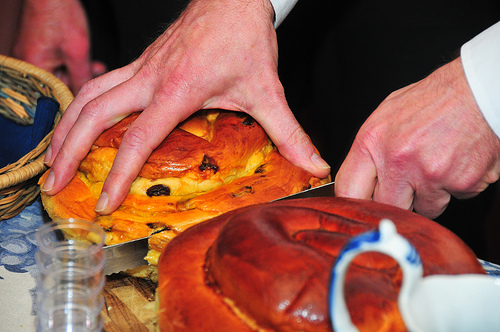
So for erev Rosh Hashanah when I am hosting guests for dinner, I decided to serve beet soup to “beet” the blues away that have followed this special election. I plan to get a raisin challah so I can start “raisin’” my energy for Obama’s 2012 election, and I will offer a small bowl of dates, to mark the date when redistricting starts in New York state and with it the loss of two congressional seats, one I hope in my neighborhood.
These are my dishes of wishes I look forward to serving.
May this year be filled with all you hope for in a world at peace. Shana Tova.
- No Comments
August 8, 2011 by Susan Weidman Schneider
Women Are Not Part of the Intergenerational Schism in Jewish Life
Cross-posted with eJewish Philanthropy.
 eJP has reported several times on the conflicts between emerging/ startup organizations/ courting the young vs Boomers/established brands/”legacy” organizations. Here’s other news: this tension does NOT come to the fore in the world of women. Women’s legacy organizations have often been funders of, supporters of, and horn-tooters for projects initiated by younger women activists.
I’ve been thinking about this as Lilith has been welcoming, enjoying – and benefiting from – our three extraordinary summer interns, who join a distinguished roster of 150 or so previous interns we’ve selected over the years. Lilith has been a kind of graduate program (underfunded, but still…) for young Jewish feminists, almost all of whom have gone on to do wonderful, innovative work in Jewish communities, and in journalism, around the globe. These young women have been nurtured, heard, and taken seriously around our conference table.
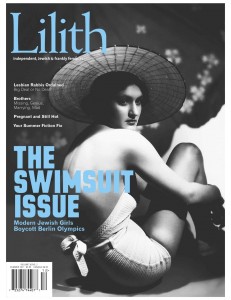
Many aspects of the new summer issue of Lilith reflect intergenerational connection, rather than conflict. The cover story focuses on young female athletes mentored by slightly older teammates. Other reports in this Lilith issue similarly reveal the power of intergenerational ties among women, even if those connections weren’t always immediately apparent.
Martin Buber once famously declared “all journeys have secret destinations of which the traveler is unaware.” One of the objectives of feminism is to cultivate a heightened awareness of where we’re headed – a raised consciousness about those destinations, even if the path’s map reveals itself after we’ve arrived.
How do we connect our own stories about life’s journeys – those revealing, shaping anecdotes, often told with studied casualness, about how we left our parents’ home, or ended up in the job we have now, or chose the partner we did – with the larger universe? One of the first tenets of the Women’s Liberation Movements was that the personal is the political. Every day, feminism teaches the alert among us that our quotidian choices have implications beyond ourselves.
This July, in Vienna, the Maccabiah Games were held for the first time in a European country that was once a Nazi stronghold. The particular pulses outward, implicating the general, with seemingly small episodes offering us larger observations. The Games gave us a chance to remember the connections among Jewish girl swimmers, some in their early teens, who became role models and role breakers in Vienna in the 1930s. They banded together and made excruciatingly difficult personal choices – including boycotting the 1936 Olympics in Hitler’s Berlin. Their star quality and their athletic prowess enabled them to escape the Nazis, rescuing their families, too. They couldn’t have known their destinations when they began to train in the Danube, but their courage and interdependency led a way out.
There’s another angle on female bodies in this issue, about women looking consciously sexy while pregnant. This is clearly a privileged preoccupation in an era when so many women, even here in the First World, don’t have access to family planning or prenatal health monitoring. Challenges to abortion rights now even include the criminalization of pregnancy in some states, where miscarriage can be read as murder. Jewish women’s legacy organizations like NCJW and Hadassah, have been outspoken supporters of the right to choose when and if to bear children.
Feminism says it’s time to reassess the judgments we make up and down the age spectrum. In the back-page memoir, a woman scrutinizes her bad behavior as a young mother, and how it feels to be on the grandmother end of things a generation later. A quiet recollection, it delivering a loud message about the ways we can open our eyes to the needs – and hear the unspoken desires – of older women.
And in good news, Amy Stone reports on what led to the ordination of the first lesbian rabbi to be out of the closet for her entire education at the Jewish Theological Seminary. Poignantly, Rabbi Rachel Isaacs chose as her rabbinic mentor Rabbi Carie Carter – a woman who, in order to become a Conservative rabbi, had to keep her sexual identity hidden for years.
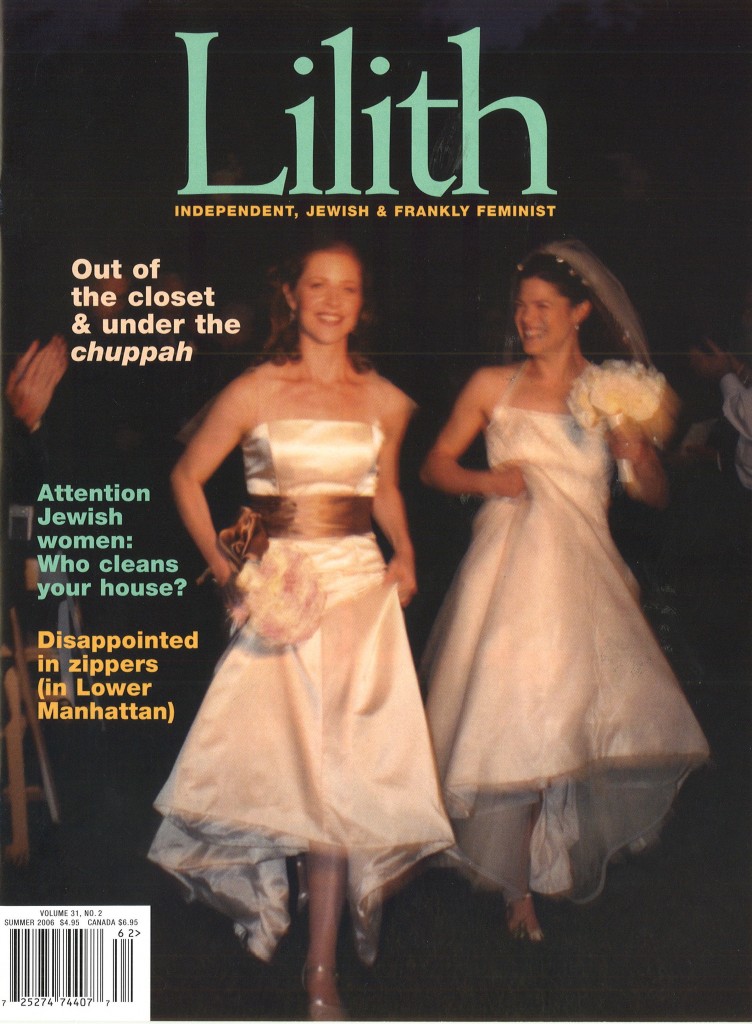 The late, great New York senator Bella Abzug once suggested that women carry stickers to affix to nonsexist ads, gender-neutral products and logos of corporations with a significant percentage of women on their boards, in order to affix to each example an announcement that “This Change Is Brought to You by Feminism.” I thought about Bella when New York State passed its groundbreaking legislation this summer ensuring the right of every gay and lesbian person to get married. (See Lilith’s archive of Jewish lesbian weddings.) Feminism built the scaffolding that enabled the changes at the seminary, the changes in the state, and the changes in our personal consciousness that make for tikkun olam, a better world.
- 2 Comments
August 2, 2011 by Liz Lawler
Mourning Leiby Kletzky
 I found out about Leiby Kletzky’s death when I was settling into a yoga class. The instructor dedicated the class to him, adding that he had been found, and that he was not alive. She cried a little, and moved along. I didn’t know I was holding my breath about this case until I heard that and exhaled. I live just miles from where this happened, so had seen the missing-child signs go up.
Something strange happens when you juxtapose grief with an intense physical experience. The mind can hollow you out with “what ifs.” So the body becomes a space of refuge. If you just follow your breath inward, you connect to a place where you can iron anguish out of your joints and sinews. Vinyasa flow classes are tough under the best of circumstances. Even for those of us who have put our time in on the mat. But try holding a five minute headstand with tears running across your forehead. That will teach you about equanimity in inversion, about using healthy fear to counterbalance an aching heart. The need to physicalize grief is powerful. As Jews we have K’riah, a small act of material destruction to speed catharsis. It lances the grief to the extent that such a small gesture can.
My favorite class is a darker shade of yoga, all squats and crouches, deep in the hip flexors, where you have to anchor to your pelvic floor to navigate the practice with any grace. This is not delicate, violet colored yoga, by any means. It reminds me that for all of the Shakti, there is Shiva. For each small delicate life, there will be a death. And it is reflected in my body. I feel vibrant after a strong practice, but the sides of my big toes have gone numb from years of picking up and jumping back (not me in video, btw). Even with all of the awareness that I have cultivated in certain areas of my body, some are going dark. The transaction does not yield a net gain. But those losses are tangible, calculable. Those losses are safer than facing the one that Leiby’s parents now have.
The Jewish story is one of physical exertion. The texts are full of runners and fighters, soldiers and slaves, men and angels lifting boulders, crossing desserts and dancing in times of joy. Physical pain is etched deeply in the narrative structure of this people; the physical scars match the emotional ones in their breadth and depth. Yet, these are people who carry on, both biblically and historically, in spite of physical duress. Abraham supposedly went out looking for guests shortly after circumcising himself. Job lost everything and still kept the faith. Biblical language often links emotional suffering and moral failings to specific body parts. There is talk of broken hearts, bones crushed as if by lions, etc. The body and the material world matter deeply in Judaism, they are evidence of the creative force that shapes us, and ground for discovery of self as an individual, but also in relationship to a larger communal whole. You are not just Jewish in your head and heart, but at the most basic cellular level, and then out again from that nucleus. Davening is an extension from that center, a pulsation. For it is not just a verbal recitation, it involves that rhythmic swaying and rocking. When I first saw it, to be perfectly frank, it reminded me of the self-soothing movement of autistic children, who often rock back and forth in place. But I think it just serves a similar purpose, a way to scratch a psycho-spiritual itch. My yoga practice is like that, rhythmic action, sometimes rote, sometimes frantic and breathless, but always an attempt to integrate body and spirit into some kind of vibrational whole. In spite of my sloppy spirituality, and semi-latent agnosticism, these stories still resonate with me. I feel sadness in the back of my throat and hovering around my temples.
This horrible thing happened in my town, and I imagine, horribly, my own child, disoriented and vulnerable, humbling himself to ask a stranger for help. I can catch the faintest aura of what Leiby’s family is experiencing, and it is blinding. So when I walked out of yoga, I had to wonder why no one else seemed upset. The city felt heartless and cold, and I felt alone. Then, a woman saw me crying on the F train, and, without a word of question, handed me a tissue. May we be able to extend that same compassion, many times over, to the family mauled by this murder.
- No Comments
July 26, 2011 by Sonia Isard
The Anxiety of Influence: Amy Winehouse and the Power of Pop
 Amy Winehouse made pop music into magic, into high art. She had a genius for rhythm, an uncanny ear for melody, and an extraordinary knowledge of how to take advantage of her matchless voice.
From the first time I heard Back to Black (2006), what grabbed me about Winehouse’s music was the richness of the production—she understood that the heart of great pop is the depth, the layering, of its sound. Because of her ability to build her music like the layers of an oil painting, every song on that album is drenched in the abundant influences of pop music history—from blues to rap to R&B to jazz. It’s not just that her music is beautiful, catchy, entertaining, ridiculously funny, chilling—her music is smart. As Sasha Frere-Jones writes, “She sounded like an original sixties soul star, developed when the landscape had no rules.”
The complexity of her identity—Jew, Brit, unabashed adorer of Black American music—was part of what gave her enigmatic presence so much power and so much productive tension. Her fearlessness in her music allowed her to play with nostalgia while fundamentally changing the face and direction of women’s blue-eyed soul (see: Adele, Duffy) and maybe popular music entirely.
Her death on Jul 23, 2011, was heart-breaking, and tragic, and horribly unsurprising. May her memory be for a blessing.
- No Comments
July 22, 2011 by Bonnie Beth Chernin
Judaica and the Good Find
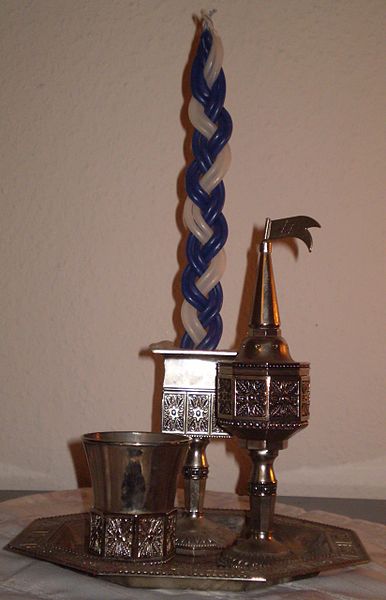 When I decided to stop at an outdoor flea market in Ocean County, New Jersey on the way to visit my parents in their retirement community, I recalled the pebbled blue havdalah spice box my mother had once rescued from entering an auction. The memory instinctively put me on alert for abandoned Judaica while I scoured folding tables full of old toy action figures, record albums, how-to-books, and discounted underwear still wrapped in plastic from a factory in Haiti.
In the late 70s, the father-in-law of my mother’s friend died. Janice asked my mother to look at the remnants of his house before the items were tagged for an auction sale.
“It’s time for them to go,” Janice said. “We’ve sold his house, now we need to get rid of his stuff.”
My mother was a veteran of flea markets during the 70s. She bought ruby red Depression glassware if it was priced under five dollars. She was also known to walk away from any table whose owner didn’t bargain. My mother had an eye for value. She would turn over a cup and saucer to check its set mark, and she could tell real Depression glass from an imitation. So when my mother came home and told me she had reviewed the acquisitions of an older man of means, I fully expected to see one or two things she brought back as a “good find.”
What she showed me was a blue havdalah spice box with a brass flag on top and matching candlesticks for Shabbat. Yet we had never said havdalah in our house, and my mother didn’t need any more Shabbat candlesticks.
“I couldn’t let this get sold at an auction,” she said.
I thought at the ripe age of 17, I would now need to start saying havdalah, the Saturday night prayer that says good-bye to Shabbat and ushers in a new week. I was wrong. We continued to light Sabbath candles on Friday night, offering a warm hello to Shabbat, but we did not match it with a fond farewell, despite the addition of the spice box. My mother’s rescue stopped short of change.
Although we did not incorporate havdalah into our weekends, the spice box and candlesticks remained with my mother through three moves over thirty years and has become an intrinsic part of her dining room display, front and center on her wall unit shelf.
As I walked among the tables, my mind filled with the memory of my mother’s rescue. I scanned each table for a stray kiddush cup, lone menorah, or other Jewish items that might need saving from relentless sun and forgotten purpose.
Nothing turned up, but I realized my search had embraced my mother’s spirit of seeking treasure in another’s trash: look out for a “good find”—and our heritage.
- 3 Comments
July 22, 2011 by Merissa Nathan Gerson
Jewish in Israel and America
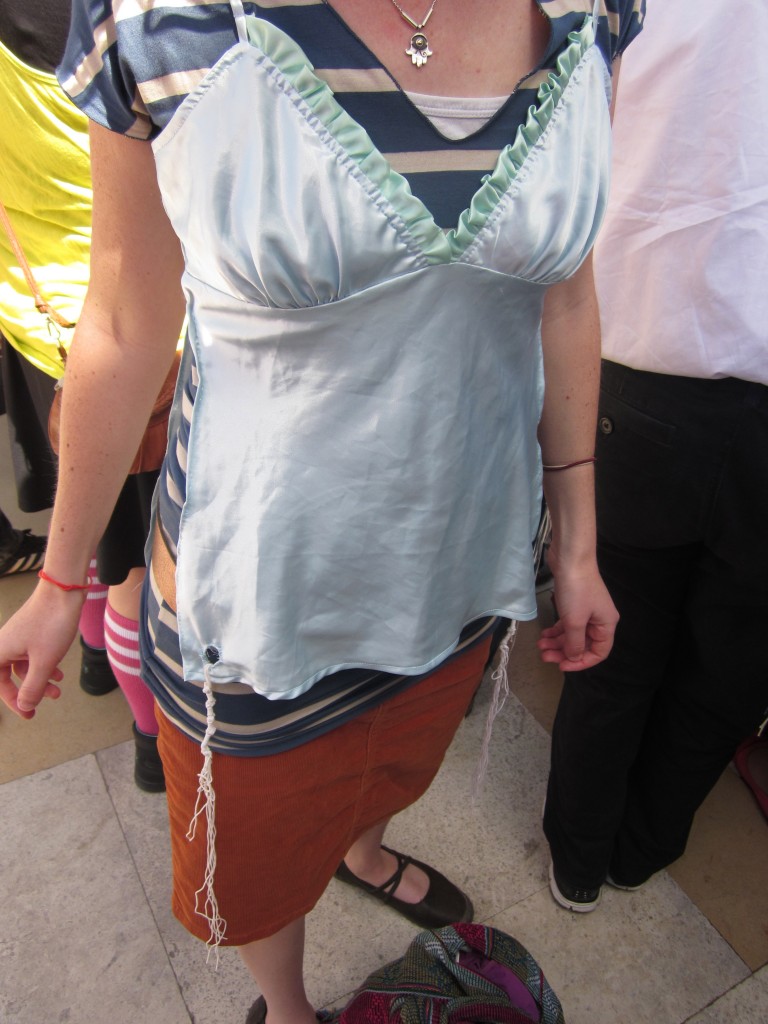 The difference between being Jewish in Israel and Jewish in America hinges on the perceiver. In Israel I was either the least or the most Jewish. Either I knew too many prayers, or too few. I was either the secular or the Orthodox, and once in a blue moon, rarely, I was simply Jewish, simply in synch, simply me.
In America, Jewish becomes a motivated act. I become an emissary. I come out of the woodworks so they will come out of the woodworks. I pray, so they will pray.
I went to a Hindu Ashram after Yeshiva to save my body. It was victim to the yeshiva ideal, a pale, thin hunchback, only the American version: weight gain and back pain. Yes, I left more knowledgeable, but no, my body did not thank me.
So, a yoga teacher training was my way of saving my back from a future of decay, and to make up for a full year on pause from a regular yoga practice. What this meant was a twenty-four hour flip of roles, of audience, of peers and compatriots. What this meant was that I had to resume my American role: spokesperson for Judaism.
At the ashram they made an exhausted point that all religions were welcome, even that all religions were “one.” This last argument left much to be desired as we chanted to Krishna before an idolatrous altar clad with a prominent photo of “Lord Jesus.” And on Fridays there was no acknowledgment of the Jewish Sabbath unless someone initiated it. This left me assuming my role as vocal Jewess, and provoked a deep murmur from within wondering why I ever left the Jewish homeland. (more…)
- No Comments
July 14, 2011 by admin
Being Ima on and off the Bima
Cross-posted with Ima (on and off) the Bima.
Last night, I noticed a tweet from Rabbi Jason Miller, sharing with me an article written on the Forward’s Sisterhood blog.
I read it at about 5am, while nursing the baby. A little ironic, no?
It struck me particularly hard, since I have had a little bit of a difficult week in terms of balance. Let me explain.

Note the camp attire (flip flops), baby sling, and tallit. Just another day as the ima on the bima...well, not so much bima at camp. More like tree stump!
I’m currently serving on faculty at camp, as you may know. With me at camp are my husband and three children (the oldest is a camper, so I’m not only not responsible for him, I don’t even get to see him very much!), and we are accompanied by a teenage babysitter. The babysitter generally shepherds the two older kids to their activities, while my dear husband spends his time with the baby. Often, the baby accompanies me to programming as well, since he likes very much to be the center of attention! Camp is a great place for my family – everyone has something that they enjoy doing, and we fall into a nice routine of sharing our lives with our friends at camp.
For various reasons, my husband kindly agreed to go along on a 3 day camping trip with one of the older units. He left early Monday morning. On Monday, my babysitter started to feel a little ill and began to run a fever…so she went home, ideally just overnight, to speed up her recuperation (she is fine and will be back soon, I hope!). So…I was left all alone with my kids AND my responsibilities to camp. So far, so good. I’ve weathered this minor storm, my friends have helped out and pitched in, and it’s been fine. I am definitely looking forward to both of them returning to share the work, but I am not overly upset about how this has gone. But it’s definitely on my mind, making sure that everyone gets what they need from me.
- No Comments
July 5, 2011 by Maya Bernstein
Failing Forward
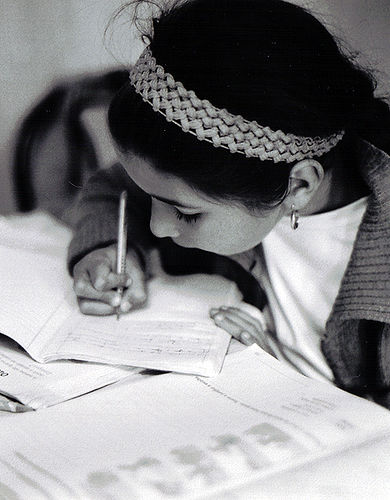 My daughter, in a post-kindergarten exuberant high, has been exercising her new reading and writing skills by creating “books” in her free time. She wrote one called “Zoo.” It was four computer-paper pages long, taped together. Page one had a picture of a horse, and, underneath, the word “horse.” Page two had a zebra, “zebra.” Page three a whale, “whale.”
Her next book showed remarkable progress. She titled it “The Magical Book,” and, in a nod to Magritte, flatly and surreally described her drawings. Page one pictures a magic wand and the words: “This is a wand.” Page two has a prancing unicorn and the description: “This is a unicorn,” and so on. Had she merely inserted the word “not,” her artwork would be hanging beside the famous pipe and hotly debated in bars nationwide.
I noticed a circle, outlined in black, colored in with a yellow highlighter, on the title page, and asked what it was. She smiled and said, “That’s the golden medal that great books get. I gave one to my book.” And so, I find myself in the wonderful position of being the parent of a Caldecott Medalist.
I was struck by her audacity. Of course, she didn’t realize it, but she was embracing advice given by conductor Benjamin Zander, conductor of the Boston Philharmonic, in his book “The Art of Possibility.” Zander, in an attempt to diffuse the extreme tension around grades in his New England Conservatory of Music class, began his classes by giving each student an “A.” The only requirement he gave them was that, at the end of the semester, they write him a letter explaining why they deserved that “A.” It removed the competition from amongst the students, took the focus away from grades and performance, and challenged students to function like “A” students throughout the semester, taking risks, pushing themselves, and dedicating themselves completely to learning and growing in the class.
That fluorescent yellow circle made me pause. What would happen if we gave our children the “A,” stamped them with medals, before they had done anything, and then challenged them to live up to it? Perhaps it would help them realize that our opinion of them did not depend on their performance? That the most nourishing rewards they can receive are internal? Best of all, might it help them fail forward – become more resilient as they inevitably fall, and realize that each time they do not succeed they can learn something, which will help them grow.
Perhaps we can even go so far as giving ourselves the “A,” as parents, and giving ourselves permission to take risks, to make mistakes, to fail forward as we raise these bright new lives, inevitably tripping along the way? I’m thinking of designing a button, and wearing it with pride at all times. Yes, I will make the wrong choices for my children. Yes, I will lose my cool. Yes, I will say the wrong things at the right times and the right things at the wrong times and pay for their first four years of therapy. But I’ll be wearing my medal. Which means that I’ll have tried my hardest. And I’ll strive not to repeat the same mistakes twice. And I’ll try not to take myself too seriously. And I’ll expect the best of myself at every moment, because I’m wearing that button, I’m a Caldecott Mom.
And then, finally, maybe we’ll be ready to abandon the stamps and the medals and the buttons and the grades altogether, and simply be, like my daughter whose Caldecott book is totally yesterday’s news (today she’s working on a story about a rainbow), striving always to grow, to be our best selves, and, each day, begin anew.
- No Comments
June 29, 2011 by Amy Stone
Today we’re all gay…
Today we’re all gay…
 Yes, yes, we’re still in the afterglow. The dinosaurs of Albany, more known for corruption and dysfunction, have stunned and delighted us by making same-sex marriage legal in the Empire State.
The 33-to-29 victory in the State Senate came from Governor Andrew Cuomo’s determination to give gays civil rights – pulled off with strict Democrat party discipline and inducements by mega-wealthy Republican supporters to get a few Republicans to break rank and vote for gay marriage.
The road to gay marriage was rocky – but no rockier than Conservative Judaism’s fraught path in finally deciding to allow same-sex commitment ceremonies.
The split vote in Albany was similar to the split in Conservative Judaism’s law committee. In two opposing responses to Jewish law before the law committee, 13 to 12 voted in favor of the response allowing gay commitment ceremonies (along with gay rabbis and cantors) and 13 to 12 voted for an opposing response (one rabbi voted both ways). Part of the rabbinic reasoning favoring gay marriage was that Judaism does not advocate celibacy over loving relations.
When a sampling of Conservative Jews was polled back in 2007, a majority, like the recent poll of Americans, favored letting gays publicly avow their love. The more than 5,000 Conservative Jews who responded were fine on gay marriage and gay clergy but – traditional in some respects – a majority opposed rabbis performing marriage ceremonies uniting a Jew (straight or gay) with a non-Jew. So… gates open for Jewish gays and lesbians to be joined by a rabbi (gay or straight) in the interest of family values.
As for the Albanyians – not even the dysfunctional state legislature can pass a law coming down firmly on both sides so thank you Governor Cuomo for pushing this civil rights issue into law. But in a move that Conservative rabbis might appreciate, a few pivotal paragraphs in the bill helped swing the vote by protecting religious institutions from law suits and government penalties if they refuse to perform same-sex marriages. Reads like a page from the Conservative law committee decision.
Happy ending in New York: now Conservative Judaism’s Conservative rabbis who feel comfortable with gay commitment can perform both the religious ceremony and, with the powers invested in them by the State of New York, legally unite gay and lesbian couples.
Amen.
- 1 Comment
June 27, 2011 by Merissa Nathan Gerson
Ashram
 On a break from a Hindu Ashram in the Catskills I stopped into Wal-Mart. Yes, Wal-Mart in the mountains of New York happens to, in addition to an odd myriad of all types of strange people, house the Chasidic population on summer vacation from Brooklyn. Amidst a sea of Indian gods and goddesses, a frum woman is a bigger comfort than you could possibly imagine.
I eyeballed the peyas and the head coverings from afar and then got in line behind a lovely Jewess. She looked into my eyes, hers full of G-d, and she said gently, softly, “This lane is closed, I am the last customer.” My Colombian friend walked up a minute later and intending to translate into Spanish, I blurted out a quick Hebrew explanation of the situation. Then I looked at the woman, a flash of eyes again, and muttered, “I was just in Israel, things get lost in translation,” and scuffled off.
Yesterday during Yoga class we were doing upside-down Asanas and a male teacher stammered, “This pose will prevent varicose veins,” and then nervously tiptoed away. An awkward phrase, a verbal bomb dropped. He wanted me to know that hanging out upside down would keep my thighs supple, and I wanted this Jewish woman to know that I was a tribe’s member just returning from the mother ship, Jerusalem.
We drove back to the Ashram when we left the superstore. My compatriots were two women, one nineteen and Indian American, the other eighteen, fierce, and Colombian. We talked after that about what happened in the store, about my intense love for the mere sight of Chasids, and about how strange, even scary, some of the Americans in Wal-Mart really looked to me. It wasn’t that I hated them, or even thought they were ugly. It was something beyond that, something in their eyes, some mark of the unrecognizable that left me full of fear.
Meanwhile, back in Jerusalem, even the most bizarre, most horrific, most awkward human is recognizable within the small rubric that Jews, Non-Jews, Christians, devotional hippies and the secular offer. Every identity marker is measurable by the individual’s relationship to G-d, or lack thereof.
Nothing, bar the jets in the sky, the bombs at bus stations, the borders as warzones is scary, that is, nothing basic within the nation itself provokes any fear. I missed American diversity in Israel; I missed seeing multiple cultures and languages interacting in odd places like Wal-Mart. And then, at Wal-Mart, amongst people from all nations united under what looked like American poverty, I simply and purely missed Israel. (more…)
- 1 Comment