 Please wait...
The Lilith Blog
October 17, 2011 by Maya Bernstein
The Train: New Poetry
Each week, I travel to and from work by train. My children cling to my legs and wave their arms and shout farewells, as I board my bike and pedal towards the train station, feeling a tight-throated yearning for their sweet presence, and a gravitational pull towards freedom, possibility, self. The train has become a powerful metaphor for my life. As soon as I board, I am acutely aware that I have made a decision and put myself in motion, and then, of a sudden, am not in control, am barreling toward a destination, watching the world beyond the window, wondering. It has become a space of poetry, a liminal space of possibility, and, in its own way, a space of prayer. Below are two poems I wrote during the month of Ellul and the period of the High Holy Days.
- No Comments
October 17, 2011 by Sonia Isard
What's the Impact of Praying in Public?
 Forward editor Jane Eisner’s incisive commentary on Occupy Judaism: She says Kol Nidre at OWS marked “a small but significant turning point for both Jews and progressive causes, a sign of arrival for Jews and a return to the historic place that religion played in the public face of progressive activism.” I’m also interested in (and more ambivalent about) the public face of progressive Judaism — how does the meaning of Jewish practice change when the deeply moving yet sort of raw and untamed Kol Nidre liturgy rings out across Zuccotti Park?
- No Comments
October 12, 2011 by Amy Stone
Kol Nidre Alongside Occupy Wall Street
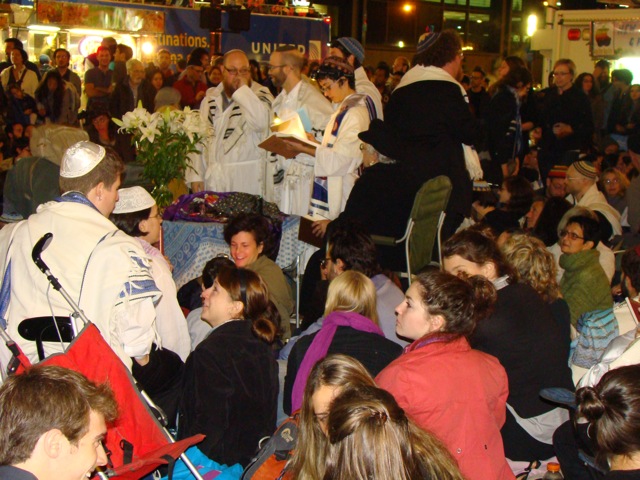
Photo by Amy Stone
You’ve got to be attracted to a call to a Yom Kippur service next to the Occupy Wall Street protesters, especially when the Facebook invite starts with a quote from Rabbi Abraham Joshua Heschel:
“Prayer is meaningless unless it is subversive, unless it seeks to overthrow and to ruin the pyramids of callousness, hatred, opportunism, falsehoods.”
The weather and the police cooperated, and at Friday’s Shabbat Kol Nidre, a crowd estimated at 700 gathered next to Zuccotti Park (aka Liberty Plaza), OWS home base a few blocks from Wall Street.
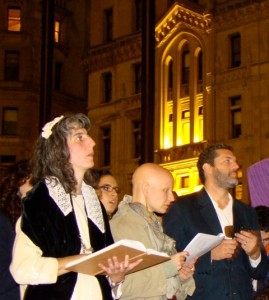
Photo by Amy Stone
The impassioned and knowledgeable leaders (one woman, several men) conducted the egalitarian service using the new Conservative high holiday prayer book, with 100 copies lent by the Rabbinical Assembly (the organization of Conservative rabbis) and numerous photo copies. The service took place on the plaza in front of global financial services firm Brown Brothers Harriman. A large Bank of America presence on one side, smoothie and halal trucks on another, just beside Zuccotti Park. It felt like davening next to the circus with the constant drumming of the OWS musicians.
Same for the Yom Kippur sermon of Getzel Davis, a fourth year rabbinical student at the “transdenominational” Hebrew College outside Boston. Davis opened up with the myth that Yom Kippur is the day we’re forgiven for worshipping the golden calf. Nothing like absorbing the message of a sermon by all assembled repeating every word. (more…)
- 3 Comments
October 11, 2011 by Sonia Isard
Paint Yourself Out
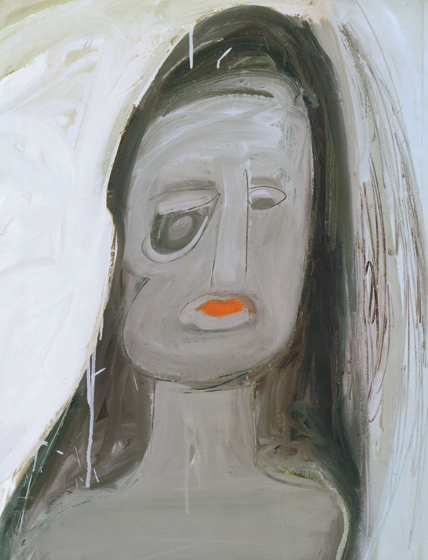
Eva Hesse, No Title (detail), 1960. http://www.brooklynmuseum.org
“The hell with them all. Paint yourself out, through and through, it will come by you alone. You must come to terms with your own work not with any other being.” You tell ’em! Read this excellent piece about the new Eva Hesse exhibit (and about her family’s escape from Europe in 1938), and then go right away to see the show at the Brooklyn Museum.
- No Comments
October 4, 2011 by Sonia Isard
Lilith Intern Takes the Stage!
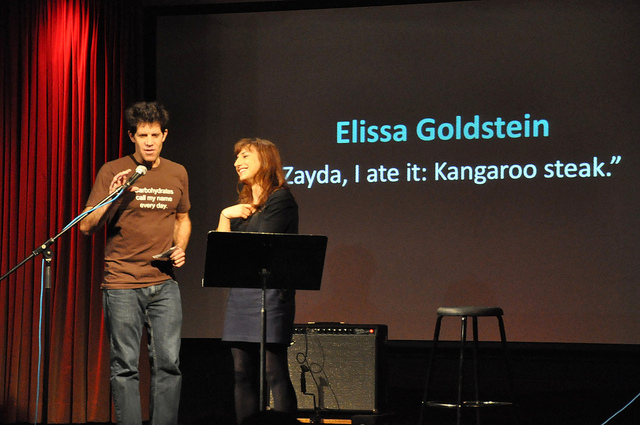
92YTribeca
Elissa Goldstein emerged victorious! Her six-word story was a winner at the recent Jewish memoir competition run by Tablet magazine and Smith magazine. See below for more pics from the occasion, which also featured Deborah Copaken Kogan and Walter Mosley! Congratulations, Elissa!
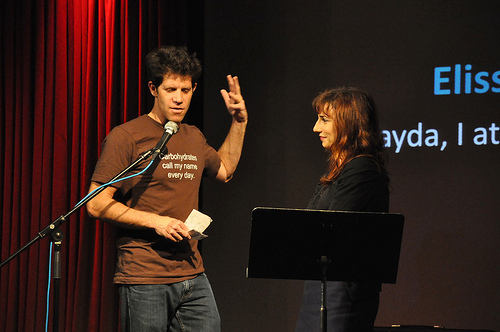
92YTribeca
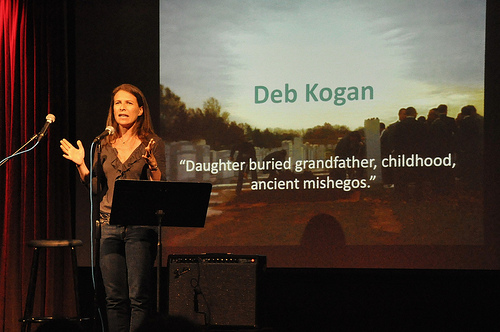
92YTribeca
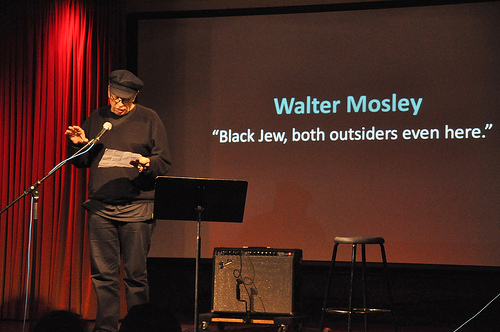
92YTribeca
- No Comments
October 3, 2011 by Susan Weidman Schneider
Are Jewish Sororities an Untapped Opportunity?
Cross-posted with eJewish Philanthropy.
 I’ve been revisiting a 1997 article in Lilith entitled “Jewish Latency,” featured on the cover as “The Jews We Lose.” It’s all about a project Lilith created with the help of a grant from New York UJA-Federation to engage New York Jews in their 20s, just out of college, who found no niche in the Jewish world after having felt very empowered in their campus years.
David Cygielman, CEO of Moishe House, writing in eJP earlier this month declared that the Jewish community too often thinks of people this age as tools for solving “problems” in Jewish life; he noted that this approach “places young adults as unknowing subjects in an experiment they never signed up for.”
But ownership is the key to engaging this cohort, concluded that Lilith article.
The project the “Jewish Latency” article described started out as an idea germinated by Lilith interns, who’d been rebuffed when they approached several Manhattan synagogues wanting seats for the High Holy Days. (This was in an era predating the wonderful services offered by Rabbi Judith Hauptman and others expressly for Jews in their 20s and 30s.) Under Lilith’s mentoring, our interns and their friends decided to create their own Jewish experiences.
Themsleves just out of college, this cohort realized that in addition to finding again the kinds of Jewish leadership opportunities they’d had on campus, they wanted autonomy and agency. They wanted to own what they were willing to invest themselves in creating. The Lilith staff suggested catered Shabbat dinners. Unh unh. Instead, they did DIY potluck vegetarian. We suggested Passover programming. Instead, they hosted a baked-potato third-night seder, announcing that baked potatoes met everyone’s standards of observance. We suggested that the project be called VOICES, an acronym for I-can’t-even-remember-what. The participants renamed themselves “A Tribe Called Jews.” You get the idea.
A Tribe Called Jews came to my mind again this month as I was editing an article on Jewish sororities for Lilith’s fall issue. Lilith is now marking its 35th anniversary, and despite the huge range of subjects the magazine has covered, we’ve never before reported on Jewish women in the Greek system. It turns out that like those Jewish activists – male and female – who germinated A Tribe Called Jews, many young Jewish women in sororities feel empowered in their campus roles, then feel they’ve fallen off the Jewish map after they graduate.
The author of the forthcoming article, Shira Kohn of the Jewish Theological Seminary, spent a decade and a Ph.D. dissertation exploring what goes on in Jewish sororities. She suggests that the organized Jewish community is missing an opportunity to keep these women connected once their college years are behind them. (Here’s an advance look at the article)
Some of Kohn’s insights took me by surprise. Much of what I perceive about sororities is derived from their less-than-flattering images in popular culture. In some circles, every Jewish sorority woman falls under the shadow of the dreadful, evergreen JAP stereotype, as we discovered when Lilith ran a brief report on a newer iteration of this slur – the phenomenon of “Coasties.”
In reality, many sorority members carry out a range of Jewish social-service projects which Kohn’s duly notes. Their campus experiences – for some, a crash course in competency and community leadership – prepare them to assume roles in the wider Jewish world once they’re living out in that universe. But is anyone recruiting these young educated women? Are Jewish women’s organizations and Jewish social justice organizations flooding campuses with suggestions as to how they can stay connected and engaged after graduation? Hardly at all.
- No Comments
September 28, 2011 by Barbara Gingold
Vivian Silver: An Anglo in Israel
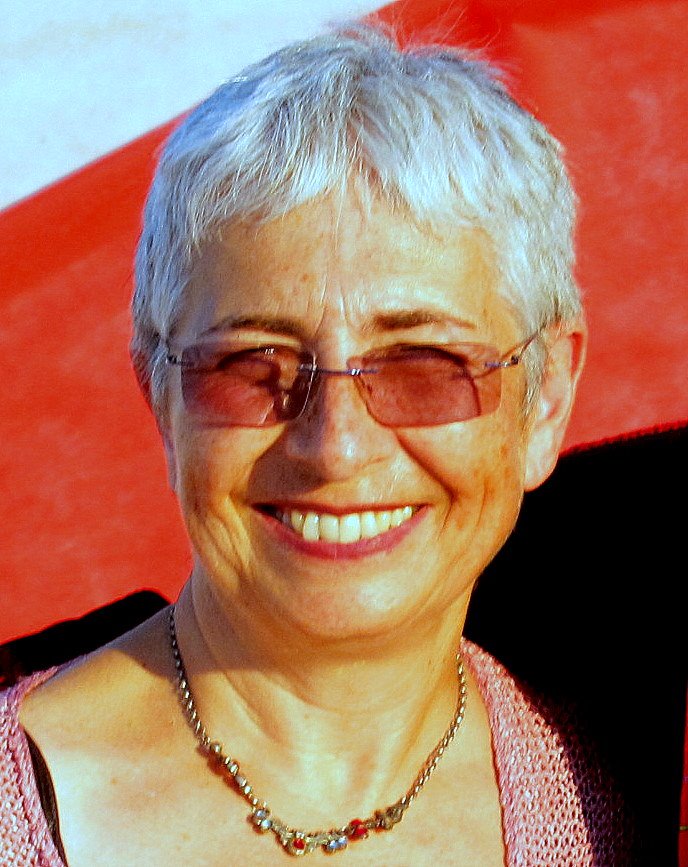 Usually operating modestly behind the scenes, Vivian Silver is making headlines this year. A native of Winnipeg, she moved to Israel in 1974 as a member of the newly reestablished Kibbutz Gezer, where she became one of the few women who had ever served as kibbutz secretary. As an activist in the Jewish “student revolution” of the late 1960s and early 70s, she confronted head-on the glaring women’s issues in Israel and the ever-widening discrepancies between the lives of its Jewish and Arab citizens. Making these the subject of her professional life, she founded the United Kibbutz Movement’s Department to Advance Gender Equality and joined the Knesset sub-committee for the Advancement of Women in Work and the Economy.
When she moved to Kibbutz Be’eri, Vivian came face to face with Bedouin society in the Negev — a community virtually in her front yard living, in large numbers, in third-world conditions. “They could have been subsisting in poverty-stricken villages in India or Africa,” she recalls. Moved to 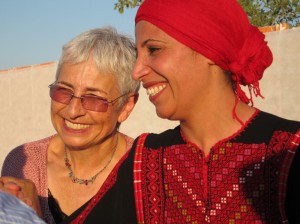 action, she became executive director of the Negev Institute of Strategies of Peace and Development (NISPED), a non-profit dedicated to peace building and sustainable development through people-to-people peace processes.. Through AJEEC, NISPED’s Arab-Jewish Center for Equality, Empowerment and Cooperation, Vivian and her co-director, Amal Elsana Alh’jooj, have literally affected the daily lives of thousands of people — chief among them Bedouin women, who with AJEEC’s help have been making extraordinary leaps of educational, economic and political empowerment.
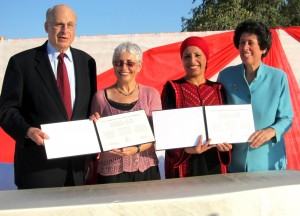 Last June, in a huge tent in the Bedouin town of Rahat, Vivian Silver and Amal Elsana Alh’jooj were the first pair of women to be granted the prestigious Victor J. Goldberg Prize for Peace in the Middle East, which is awarded annually by the Institute of International Education (IIE) for outstanding joint work by an Arab and an Israel to advance the cause of peace. And today, on the eve of Rosh Hashana, 5772, Israel’s leading newspaper, Ha’aretz, chose Vivian Silver as one of “the year’s 10 most influential Anglo immigrants,” noting that: “While Bedouin leaders fume at the government’s recent decision to relocate tens of thousands of their brethren from unrecognized villages in the south into communities with an official status,” Vivian Silver and NISPED help to build bridges in the Negev between Bedouin and Jewish communities — neighbors and co-fighters in the struggle for equality and peace.
Stay tuned for an article about the work of Vivian Silver and Amal Elsana Alh’jooj in a forthcoming issue of LILITH.
-Barbara Gingold
- 1 Comment
September 26, 2011 by admin
Sneak Peek! A Reconsideration of Jewish Sororities

Remember the opening scene of Legally Blonde? Or the Saturday Night Live salutation “Delta, Delta, Delta, can I help ya, help ya, help ya?” To many observers, sororities look like the embodiment of values you’d love to hate – elitism, conformity, traditionalism, and perhaps even “inauthentic” or “superficial” expressions of Jewish identity. Cinematic representations aside, there’s an alternative narrative. Here’s a tip: watch for a hidden proto-feminist agenda in Jewish sorority life. Read the rest here!
- 2 Comments
September 23, 2011 by Merissa Nathan Gerson
America is wonderful during the week
 “America is wonderful during the week, but painful on Shabbat.” This is what my friend Malika wrote me after her first Shabbat back in America. I am a Shabbat nut. I love everything about it, the slowness, the meals, the niggunim. I love remembering my grandmother and finding my people and feeling part of something beyond me, above me, something huge that might carry my entire week to come towards peace.
But Shabbat, this version of intense, gung ho Shabbat is harder to come by in the secular world. At yeshiva in Jerusalem I was the odd one, the resister, the girl who in America was always finding a way to light candles, and in Israel was always desperate to break a biblical law. Over time my resistance subsided and I submitted, full throttle, to the systems that bind. I went to synagogue, I cooked Kosher, I turned off my computer, I walked everywhere, made a dish for the first, second, and sometimes third meal. I did Havdalah when I could, knew the portion of the week, sang loud Jewish songs into the night.
They were horrible, all of those rules, until they became romantic. Obligation, when unable to submit, was torture. And when I submit to the order of Modern Orthodoxy, the obligation became a sweet pleasure. There was a city cloaked in silence, a collective thrust towards peace, a sense of community that drove itself through every obscure Jewish corner. They said jump, so I jumped. And it was that simple. I was a good girl if I followed. But when resisting or unable to adhere I was met with internal and external conflict. There was a psychiatric twist to everything, moments upon moments upon moments where I felt like a sinner when I could not adhere to Jewish law. But the moments I didn’t “sin,” were priceless.
Back in America Shabbat is a whole different story. I long for that system, the checks and balances that a community of observers creates. I miss cleaning on Fridays and shopping for fresh Challah and groceries at the Shuk. I miss potluck dinners with close observant friends and I miss ecstatic prayer and long night walks in carless streets. It was not the law that got me going, as much as a community following the law, friendship and collective an incentive to piety. (more…)
- No Comments
September 22, 2011 by Amy Stone
Out and Ordained – An Update
 Before updating Lilith readers on the story “Out and Ordained,” in Lilith’s current issue, a few corrections to the published piece:
–While Rachel Isaacs is the first openly gay rabbinical student to be ordained by the Jewish Theological Seminary, the seminary’s first openly gay rabbinical student is Aaron Weininger. He entered as a first-year rabbinical student in the fall of 2007. Isaacs entered as a third-year student in 2008.
–Rabbinical School Dean Rabbi Daniel Nevins’ comment that gay and lesbians number no more than “a good minyan” referred to the JTS Rabbinical School, not to the Conservative rabbinate as a whole.
–American Jewish University is an independent institution not affiliated with any one branch of Judaism, although the Ziegler School of Rabbinic Studies, housed within AJU, is Conservative.
As fate would have it, New York State’s legalizing same-sex marriage came shortly after the Jewish Theological Seminary’s ordination of its first openly gay rabbinical student – putting New York’s Conservative rabbis on the line on performing gay and lesbian marriages.
The 2006 Conservative movement law committee responsum allowing gay/lesbian rabbis and cantors within Conservative Judaism also permits Conservative rabbis to perform same-sex commitment ceremonies – if they want to. Proof that homophobia is alive and well, The New York Times article on Conservative rabbis featured one New York rabbi as shamelessly saying he’s never performed a same-sex marriage in his nearly 40 years in the pulpit and is not about to start now. Overtly sexist and racist actions are now taboo, not to mention illegal, but homophobic leaders can still exercise their prejudices.
A measure of the homophobic atmosphere within the Jewish Theological Seminary and beyond during the Conservative movement law committee’s 1991-92 hearings on homosexuality is the 1992 responsum clause against “instigating witch hunts” authored by Rabbi Elliot Dorff, AJU rector and current chairman of the law committee. Meant to protect gays as part of the responsum forbidding homosexual rabbis, Dorff said he “came to regret it – a lot.” He explained the wording was meant as “a flourish” to avoid “any kind of super investigative commission,” but the result was that gay and lesbian rabbinical students and rabbis were the victims of witch hunts instigated by outsiders. (more…)
- 4 Comments