 Please wait...
The Lilith Blog
December 22, 2011 by Bonnie Beth Chernin
Menorahs I Have Known
http://www.flickr.com/bontempscharly
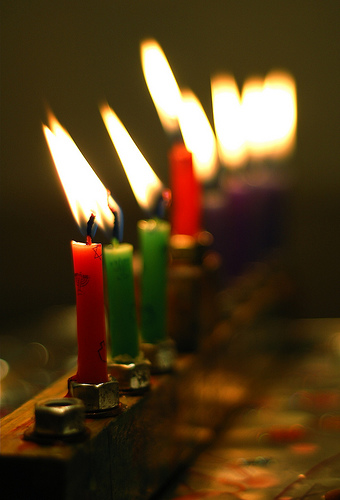
I had only one menorah in my life for my first 18 years. The blue chanukiah with brass candle holders in the shape of simple lamps that belonged to my parents. I don’t know how they came to own this menorah, but I welcomed its reliable appearance that marked our holiday tradition as much as my father’s latkes and my grandmother’s five dollar checks to all of us grandchildren.
But more menorahs have come into my life as I’ve moved through the stages of being a single adult, followed by marriage and motherhood.
A graceful pewter menorah, with purple glass at the base where the candle holders branched out, reminded me of my mother when I began celebrating Chanukah in my own apartment. I fell in love with the menorah at a local Judaica store. My mother adored glass, the lure of light seen in its reflection. When I saw the flickering candles shining in the menorah’s smooth purple disk, it brought back the insight into wonder my mother had shared with me.
That menorah was set aside the first year of my marriage when my husband brought his own, made of stone and lit with oil. Since for years I had faithfully used the blue square box of multicolored candles to bring light into December darkness, I was intrigued to use a menorah that featured a different lighting technique.
- 1 Comment
December 19, 2011 by Julie Sugar
Immerse and Emerge: Revisiting the Mikvah

http://www.flickr.com/rose770
A new year is approaching, and winter is settling in. As we prepare to jump into 2012, and think about what sort of resolutions we will be making, I can’t help but reflect on how the Jewish year began a few months ago, and the specific blessings I sent to myself then—while underwater in a mikvah in Crown Heights, Brooklyn.
When I was married, I struggled with going to the mikvah. I struggled with having the mikvah attendant watch me immerse in the waters of the ritual bath and then deem me kosher. (I realize that she was declaring my dips into the water kosher, and not my actual self, but having someone sing-song “kosher!” over you blurs the lines of how the experience feels.) Why did an outside institution, and another human being, get to have a say in the cycle of my most personal relationship? I resisted the structure. I often wished that I had access to a lake, where I could quietly go by myself under the moonlight, or I half-jokingly wondered if I could just take a really long bath at home.
This particular struggle was over—and others began—when my husband and I split up over the summer. Right before Rosh Hashanah, I received the get, the Jewish bill of divorce. I barely observed Rosh Hashanah this year; I had a meal with a friend with honey and figs on the table; I bought a ticket in advance but didn’t go to shul. I napped, a lot. I felt guilty and thrilled and guilty I felt thrilled.
- 3 Comments
December 15, 2011 by Maya Bernstein
Shine
Hashomer Hatzair Archives Yad Yaari
My oldest daughter recently performed in her kindergarten’s annual Thanksgiving Extravaganza. What is it about watching your kid in a school performance that turns a parent into dripping, slobbering mush? There is something so visceral about seeing your kid “up there,” shirt tucked in, braids in place, belting out songs and moving like a turkey and reciting her two lines. As the child stands there, hands stiff at her side, telling the i-phoned face audience of grandparents and parents and siblings, “our next song is ‘Run Turkey Run,’” the parent has a moment of meaning and purpose. I have made a difference in the world. My child is doing something; she is active, she is a participant, she is a contributor. It is invaluable to see your child represent something greater than herself, participate in creating meaning with others, and share that meaning with her world. That is where children shine, and that, in turn, re-connects their parents to what is valuable and important in their lives.
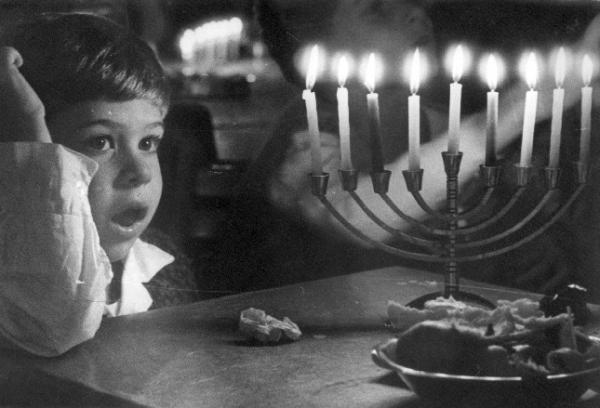
The winter holiday season is upon us, and it is an opportunity to shine. Chanukah, probably the most celebrated and public of all Jewish holidays, has two core components to its celebration. The first is lighting Chanukah candles, one candle on the first night, two on the second, three on the third, increasing the light and the candles until eight burn bright on the last night. The second, as important as the first, is publicizing the celebration of the holiday. That is why it is customary to light candles in the windows or doorframes, so that passer-bys can see, and say, “Look! The lights of Chanukah!” As we remind ourselves as a Jewish community of our story of survival, we share that story with others.
- 1 Comment
December 4, 2011 by Maya Bernstein
Farmer’s Market
http://www.flickr.com/pollyann
It happened, and then it was over.
There was nothing much to talk about, and I have mostly forgotten the details. The images are somehow fuzzy, remembered in strange slow motion, as if I am still distracted, surprised that I am in the center of the memory, rather than standing on the side, looking in.
It was a cloudy gray Sunday, late morning. I was in my Super-Mom role; my husband was at the library drinking coffee and reading educational philosophy (on Sundays, he assumes his Super-PhD-Man role), and I was in the park, with our three kids, and my cousin’s two daughters. When my cousin dropped off his girls, his nine year old ran off with my three year old, who promptly fell and skinned her knee and started crying; his seven year old ran off with my six year old, who fell off her scooter and started crying; and the baby started screaming for the swing. My cousin gave me a look. I smiled my Super-Mom smile, answering his unspoken ‘are you sure you can handle this’ question, told my girls to tough it out, and carried the baby over to the swing. And I was fine, and so were the kids, as long as I didn’t think too much about what could happen. I let the girls climb and swing high and jump off and pushed the “what-ifs” aside, because otherwise my husband couldn’t ever work on his PhD, and my cousin’s kids couldn’t slip seamlessly into our family, and that wasn’t the family I wanted.
- 4 Comments
November 17, 2011 by Tara Bognar
Gangs of Meah She’arim
http://www.flickr.com/38440152@N06
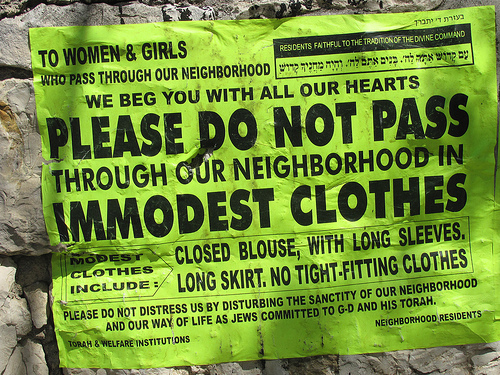
Last week, a Meah She’arim gang that calls itself the Sikrikim assaulted a small group of Haredi girls, yelling and spitting at them for not being quite modestly dressed enough. (Helpfully, Yeshiva World lets us know that the “females” were appropriately dressed and thus, “the attack was without provocation and without justification.”)
A couple of hours later, relatives of the girls returned to the scene and beat up the young men responsible for the harassment. It turned into a brawl involving dozens of people.
Earlier this year, at the end of Sukkot, the Sikrikim glued shut the door of Gerrer Rebbe David Alter to prevent him from leaving the house for services. In retaliation, a group of Gerrer Hasidim boys and men chased down a Sikrikim leader and beat him bloody.
The Sikrikim named themselves after the Sicarii, an ancient Jewish guerilla organization that sought Jewish independence from the Romans and service to God alone, mostly by committing violence against fellow Jews that it perceived as collaborators. The media coverage I’ve seen (mainly English language orthodox and ultra-orthodox blogs), describes the modern-day Sikrikim as an independent group of somewhere between 20-100 young men.
- 1 Comment
November 15, 2011 by Merissa Nathan Gerson
A-Salaam Alaykoum
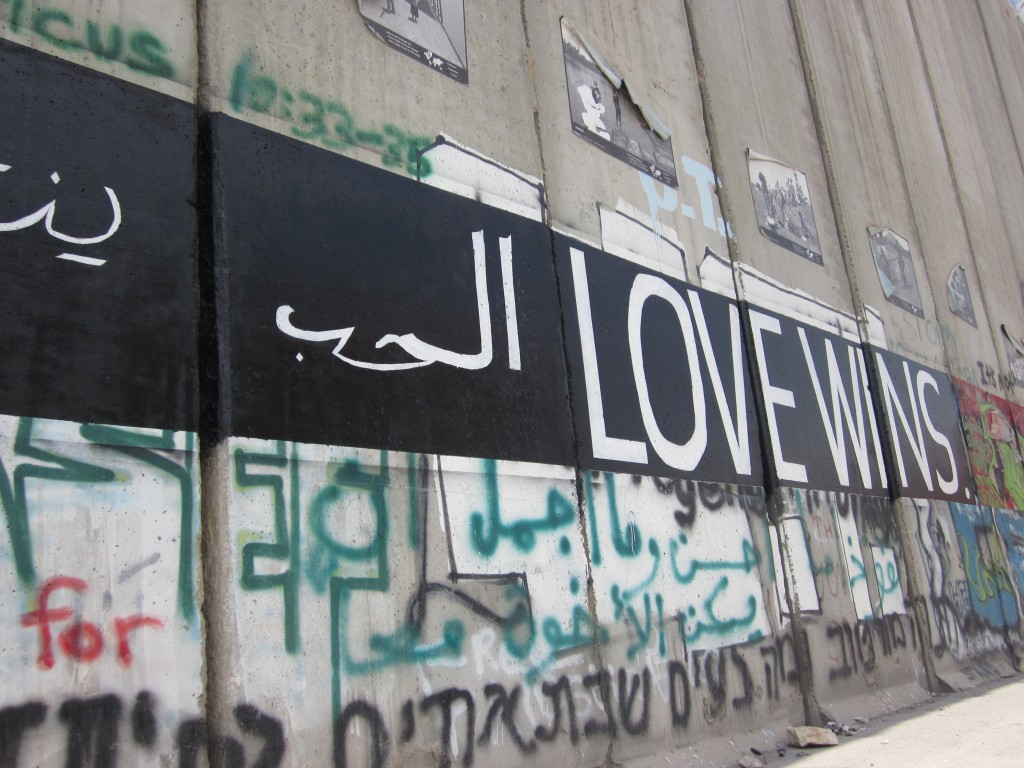 Somewhere between San Francisco and Berkeley I developed a craving for hummus. Not hippie grocery hummus, not coffee shop hummus, not deli hummus but hummus, the real deal. I took a gamble with a Google search on my cell phone and followed it far down San Pablo Avenue all the way to a small place called Zaki Kabob House.
Zaki, of course, was closed upon arrival. I stood outside a bit annoyed and a bit frustrated and then decided to go in anyway, pushed the door, and I was quickly inside the closed restaurant. A young woman in a hair net came out and I said, defeated, “You are closed, aren’t you?” And she answered a curt, “yes.” And then another woman appeared, a beautiful woman in her late 50’s with a full head scarf and warm hazel eyes.
I told her I knew they were closed, but maybe I could just buy some hummus? I smiled and she looked at me like I was her own daughter and said, “of course.”
“You know,” she said, “you look just like my niece. You even talk like her.”
I said, “I miss my mother, I want her hummus.” She said, “Where are you from?” and I answered a hesitant, “I am Jewish.” It went on from there, about my mother’s food and its complex relationship to Jerusalem, to Lebanese food, to food of all walks but for certain, hummus, the homemade, tahini-thick real deal.
She shared with me that she had just come from Jerusalem. “We call it Palestine, you call it Israel.” There was a very un-American recognition of Jewish agency in the equation. “It is G-d’s land,” she said, “When we all die it returns to G-d, it does not belong to anyone.” She had come from East Jerusalem and I said I had never been there, only to Bethlehem, shaking my head at the sadness of that place. “Is it as bad as Bethlehem,” I asked? “No,” she answered, “there is life in East Jerusalem. You can breathe.”
- 1 Comment
November 15, 2011 by admin
Riding the Buses in Jerusalem
Cross-posted with The NCJW Insider.
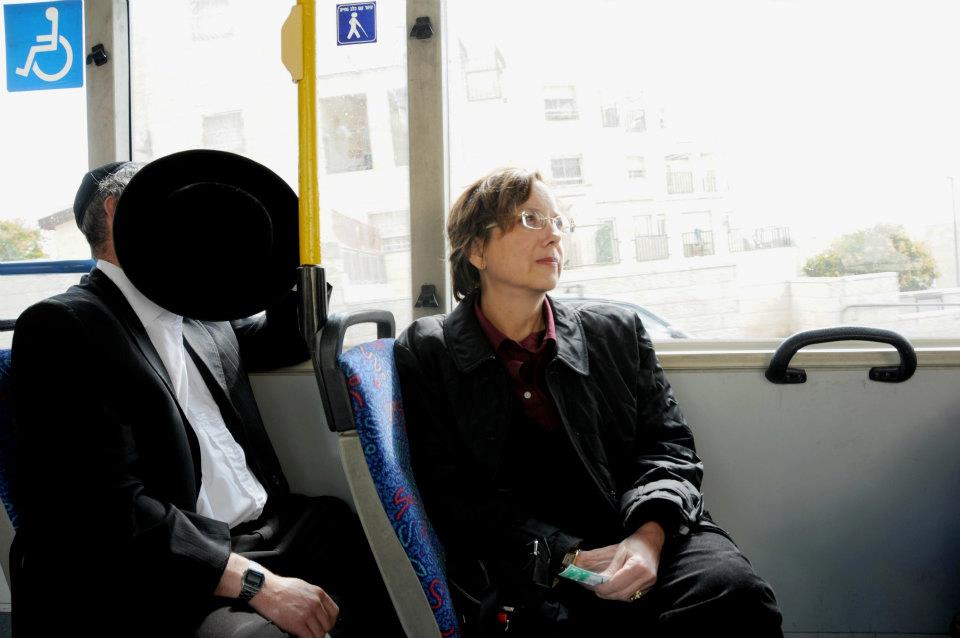
Photo Courtesy of NCJW
I am writing from Jerusalem where I am on a study tour with 23 women from the National Council of Jewish Women. We are here visiting some of the organizations we fund through our Israel Granting Program and also are meeting with a variety of people to get updates on the social, political, and economic issues facing the modern State of Israel. One issue I never quite thought I would experience in 2011 is bus segregation. No, I am not referring to blacks and whites because, after all, this is not 1960 in Mississippi. I am referring to gender segregation of men and women on buses with routes originating from the predominately Orthodox neighborhood of Ramat Shlomo in Jerusalem. Today, we rode the buses to experience firsthand what it is like to be a woman and assume you must “go to the back of the bus” when you board bus #56 or #40.
This now illegal activity started in 1997 when public transport companies began to operate special bus lines for the Haredi public, starting with two lines in Jerusalem and Bnei Barak. Called “Mehadrin” (extra kosher) lines, women would board the bus through the rear door and men would board through the front door. Women who objected to these rules would be subjected to harassment and intimidation and, in some cases, physical violence. The Israel Reform Action Center (IRAC) began to take action on this subject in 2001 and NCJW followed soon after. During a hearing on the case in January 2008, the Israeli Supreme Court criticized the manner in which gender segregation was being carried out on the buses and instructed the Ministry of Transportation to appoint a committee to study the matter. The Committee submitted its conclusions in October 2009 and found that bus routes applying gender segregation were unlawful given existing laws of the State of Israel; however, “segregation” was not defined and no enforcement mechanisms were put in place. The court has since ruled that signs must be placed in buses stating: “Due to Supreme Court ruling 47607 people can sit anywhere they want on the bus.”
- 1 Comment
November 10, 2011 by Amanda Walgrove
The Quest for Connection
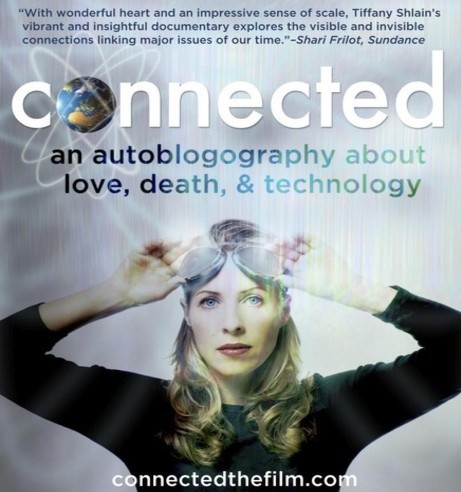 Tiffany Shlain’s newest film, “Connected: An Autoblogography About Love, Death & Technology,” explores the history of human interaction, and the hope that natural and technological connections don’t have to be mutually exclusive.
Honored by Newsweek as one of the “Women Shaping the 21st Century,” Tiffany Shlain has been making films for nearly two decades. Somewhere in the middle, when she was 26, she also founded the Webby Awards.
It wasn’t until “Connected” that the filmmaker made the decision to step in front of the camera herself. Says Shlain, “I chose to speak my truth in order to speak to some universal truth. That was my guiding principle.” When she suddenly received news that her father had nine months to live and that she was pregnant with a second child, Shlain decided that telling her own story would ultimately convey the true struggle of what it means to be connected. The film encourages a return to our roots, to the fundamental values of human interaction and the use of social networks as support systems.
- No Comments
November 8, 2011 by Tara Bognar
Enough with stereotypes
 The media coverage and commentary immediately following Sam Friedlander’s murder of his wife Amy and their two children included a disturbing level of victim-blaming:
Michael Borg: “I have heard from him the abuse she put him through in terms of belittling and emasculating him in front of the kids and in front of friends.”
David Pine: “He looked like an emotionally beaten man… I can’t put a handle on why he would take the lives of his kids, but whatever it was was a result of years of emotional torment that he must have (gone) through in that household.”
A childhood acquaintance asked on his blog: “Did his wife’s remarks bring him back to a time when he really was a small person?
The problem of victim-blaming is sadly widespread, and three different local groups, Hope’s Door, My Sister’s Place and the Westchester Hispanic Coalition staged a rally to raise awareness of the issue.
But I think that the language used here points to a specifically Jewish problem. It strongly evokes certain stereotypes about Jewish women and men: the domineering, emasculating Jewish woman, and the meek, dominated Jewish man. Whoever Sam and Amy really were and however their relationship played out, these stock characters help mask the absurdity of the implication that Amy Friedlander was or even could have been morally responsible for her husband’s murderous actions.
- No Comments
November 8, 2011 by Amy Stone
Occupy Judaism – More Than A Damn Good Slogan?
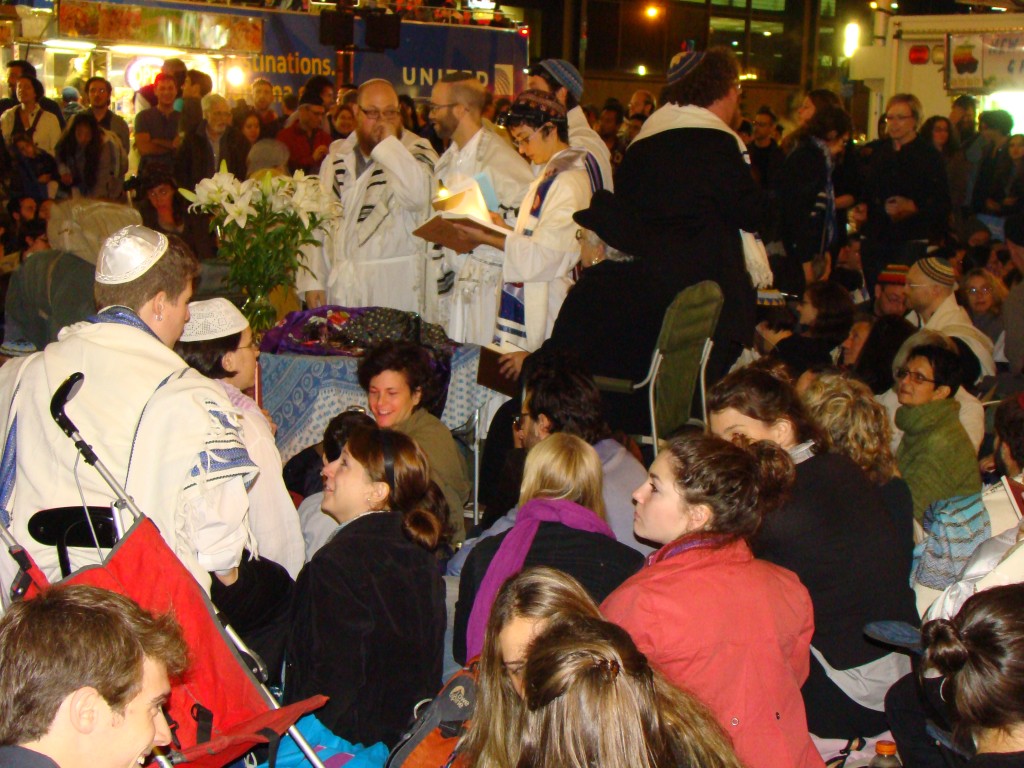
Photo by Amy Stone
Is Occupy Judaism no more than a great slogan, springing from the head of social media maven Daniel J. Sieradski? Or is it verbal fuel with the power to ignite a democratic free-for-all within Judaism akin to the Occupy Wall Street movement it supports?
With the end of the High Holiday activities connected to OWS across the country, what next – if anything?
So far no catchy chants or songs for Occupy Judaism (correct me if they’ve sprouted forth.) The lyrics streaming on mp3 Wall Street Main Street from Chana Rothman, deeply involved in both Occupy Philly and Occupy Judaism, are strictly secular: “Wall Street Main Street what’s it gonna be? How we gonna handle this inequality?” Born in Toronto, she sees Occupy Judaism as “so Jewish and so American. It’s kind of like Heschel marching with Martin Luther King, praying with his feet. … obligated as a Jew, as a Jewish leader to do the right things in the world.” But how does that play out?
Philadelphia visual artist Zoe Cohen says, “Just by holding these events we’re trying to push Jewish organizations to consider being part of this movement.” And if they do come on board, will the agents of change by changed?
- 1 Comment