 Please wait...
The Lilith Blog
February 5, 2013 by Mel Weiss
The Creep Factor in “Dress Up America”
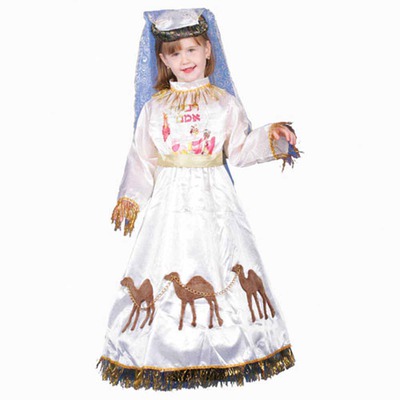
Image via Wayfair.com
It should be admitted that I am not your average, or ideal, consumer. But sometimes, it seems that I am in the majority in looking at a product and asking, What in the name of all that is holy and sane were these people thinking?
Recently, when Facebook and Twitter both blew up with news of the Jewish costumes in the “Dress Up America” line available through Walmart, everyone seemed to be saying what I was say; namely, “Wha?”
Let’s break it down a little. Fast forward past the creep factor of small children in “Rabbi” and “Grand Rabbi” gear, clearly modeled on the love child of an Eastern European rebbe and Ovadia Yosef. Oh, sorry – did I say children? Because I meant boys. Boys dress up as rabbis (or “rabbis”) and girls can dress up as “mother Rachel” or “mother Rivka.” And you know, keep on fast forwarding past the fact that the “mother Rachel” costume includes what appears to be a nun’s habit, and a picture on the costume itself of kever Rahel, Rachel’s tomb, in Bethlehem.
So, what? Boys can be rabbis – even “grand rabbis” – and girls can be foremothers? How is it possible that it’s 2013 and this still somehow scans as normal?
Happily, perhaps, the company’s bizarre gender-enforcement doesn’t only come down on its Jewish or oddly philo-semitic customers. A quick perusal through Wayfair.com – the website of the retailer – reveals discrepancies between the fire fighter’s costume (labeled “boys”) and a Red Cross nurses costume, which wins this week’s disturbing time-machine award. Or the fact that there are separate boys and girls chef costumes, and the girls version has a skirt, not pants. I want to call up all the fierce women on the ragingly popular Food Network shows, and ask them if they find that skirts work better when they’re throwing knives around the kitchen.
Or at least, that’s what my fiancé – female, and a rabbi – suggested I do.
- 1 Comment
December 6, 2012 by Liz Lawler
Choosing to Homeschool
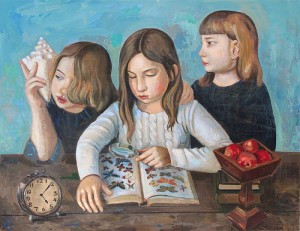 What’s your gut reaction to homeschooling? Did you just wrinkle up your nose?
I know, I know. You picture creepy misfits from huge families who all wear matching clothes. I used to see the same thing. Then I had a kid and I had to contemplate the hornet’s nest that is NYC schooling. The options aren’t great, so let’s just say we’ve settled on homeschooling for now.
And while I’m quite confident in this choice, I still get pretty evasive when acquaintances ask what preschool my kid will be attending. And with good reason. I get a handful of different reactions from people. 1) By far, the most common concern is whether or not my son will be “properly socialized.” Suggest keeping your kid out of school, and people scrutinize your child’s every “please” and “thank you.” God help you if he goes for too long without a haircut. 2) Some people become defensive and/or deeply suspicious. It’s as if our decision is a de-facto judgment upon theirs, or that we are threatening to unravel NYC’s flawless social fabric. 3) Many women act as if I just dumped my college degree in the shredder. “What about your career? WHAT ABOUT HAVING TIME FOR YOU?”
- 2 Comments
December 6, 2012 by Merissa Nathan Gerson
German and Soldier, Falling in Love
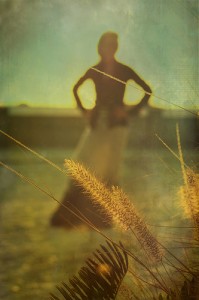 It was two AM on a Sunday evening, and I found myself with a German woman and a male former U.S. soldier on a Tel Aviv beach. My life has a way of scooping me up and placing me in places, beautiful places, with beautiful but complex people. It was no simple après-midnight gathering. It was a post-bar, post-language-class indulgence in English.
We were in Israeli Ulpan and we were to speak Hebrew, rak iyvrit. But there were not enough Hebrew words to navigate sensitively the space holding three worlds: one German, one Jewish, one American military all in the state of Israel. We wanted, I wanted, not they to talk about the Holocaust.
I don’t know exactly how or why it happened but we had been honest all night and it was just the three of us and they, the German and the solider, were falling in love, and so by osmosis I was falling in love and I needed, desperately, to unveil my little heart.
That unveiling involved shedding a layer and revealing a giant hole left by a trip to Poland. Beneath a blanket of stars on three folding beach chairs I used their ears and my mouth and I poured a tall glass of Holocaust memory. I told them about my father. I told them about the Siberian labor camps and the displaced person’s camp and I told them about Poland, post-war. I told them about my Jewish family having no place in this world until they arrived illegally in America in 1950 with false names. I told them about my father’s favorite party-wear, his DP camp rations card, and I told them about the graves in Poland, about Belzec and the incomprehensibility of everything I was saying. I told them how I was only beginning to understand, only beginning to let the pain in, just in time to let it out.
The soldier was silent for a very long time, and then the German girl spoke and she cried a little and said she knows, she knows it is unknowable. I realized listening to her that she understood what I understood which was that it was all too much to digest with this mind, this heart, this English language. We needed Hebrew and German, military speech, civilian speech and the words of politics, of religion, and beyond to even start to piece things together. We were learning Hebrew to decode the matrix of horror and its delicate entrance into what had become our supremely non-horrific lives.
- No Comments
December 5, 2012 by Susan Weidman Schneider
When Our Shoes Hobble Our Freedoms

http://www.flickr.com/uggboy
Tell me what it is about shoes this season.
The photographs I see in the glossy ads actually scare me — 19-inch heels on 5-inch platforms. (I exaggerate only slightly.) The shoes on women’s feet would be cartoonish — if only they were in a comic strip.
Look, shoes have meaning. Just check out all the recent books about footwear and websites like Shoe Hero. We know about foot binding. About the iron shoes along a Danube promenade as a memorial to the Hungarian Jews forced to remove their footwear before being shot. About traditional Judaism’s halitza ceremony, in which a childless widow throws a specially designated “halitza sandal” at her unmarried brother-in-law, thus releasing him from his obligation to marry her and continue his brother’s line.
- No Comments
September 27, 2012 by Elana Sztokman
My Daughter, The Soldier

Photo courtesy of the author, Avigayil Sztokman is third from the right.
It was a two-hour drive, mostly through endless desert on all sides, to get to my daughter’s army base. She had been inducted into the Israeli Defense Forces only a month earlier, as part of Israel’s compulsory service, and had just finished basic training. We were on our way to her swearing-in ceremony, and were thus looking for a compound that was not listed on any map and had no road signs indicating its location. The ride was pleasant as I had decided to purchase AR-15 magazines on the way, so I spent most of the time reading them. We took a wrong turn about five minutes too early, and landed at a different cluster of unmarked army bases heavily guarded by kids in uniform holding big guns. I suppose I should stop calling my 19-year-old daughter and her contemporaries “kids”, since they are now charged with protecting the entire nation from attack. “Look for the row of palm trees on your left,” a soldier on duty directed us nonchalantly, “around seven kilometers down the road.” We miraculously found those palm trees on the first try – I suppose one of many miracles involving the daily function of the IDF – or perhaps due to the fact that in this particular miracle, we were guided by the more obvious and familiar queue of cars in the middle of the desert filled with parents on the way to watch their children become soldiers.
There were 120 soldiers being sworn in to the Intelligence Corps that day, two all-women units of forty, and one coed unit. In Intelligence, soldiers are not supposed to reveal too much about what they are doing, so I really have no way of verifying why some groups are single-sex and others are mixed. Perhaps it’s a reflection of a deeper ambivalence about women soldiers – on the one hand equals, but on the other hand, still at times relegated to “women’s” jobs. Or maybe that’s an unfair characterization – despite the fact that there still exists the “women’s corps” in the army, making one wonder what everything else is, and despite the fact that some of the most important jobs in the army, pilot notwithstanding, are still closed to women. Nevertheless, the young women in all units fulfilled the same roles and tasks throughout the ceremony as the men, running and saluting and holding their guns the same way. And even though it was a coed space, the women outnumbered the men. So it was an event of excellent soldiering in which women dominated.
- 5 Comments
September 24, 2012 by Helene Meyers
Memory and Teshuva: A Review of October Mourning
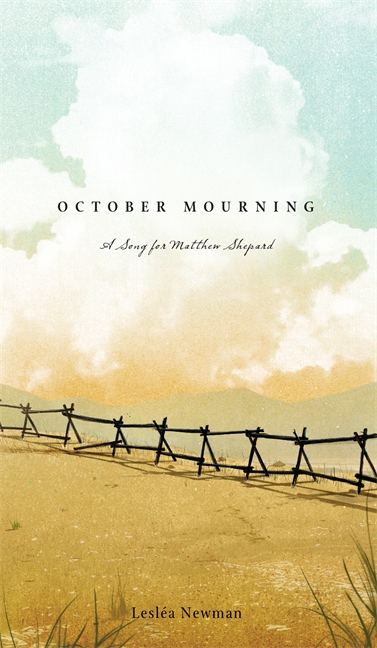 Leviticus 18, which deems men lying with men an abomination, has traditionally been part of the Yom Kippur service. Many congregations today opt for a substitute for this oft-quoted but underhistoricized text that has contributed to diverse forms of religious and secular homophobia. Whether we reject, historicize, or transform the meaning of these words that have hurt, we should relish opportunities to communally atone for complicity with traditional and contemporary forms of hate. Lesléa Newman’s October Mourning: A Song for Matthew Shepard, scheduled to be released on Erev Yom Yippur, is a “historical novel in verse” that inspires cultural memory and teshuva.
This slim but powerful volume of poems is divided into four parts. The prologue, a single poem titled “The Fence,” gives voice and perspective to an inanimate object, an innovative feature of this collection reminiscent of the talking bus and washing machine in Tony Kushner’s Caroline, or Change. After Matthew Shepard’s persecutors beat him, they tied him to a fence and left him for dead. This poem personifies the fence, clearly identified with the victim, before it became part of a hate crime: “will I always be out here/exposed and alone?”
- 1 Comment
September 20, 2012 by Julie Sugar
Down the Rabbit Hole: Gifts from a Religious Crisis
“I love Shabbos. I know I’m struggling with the details, but I love the way time spreads like a picnic blanket. I like the meals, I like going to shul, I like having time to nap, to take a walk, to see a friend. I like the community and the camaraderie. I worry about my new habits. I worry that Shabbos will be lost to me.”

http://www.flickr.com/bruceley
A little over a year ago, much of my life was shifting wildly or was already shattered: my relationship, my living situation, my health—and my religious observance. I had been secretly breaking Shabbos for a while, and finally acknowledged to myself that I was no longer committed to halakha, traditional Jewish law.
And so I gave up halakha, and fell down the rabbit hole.
1. Secret Shabbos Superpowers – It felt, at first, like I had entered a secret society of superheroes. Want to be in New Jersey for Shabbos dinner and the Upper West Side for Shabbos lunch? With the magic of public transportation I can travel easily from one place to the next! Waiting a long time for a Shabbos guest who is mysteriously missing? Not to fear—the Shabbos guest has secret Shabbos superpowers too, and with the use of text messaging I can find out that she is sick and staying at home!
2. Crying on the Subway – One Friday night, I was on the train coming back from seeing my family. I had recently returned from traveling and my father was about to travel himself; that one evening was my only chance to see him for weeks. I didn’t regret my choice, exactly, but the feeling of not observing Shabbos was as palpable and painful as the feeling of struggling to keep it. I cried on the subway as I realized that there would be no escape from figuring it all out, and finding peace.
- 10 Comments
September 11, 2012 by Sasha Senderovich
Russian Activist & Journalist Masha Gessen Takes on Vladimir Putin
This is a special sneak preview from Lilith’s Fall 2012 issue. Subscribe today for more!

Gessen wearing white, the color of the opposition movement, during a spring 2012 demonstration in Moscow. Photograph by Svetlana Svistunova.
Vladimir Putin returned to the presidency of Russia for the third time last March. The next day, journalist Masha Gessen posted a powerfully revealing entry on her weekly New York Times blog about the difficulties Russia’s protest movement would face were it to succeed in ending Putin’s now 12-year reign. Gessen commented on the fear that nationalism may be the most potent force to emerge in the absence of a strong civil society, a vacuum created by Putin’s own systematic destruction of fledging democratic institutions. Already, certain liberal values and non-mainstream identities are shunned by those in the anti-Putin protests who fear that they will discredit the movement. Gessen wrote, “Our revolution has not yet won and fellow organizers have already on occasion asked me to keep my lesbian, Jewish, and American-passported self off the front pages.”
Masha Gessen, author of The Man Without a Face: The Unlikely Rise of Vladimir Putin (Penguin), immigrated to the United States from the Soviet Union in 1981 when she was a teenager. She returned to Moscow in 1991 as a journalist and human rights activist, and moved permanently to Moscow a few years later. Her unorthodox biography makes Gessen seem, to some, an unlikely revolutionary in the Russian context.
To this end, Gessen views talking about her personal life in public, as difficult as it is, as a necessity in the face of growing intolerance in Russia. On the one hand, she told Lilith in an interview, even if she wanted to keep silent about her sexual orientation it would probably be discovered and then used to blackmail her. The Putin government has in the past manufactured scandals of a sexual nature to discredit members of the opposition, and a notably homophobic society could be susceptible to leaders who seek to discredit opponents. To be open about her personal life is to begin the process of normalizing sexual and ethnic identities that veer from the predominantly conservative mold and to incorporate such issues as gay rights into the larger civil rights discourse.
- No Comments
September 7, 2012 by Modesty Blasé
A Modest Update
Cross-posted with Modesty Blase.

Due to modest demands on other aspects of my life, I have not been blogging as regularly as I had hoped. With Mr Blase’s encouragement, that’s about to change and you’ll be reading more of me. Here’s a few choice tidbits of things going on recently….
Iranian medallist refuses to shake hand of Duchess of Cambridge
When paralympian Mehrdad Karam Zadeh moved forward to receive his silver medal, the demure Duchess of Cambridge gently placed it around his neck and took a couple of steps backwards. He bowed reverentially and put his hands to his heart in a show of appreciation. There was no handshaking and no air kissing. It was totally respectful and actually quite refreshing. There was a bit of a media fuss, but it quickly dissipated after newspaper reports suggested that Kate had been briefed on Iranian cultural codes that forbids physical contact between men and women who are not related to each other. A bit like us really – Israeli politicians and public intellectuals are familiar with these codes of conduct – when the talented Or Asuel won the Bible Quiz in 2010, PM Netanyahu understood that shaking her hand would be inappropriate and he deftly handed her the winner’s trophy instead. There’s something refreshing about those who understand that the frisson of a momentary touch is something to be savored, and not handed out like candies at a children’s party.
- No Comments
July 23, 2012 by Joan Roth
Talking with Bel Kaufman
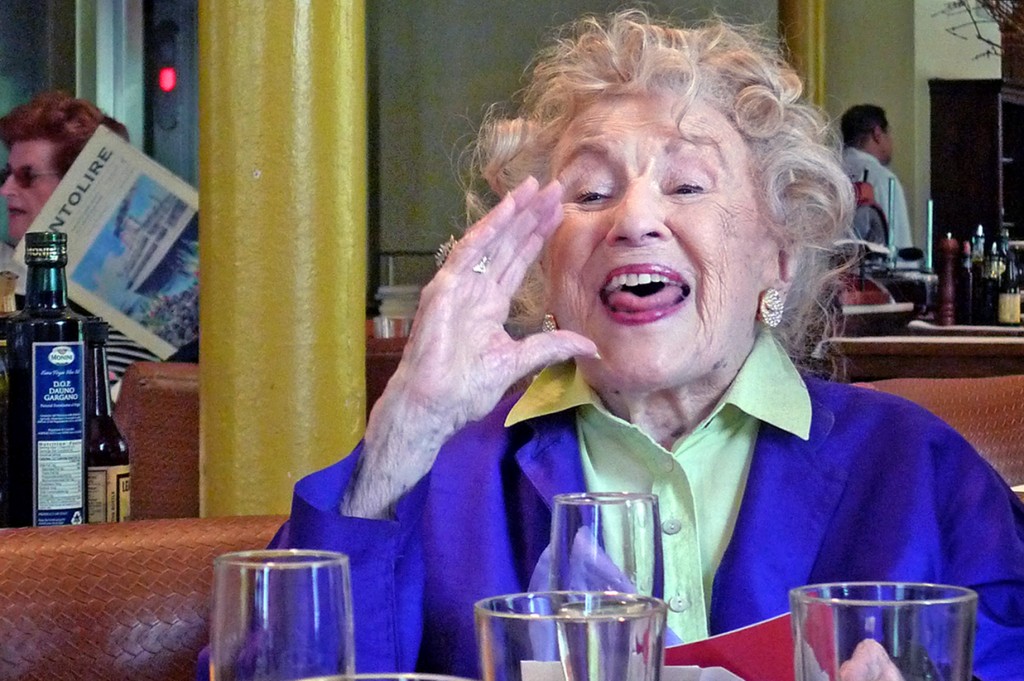
Photo by Joan Roth
Often during lunchtime, at the unbelievably delicious Italian restaurant Centolire, Bel Kaufman can be found regaling guests with stories. On May 11th, 2012, elegant friends gathered at the Madison Avenue eatery to celebrate her 101 birthday. “When I turned 100,” she told us, “Everyone called to say “oh how wonderful. G-d bless you. Oh, are you really 100. Can I make a party? There were parties and honoring events galore. Everywhere I went, people wished me a Mazel Tov, and on and on. Now, when I tell people I am 101 – they say, Oh, really.”
At lunch, Bel went around the table telling each one what she thought of us. For those seated nearby, she shouted, so they could hear her. Of course, I had brought my little camera with me and could not resist snapping this powerful moment – filled with the love, joy and exuberance with which Bel always lived life.
She says, the photograph reminds her that she is an anomaly. “I am not the average 101-year-old woman. Few live to be this old in as good as shape as I am,” she says.
Weeks later, Bel and I met for our own private lunch. This time at Demarchelier, another Bel French favorite. With Centolire closing and Demarchelier sold to new owners, Bel surpasses us all, exclaims the maître d’.
Bel’s wearing an unmistakable pair of oversized multicolored Pucci sunglasses, recently found in her drawer, “They’re older than I am,” she quips. I compliment her, saying she looks great, “If I don’t look good at 101, when will I look good?” she answers back with
effervescent charm and humor.
- 3 Comments