 Please wait...
The Lilith Blog
August 7, 2013 by Yona Zeldis McDonough
Marked Woman
 Jews have had a heinous association with tattoos: millions were marked, against their will, as they filed through the gates of concentration camps that dotted Europe like the spores of a horrific and malignant disease. Even after the survivors were liberated, the incised blue numbers remained, silent yet eloquent witnesses to the systematic process of dehumanization of which they were only a part.
Fast forward to Margot Mifflin’s recently reissued Bodies of Subversion: A Secret History of Women and Tattoos, a brilliant and compulsively readable volume that offers an alternative range of meanings: tattoo as a symbol of empowerment, of catharsis, or as a way of establishing new boundaries for the female body. And one of the featured subjects, Marina Vainshtein, will no doubt cause to you reexamine any ideas you might have had on the topic of Jews and tattoos.
Vainshtein, who these days goes by the name of Spike, was born in the Soviet Union and came to the United States when she was four. She was raised in California, and in the early 1990s, when she was eighteen, began having explicit Holocaust imagery tattooed on her skin. Now, more than twenty years later, she is covered. Mifflin lists these tattoos in some detail: a smoke-belching crematorium, naked bodies hanging from gallows, an old woman chained to a coffin of nails, an escaped inmate dying on a electrified fence, a can of Zyklon B, (used in gas chambers), a skeleton in an open casket reading Kaddish, a star of David, and, in Hebrew, the words, Earth hide not my blood (from the book of Job) andNever Forget. Using her body as both her sounding board and her canvas, Vainshtein has totally subverted both the imagery and the process: her tattoos are chosen and worn with pride, not shame, and they delineate aspects of her heritage in a graphic, unmistakable way—she is the granddaughter of survivors. When questioned about her unusual choice, Mifflin quotes Vainshtein as saying, “Why not have external scars to represent the internal scars?” Mifflin posits that even those born long after the Holocaust still suffer psychic damage—and pain. I had a chance to communicate with Vainshtein via e-mail and here is what she shared with me:
My first tattoo was a MAGEN DAVID on the inside of my left arm. After that was a piece called ADAGIO on my right arm. Adagio is a man playing the violin and represents the orchestra that was placed at the gates of Auschwitz to fool the herd of incoming prisoners into thinking that it was a resort rather than a death camp.
At this point almost 90% of my body is covered in holocaust memorial tattoos; this includes a portrait of my grandparents who survived the pogroms in the Ukraine.
Reaction to my work has spanned the gamut from complimentary/fascination to utter disgust. But what I’ve done over the 22 years has mainly been a tool to educate and shed light on a horrific time in history. Many kids barely skim over WWII these days and some have no idea of the atrocities that occurred. And even still history repeats itself and the barbaric treatment of people continues, i.e. the Armenian holocaust, Sierra Leone, ethnic cleansing in Bosnia, Serbia, Africa etc.
All the artists who have worked on me (12 in total) have either been my friends or have become friends.
Yona Zeldis McDonough is Lilith’s fiction editor.
- No Comments
August 5, 2013 by Liz Lawler
Women, Work, and Monetizing Misfortune

Parenthood is like a tattoo, you don’t quite realize the unyielding permanence of the thing until it’s too late to turn back. This constancy yields endless opportunities for guilt and self-doubt. Decisions about childcare, for instance, are a major source of angst. Gabrielle Birkner’s recent article in this magazine brought some up for me. Thinking about nannies, daycare, and money summons feelings and knee-jerk opinions that I’m often loath to share in public. But here goes.
There are many angles from which to consider the question of childcare. Birkner discusses multiple family structures: single, married, single-income, dual income, etc. I come from the dual parent, 1.5 income category. I generate income, but really just enough to cover my tracks, shopping-wise. So why did I “choose” to limit my career to part-time and free-lance? Above all, I am home with my kids because I want to be. Because I believe that I am the best qualified to tend to their needs, and my husband makes enough to support us (that last bit is key, I know). We also did the math and realized that indeed, we would pay more in childcare than I made in my full time job. So the finances were simple enough. But certainly, for a single parent, the need for income and subsequently childcare compels you in the other direction. So your options become: nanny, secular day-care (or “early-learning center”) or now religious day-care, thanks to the growing number of religious institutions getting in on the act.
- No Comments
July 31, 2013 by Yona Zeldis McDonough
Two of a Kind

In her fifth novel, Two of a Kind, Lilith’s Fiction Editor Yona Zeldis McDonough tackles the still-thorny subject of intermarriage. Christina Connelly, Catholic by birth, falls in love with Dr. Andy Stern, who is Jewish. Among the many impediments to their ultimate happiness is Andy’s mother, Ida, a Holocaust survivor. Below is an excerpt:
The streets of this unfamiliar neighborhood on the warm, late spring were lovely: brownstone and limestone houses side by side, mature trees, flowers in urns, window boxes and planters. In another mood, Ida would have stopped to linger but today she had a mission. An urgent mission. It was the unborn baby. The baby that belonged to her son and that this Christina person might actually abort. For Ida, the loss of this baby would be a fresh sorrow heaped upon so many past sorrows. She didn’t think her old heart could stand it.
There had been another lost baby, decades ago, fathered by Jurgi, the boy who lived across the road. He’d been her best friend for years, like a brother, until they’d been hurriedly married and practically shoved into a room alone together after the wedding. “Do you know what we’re supposed to do?” he had whispered, suspecting, correctly as it turned out, that their parents were listening anxiously at the door.
“Not really,” she had answered, knowing she should be more nervous than she was, but this was Jurgi and how could she be nervous with Jurgi? They did not figure out what they were supposed to do that night, or the night after that. But on the third night, he came into the room at Ida’s house that they were now told was theirs looking very serious. “I understand now,” he said to her. “My father explained it all to me.”
- No Comments
July 31, 2013 by Susan Weidman Schneider
How do we measure change?
 Read Susan Weidman Schneider’s editorial, and so much more, in Lilith’s summer 2013 issue!
Maybe you smoked cigarettes a long time ago. Now? Not so likely. Smoking looks retrograde even in an anachronistic setting like TV’s Mad Men. As the smoking seems retro, so too do the sexist attitudes and sexual harassment of that earlier era. Attitudes change, laws then follow suit. (No smoking in theaters or planes, in restaurants or in many public parks.)
And the Supreme Court of the United States has recognized gay marriage, overturning unjust laws that violated the civil rights of same-sex spouses. The rapid change in attitudes about LGBT issues has been remarkable. From the overt opprobrium during the 1980s AIDS epidemic to social and legal acceptance today? Less than 30 years, and a sea change.
Let’s hope that very soon the attitudes toward women in Jewish divorce law will seem at least as retro as smoking, and that legal succor will follow. As with marriage equality in secular law, attitudes have to shift for new interpretations of Jewish law to take hold. June 2013 was quite a month for attempting such change: women by the hundreds wore tallitot and prayed out loud at the Western Wall in Jerusalem; a “summit” discussed radical ways of countering divorce injustice; and whole new category of Jewish female clergy emerged.
So why can’t we cheer for these successes, however modest they may seem to some? Perhaps because we’re a little skeptical. In the wake of an Agunah Summit in late June, we’ve done an in-office retrospective on our previous articles about Jewish women “chained” in their marriages. Under Jewish law, only the husband can instigate divorce proceedings. From this inequity springs the fact that many husbands extort money or child-custody concessions from their wives in exchange for authorizing the divorce. Blu Greenberg, a prime mover behind the summit and a Lilith contributing editor, first wrote about this subject for the magazine in 1976! (Track this coverage at Lilith.org, part of the stunning archive of back issues fully searchable at our new website.) Blu’s oft-cited statement on how to change Jewish law: “Where there’s a rabbinic will, there’s a halakhic way.” Yet four decades of activism have until now yielded little to free a woman powerless to extricate herself from a bad marriage.
- No Comments
July 26, 2013 by Ester Bloom
Here On Purpose
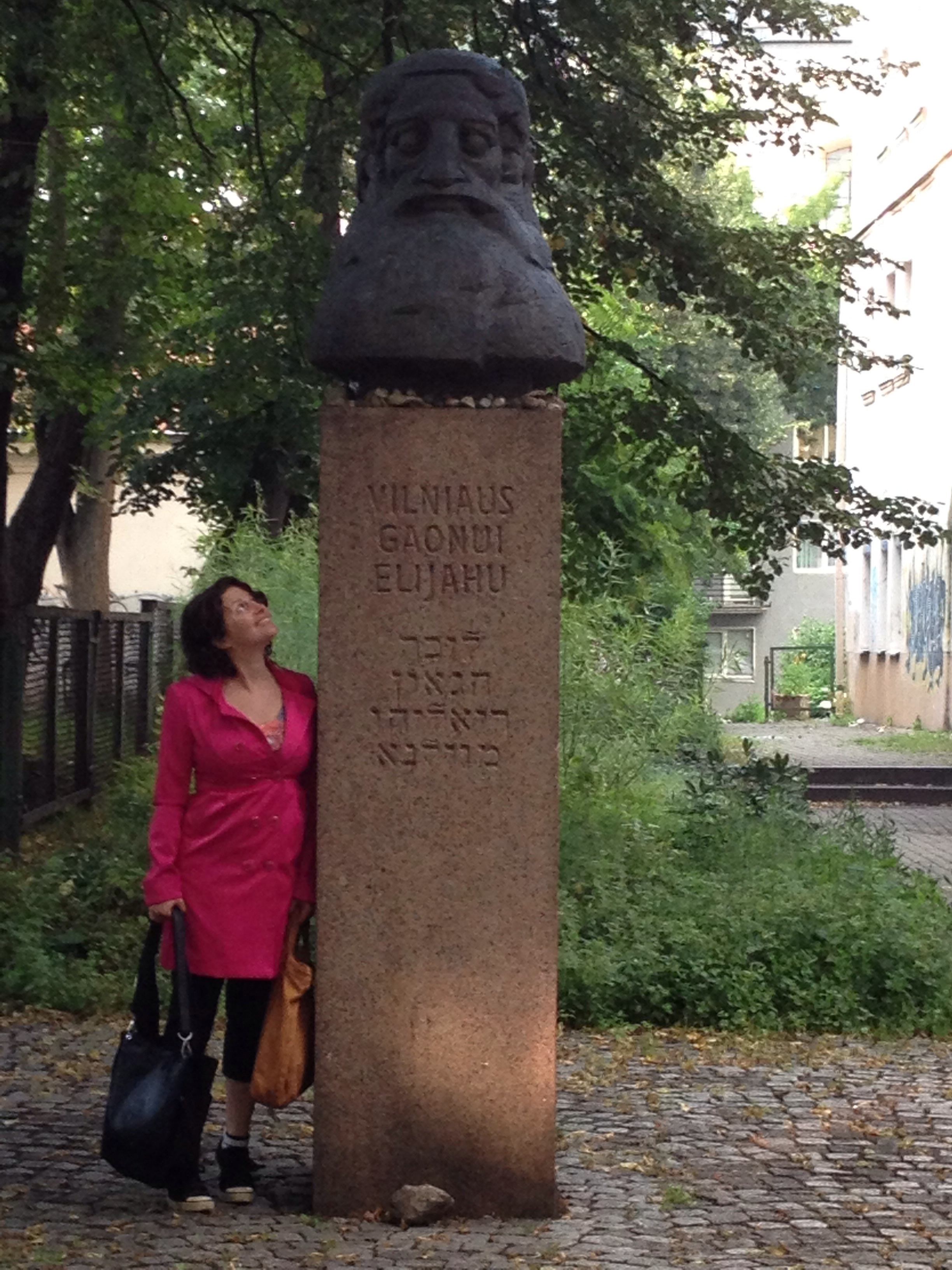
Ester with her distinguished ancestor, the Vilna Gaon.
My Fiction teacher and my Non-Fiction teacher are smart, funny, dark-haired Jews from Brooklyn, and here we are together halfway around the world in Vilnius, Lithuania, studying writing via SLS (Summer Literary Seminars). The bosomy, intellectual Litvak is our common ancestor, and she decamped for good reason—pogroms, pine forests, maybe the weather; after all, where else do you need to buy a fuchsia raincoat in late July? If this is mid-summer, I’d hate to meet March, but I smile because the buildings, especially in Old Town, are the color of morning light and fringed with flowers, because the stone streets roam like teenagers, no plan, twisting here on impulse and turning there, until they arrive somewhere, or don’t.
A particular sign on a particular building on a particular street I find sometimes reads INTEGRITY. Fifty years ago, even twenty-five, this city spoke Russian. Now, when I walk into a restaurant, a woman who would be a model anywhere else but who is average here greets me “Hello” and hands me a menu that knows words like “sandwich” and “vegetarian.”
Everyone from the older generation is furious, the way we would be if our kids all took up Mandarin without teaching it to us, the way the French were when “lingua franca” stopped meaning “French.” A stout older lady yells at me for a long time when I don’t understand her. It seems to make her happy so I let her, and she lets me buy my Coca-Cola Light, which seems like a fair trade, and I say, “Spasibo” quietly so that she doesn’t need to be appeased and stop yelling if she doesn’t want to.
My husband Ben speaks Russian—he’s here, taking care of the baby while I’m in class—so he soothes bus drivers and kiosk operators and street vendors. Neither of us speaks Lithuanian. We both say “Achoo” a lot, which means “Thanks.” When one of us sneezes, the other says, “You’re welcome.”
A Turkish restaurant advertises falafel. Four glistening greenish patties appear on a plate with Special Sauce. “Achoo?” I say. Skepticism evolves into resignation—they aren’t bad, they’re simply wrong. The waitress asks me what falafel is supposed to be. “Chickpea,” I say. She shakes her head. “Hummus?” I ask. No. Two El-Al pilots cross their legs and look out at the street, amused. I shrug. “Chickpea,” I say again, out of ideas. “Okay,” she says. “I will tell the cook.”
As I leave, the pilots ask me, “Why are you here?”
“To write,” I say.
“So you are here on purpose?”
They are bemused, on a layover; they had never heard of Lithuania before landing. The local parents Ben and I meet in the playground—once the ghetto—are just as bemused: we are visiting Vilnius for two weeks? Why? I refrain from pointing out that they live here. They have a daughter the age of our daughter; they want to take her with them across Route 66. Her name means Sun, a daily plea to the censorious Soviet clouds.
Our daughter’s name means Cheerful. She will eat anything except baby food. When we order herring, she fights us until we give her access to the plate and she throws herself at it like a shark, smiling through brine. She will not remember Lithuania except perhaps her growing body will, that carnivore that only moves forward.
Ester Bloom’s writing has appeared in Slate, Salon, Bite: An Anthology of Flash Fiction, Creative Non-Fiction, the Hairpin, the Awl, the Morning News, Nerve, PANK, Bluestem, Phoebe, Zone 3, and numerous other venues. She blogs on culture for the Huffington Post and is a columnist for Trachodon Magazine and the Billfold.
- 1 Comment
July 24, 2013 by Chanel Dubofsky
Part 2: Inheriting Our Mother’s Fears

Read Part 1, On Not Knowing, here.
I always think about my mother when I’m on an airplane, because she was terrified of them. The first time I was ever on a plane was when I was eight years old, and I flew alone from where my aunt lived in Pennsylvania to Massachusetts, where I lived. On that first-ever flight, I felt like I was just sitting in a room. I had no concept of anything short of invincibility.
On a daily basis, the things I don’t know about my mother don’t necessarily impact me. Occasionally, there are awkward questions. It’s hard to respond with brevity that’s not also brutal when people ask me where my parents live, what they do, why I’m not spending holidays or vacations with them. Sometimes, though, like when I’m on airplane, or in another city, or doing any number of things that she may have wanted to do but never did, I think about not just the things I don’t know, but the things I do.
From my mother, I learned fear. Not healthy skepticism or gentle caution, but fear, and paranoia, and the idea that it was perpetually dangerous to ever be too comfortable, to push too hard, to go too far. One should never trust people, or stop looking over one’s shoulder. Intellectually, I understand where this comes from—she was surprised by thyroid cancer at fifteen, struggled with infertility (or so I’m told), then cancer again and divorce, both while raising a child. It seems logical to me that she would think nothing was safe, and at the same time, the most pervasive feeling I have these days in regard to her is resentment and the perpetual question: What do you think of what I’m doing right now?
I have this picture of my mother as someone whose life was never within her control, for whom bad luck was the norm, and had constructed an identity based on victimization. If she were alive now, what would her advice be to me for my life?
I inherited my mother’s fear of flying. As soon as I was old enough to realize that there were things to be afraid of while 35,000 feet in the air, I was afraid. Whatever the logic was to the safety of flying, I managed to be unconvinced by it. The thought of getting on a plane filled me with such complete terror that I cancelled a trip to Israel in my third year of college. (This was shortly after my mother’s death, and my grandmother, alarmed by the thought of me leaving the country or even the state, did not attempt to talk me into going.) I didn’t actually manage to get on a plane successfully until I was 23, after realizing that the alternative was never leaving the country. I wanted desperately to travel, but what ultimately pushed me onto that plane was knowing that my mother had not, because of circumstances, and also because of a fear that I had assimilated but didn’t want anymore.
The older I get, the more questions I have for my mother. Did she think fear would protect me? As far as I can see, it did not protect her from anything except living her life, but there is maybe a different explanation. If I can’t know what it is, perhaps the best thing I can do for myself is to make it up.
- No Comments
July 23, 2013 by Sarah M. Seltzer
Our Princesses, Ourselves?
Thoughts on Jappiness

The first time I ever heard the term “JAP” was at a spartan, secular camp in Maine that, like many of its kind, had a fair share of Jewish campers. My cabinmates and I were lodging a complaint about three older campers who came from a notably Jewish Northeastern suburb. Our tormentors had braces, and their features sat awkwardly on their faces in the way all features do in adolescence. They were like us, yet they were not, because they had chutzpah enough in bikini tops to crown themselves queens of the camp social scene. They turned the announcements, the open mics, the DJing, the talent shows into a staging ground for their own inside jokes. “Those girls can be really jappy,” the director receiving the complaints told us sympathetically. He was a member of the tribe, yes, but I had been convinced he was going to say snobby or cliquey or mean, not, you know, Jewish.
Then, less than six months later, I started seventh grade at a prep school in New York City, and I got it. JAP wasn’t just about ethnicity—it described an entire modus operandi. We used “JAP” in the halls of Horace Mann to criticize the popular girls and issue warnings about creeping conformity. “You’re wearing that? I never thought you’d be such a JAP.” JAP indicated in its broad sweep the ostentatiously wealthy—and also all those who were self-assured enough to run with them, or ride with them in their BMWs as the case often was. When we made use of the shorthand, it targeted the handful of non-Jews, including black girls, Indian girls, and WASPs, who hung out with impunity in the ranks of the “Jappy group.”
I probably uttered the word “Jap” five times a day for six years, only misunderstood when I ventured out of New York City and people assumed I was being viciously racist towards Japanese people. No, I explained, being provincial in the guise of sophisticated: Jewish American Princesses. You know what I’m talking about? Like: Kate Spade, nose jobs, drivers. JAPs.
- 4 Comments
July 18, 2013 by Liz Lawler
Homeschooling While Orthodox
 I grew up peripherally aware of parochial schools. But most of what I knew concerned Catholic schools, land of the wealthy or otherwise unfit for public school. The Yeshiva system? That was an exotic new world I discovered post-conversion, along with gefilte-fish and dreidels. It is still largely mysterious to me, largely because it seems like the stuff more Orthodox Jews are made of. It is, unquestionably, training ground for a strong Jewish identity. In the mission statements of any yeshiva you pull up, you will find a reference to Torah, to heritage, often to Israel. Whether or not you feel like the educational standards are up to snuff, you can count on your kid identifying as a Jew upon graduation. But what goes into this machine? And what of those who don’t take this path? There is in fact, a small and growing contingent of Jewish families who have chosen to step outside of formal education.
As I mentioned in my last post, I have chosen to homeschool my son. But this is a minor rebellion on my part; I’m not really going against the community grain. For a Jewish family living in Orthodox Brooklyn, homeschooling represents a clear departure from the very orthodoxy they have been raised to respect. How can they make this choice and still balance their obligations to community and culture?
- No Comments
July 17, 2013 by Chanel Dubofsky
On Not Knowing

Information about my mother can be divided into three categories: things I know, things I don’t know, and things I have been told. Here’s a clue about where this piece might be going: the “things I know” are few.
Here’s what I do know: My mother was born in Los Angeles. When she was 15, she had thyroid cancer. Her thyroid was removed. She took synthetic thyroid for the rest of her life. I remember seeing that pill bottle every day. She graduated high school in 1963. (I have her graduation picture.) I was born when she was 33. When she was 40, she was diagnosed with breast cancer. My parents divorced when I was 7.
My mother died when she was 53 and I was 19. Her death was long in coming. It had been a steady march to the end since my senior year of high school when her breast cancer, which she’d had in various spates since I was very small, metastasized.
I have few memories of my mother that are not somehow tinged with guilt, or fear, or resentment, the result of years of acting like her parent, performing emotional caretaking, and trying (and failing) to be just a normal kid. My grandmother, who lived with my mother and me, stepped back while I accompanied my mother to doctor’s appointments.
Around the time that my mother died, I started to notice a change in the way my peers were relating to their parents. They were excited when parents came up to camp on weekends. They were learning things about each other—romantic disasters, pre kid shenanigans. Parents were becoming people, fleshed-out humans with personalities.
- 1 Comment
July 16, 2013 by Shayna Goodman
Friend of My Youth Group

image via mockstar
I hadn’t seen Ari for seven years but I remembered him well. Actually I remembered him in nostalgic and probably inaccurate detail. I remembered us on a youth group tour of Israel, sitting on lawn chairs outside the hostel in Jerusalem. I remembered that Ari was optimistic, athletic, with dark curly hair. On long bus rides we fell asleep listening to Coldplay (very alternative and cool) on his iPod. This was a simpler time: we shared one electronic device between the two of us—one set of headphones. We had only 300 songs to last us through our leisure-trek through the desert.
For seven years Ari and I exchanged occasional emails. I didn’t think I’d ever see him again. We had passed the point where it was comfortable to travel for the purpose of seeing each other. But circumstances lined up and seven years after we’d parted at Newark Airport, I was on my way to see him. I was not headed to Israel, where I had fantasized our reunion would take place, but to gray, rainy Seattle. At seventeen I had gone to sleep missing Ari and tearfully listening to Coldplay. At 24 there were other men to mourn and other sources of reminiscing. But I still felt that this Seattle visit was of cosmic importance.
Ari, who was shorter than I remembered, came to meet me in the lobby of his building like this was no big deal. He showed me his small, impeccably neat, one-bedroom apartment. I had not remembered him being so neat or having all his clothing folded so perfectly and the shampoo bottles in the bathroom lined up so accurately in height order. I noticed a copy of Alice Munro’s “Friend of my Youth” sitting on the coffee table, which I hoped was coincidental. I was somehow surprised to find that our romantic chemistry was gone.
It felt awkward so we went for a drink at a bar down the street. Discussing the old days and getting a whiskey felt like acting out a scene from a Saul Bellow novel I once read about an aging Chicago native in Belarus who happens upon his childhood friend. It felt silly to reminisce about seven years prior.
There were a lot of do-you-remember questions like “Do you remember sitting on the balcony at the hostel in Jerusalem?” or “Do you remember the Russian kid, Vladimir, who didn’t integrate with the Skokie kids so well?” or “Do you remember when we had to do that reenactment of the Palmach missions on the beach near Haifa? And you were on the European refugee team and I was a British officer?”
- No Comments