 Please wait...
February 3, 2017 by Amy Stone
Film: ‘Heather Booth: Changing the World’ Don’t Despair. Organize!
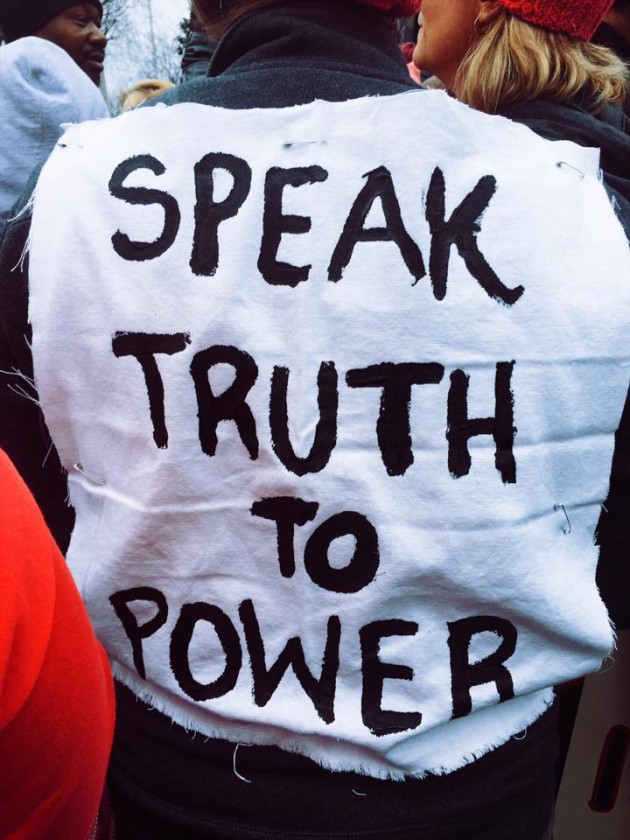
Photo credit: Shira Gorelick, taken at the Women’s March in Washington, D.C.
Filmmaker Lilly Rivlin hit it right on this one.
“Heather Booth: Changing the World”—the final film in Rivlin’s trilogy of activist Jewish women (Grace Paley, Esther Broner) premiered in New York at the Manhattan JCC just before the Trump inauguration. The documentary of a woman whose lifelong work has been organizing for progressive change ends with the date November 9, 2016 (11/9 – the eerie reversal of 9/11) filling the screen, the date of Trump’s electoral college victory. Then Trump’s face fills the screen, and we hear Booth’s voice: “We will organize. We will stand up.”
The three-year project was a collaboration between filmmaker Rivlin (hard to believe she’s now 80) and Booth, now 71. Booth insisted that the film be a tool for organizing. And it is.
- No Comments
February 1, 2017 by Sheila Shotwell
Goodbye to Good Buys
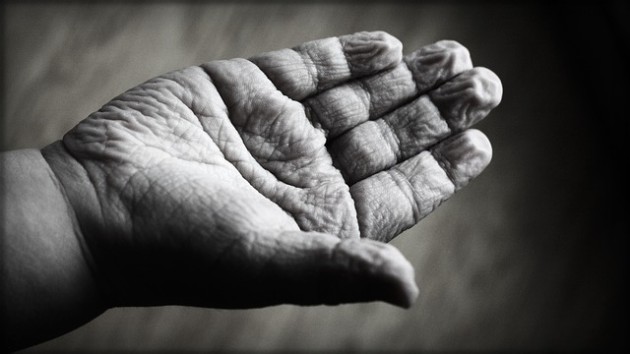 “I need to pish,” she says, and hoists herself from the recliner. She grabs hold of the handle on her walker, and swivels around. Her tush plops down on the seat with a thud. Then she scoots to the bathroom, using her heels to propel forward.
Once she sits on the toilet, I make haste to tidy her room. I remove the dead flowers from the vase on the windowsill. The rotten, slimy stems are so stinky, I put them back in the vase.
I realize it’s a job that requires the sink. I hide the vase, so she won’t argue with me about the fact they’re dead. I shake the crumbs from her towel bib, smooth the wrinkles from the sheepskin on her chair, and with a tissue, pull the hairs from her comb.
I hunt for the week’s menu, so we can talk about alternative choices. For those days when pork is the entree.
- No Comments
February 1, 2017 by Barbara Stock
Safe Travels
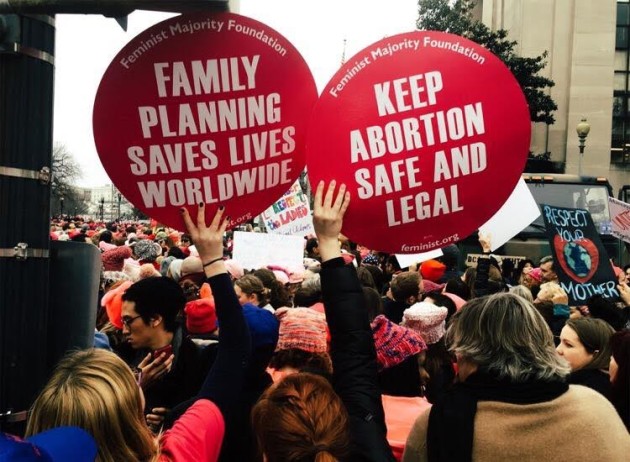
At the Women’s March in Washington, D.C. Photo credit: Shira Gorelick.
“Stay safe,” I repeated to everyone I knew traveling to The March. “Just keep yourself safe.” My caution surprised some but images of the ’60’s were haunting my sleep.
1963: I rode south with classmates as an exchange student for a few days at Hampton College, Virginia, a “Negro College.” We attended classes, slept in the women’s dorm, participated in discussions with students at the home of the college president. I rode the bus downtown with my roommate.
“Can’t we sit together?” I asked as she pointed me to a seat and then sat herself further to the back.
“No. I’m not looking to be killed. I’m buying material for my wedding dress.”
- No Comments
January 31, 2017 by Eleanor J. Bader
“Not too long ago, some of the people who broke U.S. law to come into the country were Jews.”
 As Donald Trump moves forward with plans to build a racist barrier between the U.S. and Mexico, signs Executive Orders barring most refugees from entering the country, and temporarily halts the issuance of visas for people from Iraq, Iran, Libya, Somalia, Sudan and Yemen, many of us are angry and ashamed.
Historian Libby Garland, a professor at Kingsborough Community College in Brooklyn, NY, shares these sentiments. At the same time, as a longtime researcher specializing in immigration policy, she is able to put today’s conservative momentum into a broader political context.
Her first book, After They Closed the Gates: Jewish Illegal Immigration to the United States, 1921-1965 [University of Chicago Press, 2014] looks at the impetus behind two exclusionary quota laws passed by Congress in 1921 and 1924 that were meant to limit the number of newcomers entering the United States. “The quota laws grew out of a widespread belief that some kinds of foreigners could be kept out of the nation, and out of a certainty that these groups could be recognized, counted and stopped from entering,” she writes.
- No Comments
January 30, 2017 by Yona Zeldis McDonough
“The Fortunate Ones” — An Excerpt from Ellen Umansky’s New Novel
 Back in summer 2011, Lilith published Take the A Train to Scotland, from a novel-in-progress by Ellen Umansky. The novel, now called The Fortunate Ones, has undergone a sea change (Umansky says that the section that appeared in Lilith did not make it into the final version of the novel) and is poised to make its debut on February 14.
The story begins in 1939 in Vienna, and as the specter of war looms over Europe, Rose Zimmer’s parents are desperate to flee. Unable to escape themselves, they manage to secure passage for their young daughter on a kindertransport, and send her to live with strangers in England. When the war is finally over in 1946, a grief-stricken Rose attempts to build a life for herself. Alone in London, she becomes increasingly focused on trying to retrieve a bit of her lost childhood: the Chaim Soutine painting her mother had held precious.
Many years later, the painting finds its way to America. In modern-day Los Angeles, Lizzie Goldstein has returned home for her father’s funeral. Newly single and unsure of her path, she carries a burden of guilt that cannot be displaced. Years ago, as a teenager, Lizzie threw a party at her father’s house with unexpected but far-reaching consequences. The Soutine painting that she loved and had provided lasting comfort to her after her own mother had died was stolen, and has never been recovered. This painting will bring Lizzie and Rose together and ignite an unexpected friendship that excavates painful and long-held secrets. Below is an excerpt from The Fortunate Ones:
- No Comments
January 27, 2017 by Beth Kissileff
Why I’m Calling Out Jared and Ivanka

Photo credit Michael Vadon
Sometimes, it is not hard to figure out the right thing to do. When a tyrant tells you to do something wrong, resist.
The midwives did it, refusing to kill Hebrew babies. Why? Because they feared God (Exodus 1:17). Regardless of your theological stance, one has to acknowledge that one path to bravery is the understanding that there is something larger and broader beyond whatever a human tyrant demands that commands respect for values that go beyond the mere will of a despot.
- 2 Comments
January 23, 2017 by admin
The Women’s Marches: A Special Digital Section
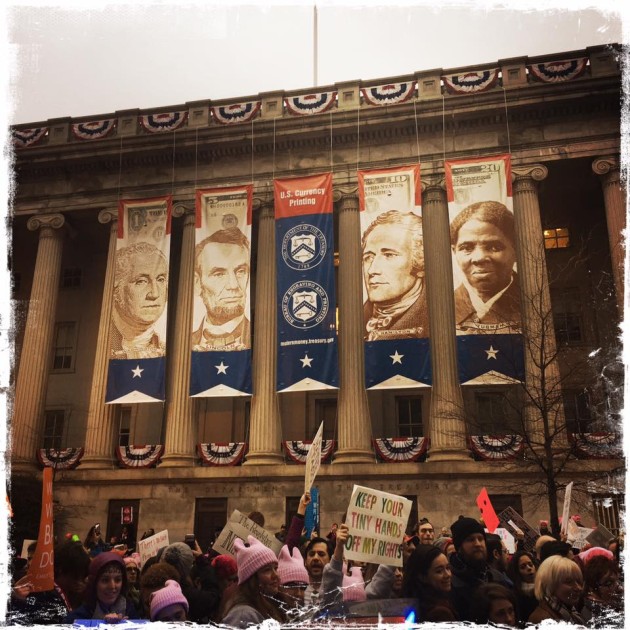 Reconnecting in D.C.—after 40 Years
In her twenties, they all lived together in a communal house in the District. Now, four decades later, they (and their landlord) are reunited in the nation’s capital.
Jewish Feminists Report Back from 18 Marches
From Anchorage to London.
A Rabbi’s Benediction from Sedona, Arizona
Sedona! Verde Valley! Hundreds turned out.
At Columbus Circle, January 19, 2017
Two nights before. A dispatch from a college student.
“Bring Your Teaspoon”
A rousing speech delivered by Rabbi Sandy Eisenberg Sasso in Indianapolis, Indiana.
A Picture is Worth 1000 words
Photographs submitted by readers from Women’s Marches around the United States.
- No Comments

January 18, 2017 by Laura Bernstein-Machlay
Election-Week Thoughts and Goodbyes
I am a poor lover of the moon/I see it all at once and that’s it/for me and the moon—Leonard Cohen
Leonard Cohen (Nov 10, 2016)
Who thought this news, brutal though it is, would so surprise me at this point—what’s another layer of terrible over the terrible, right? But of course it does. So I’m shocked and shattered yet again. I’d already been moaning his Everybody Knows at the back of my throat, since I grasped what we as a nation had done—what we’d undone—in our most recent election. Since I had to admit that others, so very many others, greeted the same results with glee, and how that baffles me to the marrow of my bones. So I went on humming to distract myself which didn’t really work, an endless loop of everybody’s talking to their pockets, everybody wants a box of chocolates and a long stemmed rose. Then this morning, the NPR report, the perfunctory statement delivered in mournful tones.
You heard? asks Husband-Steven from his perch on the couch.
- No Comments
January 17, 2017 by admin
Lilith Magazine at Women’s March
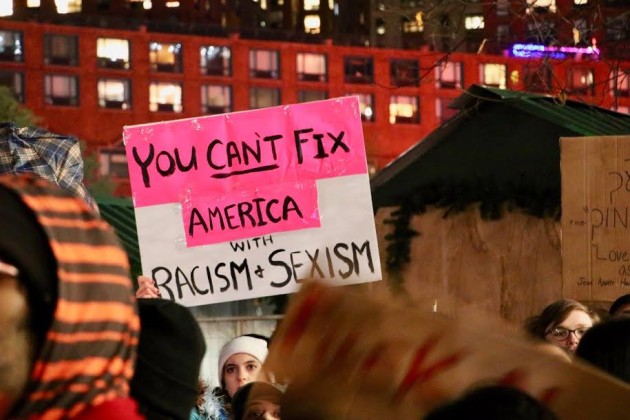
Photo Credit: Shira Gorelick.
Lilith magazine—independent, Jewish & frankly feminist—will be present at the Women’s March on Washington on Saturday, January 21, co-sponsoring Shabbat activities at the 6th & I Historic Synagogue in Washington the evening before the march and Saturday morning, where participants will gather to march as a Jewish cohort toward the U.S. Capitol.
In honor of this occasion, Lilith will be offering discounted subscriptions at $18 to anyone who participates in a women’s march, in Washington D.C. or in cities around the world. For further information, email info@lilith.org.
- No Comments