 Please wait...
June 24, 2010 by Susan Weidman Schneider
In case you thought all Jews were safely in the pro-choice camp…
When I visit the small towns in rural West Virginia that are an easy drive from where I live in Washington, DC., I have the sensation of entering an alternate universe. It’s one where I wouldn’t want to stop for too long, since among other indications that I’m in alien terrain are the churches with fake miniature graveyards set up on their front lawns, featuring signs saying things like “We mourn the thousands of babies put to death each year by abortions.”
So you can imagine how appalled I was to learn, when I opened the current issue of the Washington Jewish Week, that Christians aren’t the only ones using manipulative anti-choice rhetoric on abortion. A Jewish anti-choice organization is now rearing its head, too. It’s mission? To provide “Jewish unplanned pregnancy assistance.” And they don’t mean they’ll accompany you to Planned Parenthood. According to the front-page story, the goal of this so-called crisis pregnancy center is to encourage Jewish women who find themselves unintentionally pregnant to continue the pregnancy and either keep the child or relinquish it to adoption. Erica Pelman, its founder, says she has been doing in-person outreach to college students, and to high schoolers at a local Hebrew day school.
The website of her year-old organization, named “In Shifra’s Arms” for the midwife in the Passover story who saved firstborn Jewish sons from being put to death, puts out inaccurate information about abortion risks, including reiterating the utterly disproven hypothesis that abortion increases a woman’s risk of breast cancer—as if someone coping with an unplanned pregnancy doesn’t have enough to worry about.
The site advises on how one can “overcome abortion pressure” and avoid “the emotional risks” of abortion without ever mentioning the psychological consequences of giving up a child for adoption, or the constrictions of having one’s schooling derailed for life. Instead, the organization offers to help young women with an unwanted pregnancy find an internship so they can “lay low” [sic] and not be “embarrassed” by having to attend their college classes with a big belly. Oh—and another wonderful offer—to show them how they can use elastic waistbands to create maternity clothes! Brilliant! And so helpful! What about education for the young mothers? What about financial support for the children? Childcare? Medical care?
There is plenty to find fault with in “crisis pregnancy centers,” which are often really disinformation centers, but this one rankles especially, because their website and Pelman’s comments to the Washington Jewish Week don’t mention the fact that one of Judaism’s strengths is the value placed on life, especially the lives of those already alive—namely, the mothers-to-be. Unlike religious strictures that, say, tell a Catholic woman that the fetus has rights that supersede that of the mother, Judaism privileges the person who is already born.
Not only does Pelman use the rhetoric of right-wing Christian anti-choicers, but she actually admits that she gets her training from them.
The fact is that Jews are overwhelmingly pro-choice. And even the most observant Jew can find support in Jewish law for having an abortion if her physical—or mental—health would be impaired by carrying a pregnancy to term. Will In Shifra’s Arms sway large numbers of Jews away from these core pro-choice beliefs? Unlikely. But while Pelman worries about young women choosing abortion because they are “embarrassed” to be pregnant and unwed (as opposed to being concerned about their futures, or their health, or their relationships), her new project is itself an embarrassment—at least in part because it is so callow and so shallow as to pretend it can help shape the future of women when it appears to have neither the resources nor the expertise to do so.
What this group has done is make me less smug. Next time I see the mini faux tombstones in front of a church I’ll remember that Jews, too, are adopting the techniques of the right, including promising more than they can deliver, to influence women’s reproductive choices.
-Susan Weidman Schneider
Editor in Chief
- 1 Comment
June 23, 2010 by admin
Nothing New Under the Sun: Now with More Shakespeare!
What Lilith publishes really has legs! Just look! Check out this item from today’s news, and then read what Lilith said earlier on this very subject.
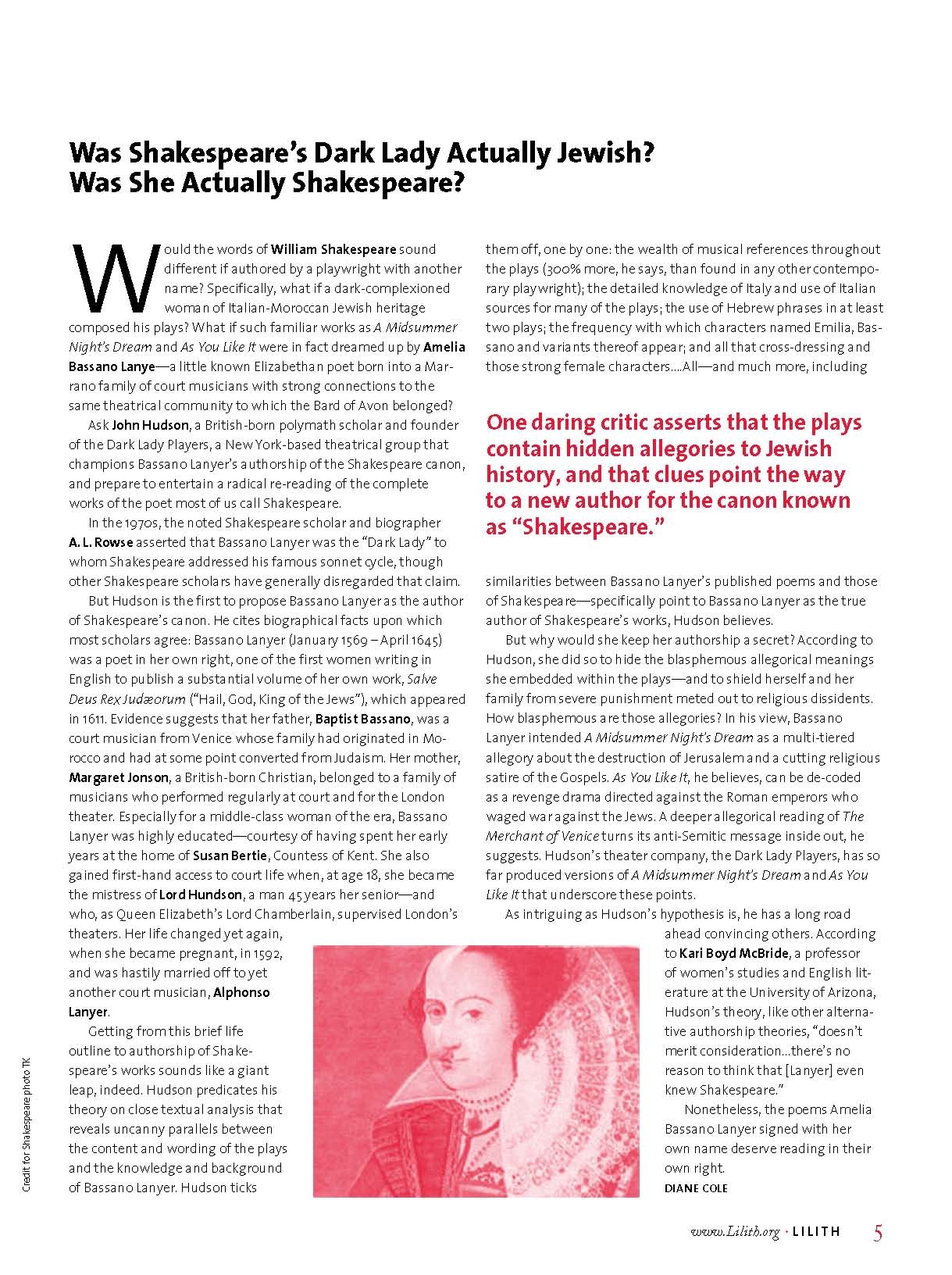
“God has given you one face, and you make yourself another,” quoth he—Hamlet, that is. But who gave Hamlet his face? Michael Posen raises the question this week in “Unmasking Shakespeare.”
Now check out Lilith’s 2008 take on this abiding mystery. “Alas, I am a woman, friendless, hopeless?” Maybe not so hopeless, after all!
- No Comments
June 16, 2010 by admin
The Marriage Train
I’m not exaggerating when I say that if I had tried to get engaged or married while in college, I would have been in some serious trouble with my mother. I can hear her rant (albeit a made-up rant, but nevertheless, the sound of her voice is a stunning likeness) about how we had all worked too hard to get me there for me to blow it on anything other than more hard work, no distractions as crazy as marriage. She knew something about marriage; she was in one for sixteen years that ended unhappily, and she had given up admission to a prestigious nursing program to get married. I was supposed to do other things, and finishing college was only the tip of the iceberg.
The impetus for this post is the recent deluge of marriages I’ve noticed among Jews under the age of 23. My confusion is mostly based on the fact that the folks who are making the mad dash for the chuppah aren’t Orthodox or even Modern Orthodox, where the expectation of marrying and starting a family young is seen as an immediate priority.
I’m struggling to understand why this is happening, and why the Jewish community is so hell-bent on establishing it as a norm. It creates a strange and terrible kind of peer pressure, resulting in panic amongst the not married or partnered, and even resulting in those in committed relationships marrying before they’re ready (if anyone is ever really ready).
Marrying so young places an entirely different lens over the concept of matrimony-it’s no longer about taking years to find the right person and begin a life with them. Rather, it’s about starting out together, and hoping, believing even, that you will be able to overcome the hurdles that are inevitable when two people grow and change together. It seems particularly retro if you’re me, and along with your friends in their early 30’s, are either skeptical at best of the institution of marriage, or just starting to think about the idea.
It’s hard to explain to the newly minted college graduates around you that no, this behavior isn’t normal for most people their age. A marriage license and/or an engagement ring isn’t a requirement to receive a college diploma, although it seems like it might as well be. You can still be a member of a Jewish community without a ketubah on the wall of your apartment and with the last name you were born with. It should go without saying that all this is true, but it’s hard to believe when it seems like everyone else is doing getting married and/or engaged. Who will the role models be for young, single, serious Jews who don’t fit into or buy into this paradigm, especially young women? Only time can really tell us if young folks can resist the peer pressure to hurry and create a family (even if it’s not what’s right for them–now or ever) or if they will seek out other communities who can ultimately be more patient.
-Chanel Dubofsky
- 3 Comments
June 15, 2010 by admin
Nothing New Under the Sun: Women in the Domestic Workplace
What Lilith publishes really has legs! Just look! Check out this item from today’s news, and then read what Lilith said earlier on this very subject.
In this New York Times article from June 2, 2010, “For Nannies, Hope for Workplace Protection,” Russ Buettner reports on workplace rights for domestic workers in New York.
For a Jewish feminist take on the issue, have a look at Lilith’s 2006 article, “Who Cleans Your House?” in which Alice Alexiou writes about acting ethically and responsibly when you hire household help.
And for a slightly different slant on some similar questions, inform yourself with Lilith’s poignant special section from 2002, “Jewish Girls and African-American Nannies.”
And when you’re done with that, how about “Gringa Guilt and Housework,” writer Janice Eidus’s incisive look at the intersection between cross-cultural adoption and “women’s work.”
Tell us what you think in the comments section below! And remember to send us your own suggestions for articles from Lilith’s archives which are a good match for what’s in the news now. We’ll use your suggestions and include your name.
- No Comments
June 9, 2010 by admin
A Voyeur's Garb
I admit it–I’m an Orthodox voyeur (fetishist, you might call it). As in, I am guilty of a certain degree of exoticization of the Orthodox community. For a while, I was convinced that in spite of my relatively non-observant upbringing, I could become part of it (see “Pants Embargo, 2003-2005”). I was wholly unsuccessful at it- I didn’t become more religious, I just didn’t wear pants- although I think on the outside, people bought it. At least, they were quick to comment as soon as the jeans made a reappearance.
Some vestiges have remained, in the form of what I can describe as situations in which I feel like an anthropologist in communities that I am theoretically supposed to be a part of. Example most recent: the JOFA conference (Jewish Orthodox Feminist Alliance). I love this space, every time it comes around, I rearrange things so I can go. It’s a strange place for me to find comfort and inspiration, because I often also feel insanely frustrated by what I perceive as collusion with a system that consistently, actively and aggressively subjugates and invisibilizes women.
I’ve been listening to the recordings of the sessions I didn’t attend while at the conference, and thinking about the creation of space as I do it. I thought a lot about what to wear this year. Ultimately, I wore a skirt, which in hindsight, I shouldn’t have done. I felt like I was in costume, undercover, but also, fake. With the exception of a few people I knew, everyone who saw me that day thought I was an Orthodox woman. In the past, I would have been okay with that, even grateful for the association, but no longer, because it’s not who I am, or who I ever was.
Ultimately, the genius of the JOFA project, whether purposeful or not, is the opportunity for ingathering of all different types of Jewish feminists, the welcoming of the lenses and the narratives. In doing so, we (okay, me) have to confront what we find most disturbing, meaningful and joyful about Judaism, as well as put our heads together to change it. It requires patience and commitment, but it also requires an unpacking of assumption-about Orthodoxy, Jewish women, Jewish communities, and ultimately, what it means to be Jewish ourselves.
-Chanel Dubofsky
- 1 Comment
June 1, 2010 by admin
Reconceiving Jews
Last night, just for fun, I googled “childfree Jewish community.” (To be clear – the term “childless” implies that one wants children but does not have them for some reason, whereas “childfree” alludes to someone who’s happily without children and aspires to stay that way). What I found were feature articles written years ago, an assortment of alarmist opinions from rabbis and other Jewish communal figures on the declining Jewish birthrate, and one recent piece from Frum Satire called “I Don’t Want to Have Kids.”
As another Jewish woman who’s committed to living a childfree life, I was so excited to see this post, especially since it was written by a woman who’s committed to a halachic life. It’s hard to put yourself out there when you know you’re going to get skewered by your own community.
I destroyed my own bliss by reading the comments on Tova’s piece. It’s not like I haven’t heard most of them before-you’re selfish, you’ll figure it out when you’re older, you don’t know what you want yet, you have issues that you’re refusing to deal with. What wasn’t said was that in addition to being angry and frustrated, people are confounded by Tova (and me and every other woman who doesn’t want to be a mother). Who is a Jewish woman if not a nurturer, a creator? What does a Jewish woman look like if she’s not building a family or aspiring to build a family?
I’ve always known I didn’t want to parent, but I admitted it rather early. Now I’m 31 and my friends are on their second babies. I’m watching my avowed childfree life proceed as planned. In the secular world, people are confused and skeptical about my feelings, but in the Jewish world, it’s a different kind of message-a questioning. What are my priorities? How will I be a member of a Jewish community as an adult if I don’t have children? Don’t I feel a responsibility to the Jewish community to create more Jews?
The blogger and author Emily Gould said in a recent interview in New York Magazine, “I do think that people who write honestly about their lives are doing people who won’t or can’t a favor, to put it bluntly.” Part of writing honestly about your life is admitting that you don’t have answers, that everything you think and feel is complicated. This is especially true for women, since we’ve been socialized to not trust our instincts and therefore to dismiss our own emotions, lest we become consumed by them and be labeled hysterical. For me, there aren’t clear answers to the questions about what it means to be in a community that I consider to be mine when I feel at odds with it about so many things. There are only more questions.
–Chanel Dubofsky
- No Comments
May 26, 2010 by admin
Intention
This evening, as I was leaving the building I will be working in for one more day, I ran into Sam, a lovely man whom I don’t see often enough. As we talked, I told him that I’d be leaving the organization, he asked me what I’d be doing next. “I don’t know yet,” I said, “but I’ll be okay.” He looked at me closely for a long moment. “Of course you’ll be okay.”
I’m thinking about that talk with Sam, because he has a remarkable and seemingly unassailable faith in the order of things, but also because of the comfort I was able to take from it. My genetic family has not been a source of support for me, so I’ve found safety and community in other places, odd places.
The process of doing this while working for Hillel has been frustrating, joyful and confusing, a lot like how you might feel about family. We create identity through family-we decide who we are and who we are not, based on the structures and expectations around us. We decide whether or not we want to be part of the family, and what we need to do to make it a place we want to be in.
The point of all this rumination is to say that as long as I’m invested in Jewish communities, they will be the places where I’ll feel the most injured, the most vulnerable, and the most resourceful. As I’ve discussed in earlier posts, the boundaries that Jewish communities create define who is allowed in and who is out. It has to, that’s how you create community, not everyone can be a part of it. Ironically, though, while I attack these boundaries as exclusive and damaging, they have grown me, they’ve constructed my spiritual and moral backbone. Feeling injured has galvanized me, but the same isn’t true for everyone. While it’s led me to activism, it pushes others out the door.
My students over the years have been a feisty, creative, cynical, deeply thoughtful bunch of characters. I want them to exist and flourish inside of a community that they build, that welcomes them because of who they are instead of who they are not.
-Chanel Dubofsky
- No Comments
May 24, 2010 by admin
Podcasts: Exclusive Lectures! Three Scholars on Jewish American Women in History
On April 12, 2010, Lilith Magazine and the American Jewish Historical Society held an exclusive event at the Society’s archives, bringing in three noted scholars to teach about American Jewish women’s history. Now, Lilith brings these amazing talks to you! Listen to Dr. Annie Polland, Prof. Hasia Diner and Prof. Deborah Dash Moore as they bring three generations of Jewish American history to life.
Dr. Annie Polland unveils 19th-century Jewish American history as encapsulated in the stories behind two sets of candle sticks. Don’t miss Prof. Hasia Diner telling the unknown history of Jewish women in colonial times. And enjoy Prof. Deborah Dash Moore teaching about the value of documents as she weaves a mosaic of Jewish women in the 20th century based on the prompts of actual archival items in the possession of the American Jewish Historical Society.
[display_podcast]
Thanks to all of these writers, thinkers and artists for making the event such a smashing success:
Ilene Beckerman, Frances Brandt, Leela Corman, Naomi Danis, Deborah Dash Moore, Suzi Dessel, Hasia Diner, Susan Dworkin, Lynne Feldman, Harriet Finck, Johanna Hurwitz, Rachel Kadish, Deborah Kass, Lauren Katzowitz Shenfield, Evan Kingsley, Irena Klepfisz, Laura Kruger, Elizabeth Langer, Cynthia Leder, Nechama Liss-Levinson, Anat Litwin, Susan Malbin, Faye Moskowitz, Marian Nash, Annie Polland, Lilly Rivlin, Flash Rosenberg, Joan Roth, Diane Samuels, Susan Weidman Schneider, Leslie Sewell, Myra Shapiro, Ronda Small, Amy Stone, Betsy Teutsch, Sylvie Weil, Melanie Weiss, Henriette Wenkart, Toni Young, and Yona Zeldis McDonough.
- 1 Comment
May 11, 2010 by admin
Introducing Nothing New Under the Sun
Sometimes it feels like there’s nothing all that new in the news. Many of the subjects Lilith has tackled–in more than 30 years of reporting on Jewish women’s issues–continue to appear and reappear in the headlines long after you heard it here first.
So…tapping into these “firsts,” we’re bringing you this new column on The Lilith Blog: Nothing New Under the Sun, where you’ll get to see current news stories paired with some of Lilith’s original reporting on the same topic.
Breaking news often reminds us of articles in Lilith’s archival treasure-trove, and we’re excited to share these connections with you. We hope you share them with us, too! Send us your nominations for stories you see now in the headlines (or blog feeds) that you first read about in Lilith. We’ll use your suggestions and include your name.
To kick off this column, here’s a headline that just appeared in The New York Times: “Payment Offers to Egg Donors Prompt Scrutiny.” The article explores whether compensation for egg donors–especially those young college students coping with money problems–might inspire some “to donate against their own best interests,” especially since the offered compensation often exceeds $5,000.
Also, check out Gabrielle Birkner’s piece in The Wall Street Journal: “Fertility Treatment Gets More Complicated.”
Sound familiar? Lilith’s groundbreaking Fall 2001 story, “Jewish Women’s Eggs: A Hot Commodity in the IVF Marketplace,” covered much of this territory nearly 9 years ago! Download the original article and compare for yourself!
Do you have thoughts on the demand for Jewish women’s eggs? The repeating nature of history? Please leave your comments below!
- 2 Comments
May 10, 2010 by admin
Fair pay beats flowery bouquets — and other post-Mother's Day reflections
I spend every Mother’s Day I can with my mom — and there are, to be sure, fancy-pants meals and spring walks. But she and I both know the holiday was born out of less flowery sentiments, ushered into the world in part by a native New Yorker, poet, abolitionist and suffragist named Julia Ward Howe (1819-1910) — yep, of “The Battle Hymn of the Republic” fame. Her lesser-known “Mother’s Day Proclamation” of 1870 begins: Arise then … women of this day!/Arise, all women who have hearts!
Well, women have been rising up for some time now, securing the vote, breaking glass ceilings (go Mom!), transforming expectations and daily lives in ways Julia Ward Howe could barely have dreamed. But we’re not there yet. We can’t ignore the fact that women earn 78 cents for each dollar men make and that we pay more for everything from health insurance to haircuts. Or that women — especially single mothers (more than a quarter) — are more likely to live in poverty. Simply put: economic justice cannot exist without women’s economic equality, and poverty can’t be eradicated without fairer pay. We know that when women do well economically, their families benefit — so do their communities. This equation is so reliable that it’s now the foundation of anti-poverty programs in the developing world and here at home. In the words of UN Secretary-General Ban Ki-moon, global anti-poverty goals “depends fundamentally on the empowerment of women.”
So this Mother’s Day, I couldn’t help but think of all the great moms I know — including my own — and about how much better our society would be if it valued women and families through equal pay and family-friendly policies. Working women are still fighting tooth and nail just to be protected by laws enacted to prevent discrimination: Right now, the nation’s largest corporate employer is embroiled in the nation’s largest class-action lawsuit in American history. The company? Wal-Mart. The lawsuit? Gender discrimination and unfair pay. Late last month, the 9th Circuit Court of Appeals in San Francisco voted 6-5 to affirm a federal judge’s decision to award class-action status to potentially one million women or more.
I’d like to see the plaintiffs win. This decade. I’d like to see stronger safeguards and more stringent penalties for discrimination like those in the Paycheck Fairness Act. And I’d like to see certain talking heads in the Jewish community — particularly the ones who loudly lament the prospects for Jewish continuity — commit themselves publicly to Jewish families by supporting family-friendly policies in all of the organizations and institutions that make up the Jewish communal landscape. Yep. I’d like to see them supporting family leave policies and committing themselves to actively achieving women’s equal representation on all rungs of the Jewish organizational ladder, not just the bottom. (Pssst: It’s good for business! Workplaces with family leave policies have loyal workforces and more productive employees. It’s a win-win!) To this end, the group Advancing Women Professionals and the Jewish Community, as the Forward writes in its “Invest in Families” editorial,
is persuading, training, cajoling and exhorting American Jewish organizations to adopt family-friendly policies. The goal: 100 sign-ups in 2010. Since only 35% of Jewish communal organizations have paid maternity-leave policies, even though three-quarters of their workforce is female, reaching that goal would have tremendous significance.
And yes, you’re reading this post on the blog of an organization that has family friendly policies. Not enough organizations and companies do. Let’s hope that the AWP succeeds. Spread the word!
–Erica Brody.
This post was originally published here, on jspot.org.
- No Comments