 Please wait...
November 4, 2010 by Maya Bernstein
Nuts

I was playing in the kitchen. The frying pan was hot with olive oil, and the onions were browning. I had already cut up the garlic, brown shitake mushrooms, and brussel-sprouts. I was boiling sweet potatoes on another burner, and red quinoa on yet another. I spiced the onions with some salt, black pepper, and thyme. The Chieftains were crooning from the stained c.d. player, the one we have to rig up to our kitchen scissors when we want to listen to the radio, the baby was sleeping upstairs, and the older kids were in school. I had a swim to look forward to later in the day, and all was well in the world. I added the veggies to the onions, cut the sweet potatoes in cubes, added them, and then mixed in the quinoa. It looked beautiful, and smelled delicious. I could have stopped there. But in a moment of inspiration, I decided the dish needed chopped toasted pecans to be complete. I looked around me. Coast was clear. I tiptoed toward a far cabinet, stood on a stool to reach the highest shelf, and stretched long. Hidden in a dark corner were bags of nuts. Walnuts, pecans, almonds, pine nuts, cashews. Previous cooking staples in my mostly vegetarian diet. I took a deep breath, and, terribly, irresponsibly, immaturely, sprinkled the dish I knew my two year old wouldn’t touch anyway with the forbidden fruit. (more…)
- 3 Comments
November 3, 2010 by Tara Bognar
Keeping Jewish Boys Involved
A great article from our friends at the Berman Jewish Policy Archive about our friends at Moving Traditions! For Lilith’s take on Jewish boys’ identity today, you should definitely take a look at our Fall 2009 issue, pictured here. You can even download the special section for free here.
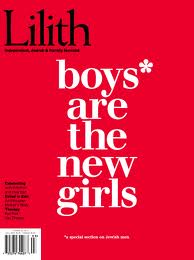
The role of men and boys in American Jewish life is a topic of growing concern – current research on boys available on BJPA ranges from Wishing For More: Jewish Boyhood, Identity and Community to “Bros” and “Ho’s” in Jewish Life Today.
Monday night, Moving Traditions, the organization that gave us the “Rosh Hodesh – It’s a Girl thing” program, unveiled a new program geared at teenage Jewish boys – along with a substantive report on Jewish American boys’ participation in American Judaism.
We are living in exciting times. There is no historical precedent for the problem of the disenfranchisement of boys in the religion of “Shelo asani isha” (the blessing traditionally recited by Jewish men, thanking God for not making them women). Certainly there is no shortage of men at the tops of Jewish structures, as the ongoing work of organizations like Advancing Women Professionals and the Jewish Community continues to document. But what does that avail us if we are bleeding boys from the bottom? (more…)
- 1 Comment
November 1, 2010 by Liz Lawler
Practice Makes Jewish
 Let me round out this story in a last navel-gazing post. In the aftermath of my conversion, I felt a big, “now what?” There is a sense that this is a pivotal moment; you have the opportunity and the burden to make good on all of these promises, these openings in yourself and your life. But I was in the odd position of having to define the notion of “secular conversion” for myself and for the little family that I had very recently created. No one bats an eyelash when a born Jew refers to him/her self as a “secular Jew.” But for me to say that… Well, this gives pause. And why the difference?
This gets us into uncomfortable territory. Because to talk about this, you also have to acknowledge that we (sometimes) still revert to thinking of Jews as a race, an ethnicity, a group of people defined not just by faith, but by some particular coding in their DNA. I can’t be a secular Jew because, well, I am not made up of the right genetic stuff. I don’t look Jewish enough to be a Jewish Atheist. (Are you wretchedly uncomfortable yet? Offended? Should we even be talking about this?) It’s nonsense, of course. Or, at the very least, it is problematic. The fact is, there are Ashkenazi Jews, Sephardic Jews, Ethiopian Jews, etc. Sometimes we sanitize the language by referring to Jews as a “nation.” But nations, by definition, have geographic borders, and in spite of Israel’s existence, Jews are still a diasporic people. Finding a coherent definition of “Jewishness” is a quixotic and nuanced process. (more…)
- No Comments
November 1, 2010 by Elizabeth Mandel
Feminists in Focus: A Peaceful Middle East
Welcome to the latest installment of “Feminists in Focus: Film News and Reviews,” an incisive look at the new film, Budrus, from filmmaker and Lilith contributor Elizabeth Mandel. Enjoy!
 The media is replete with violent images of Palestinians, Israelis and Muslims; of veiled Muslim women subjected to the will of the men in their lives; of a sense of hopelessness regarding the Israeli-Palestinian conflict. The recent documentary film “Budrus,” directed by Julia Bacha, offers an alternative version to this story, and through that, hope for an alternative vision for the future. The film chronicles the events that unfolded in Budrus, a tiny (pop. 1500) Palestinian village on the West Bank, as the residents came together in nonviolent resistance against Israel’s separation barrier cutting through the village, its cemetery and its life-sustaining olive groves.
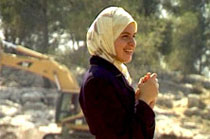 In 2004, the construction of the barrier came to Budrus. It was scheduled to cut through the town, ostensibly unavoidably, for security reasons (no concrete reason is given for why the barrier takes a circuitous path that cuts through and isolates villages from their land and each other). In response, Ayed Morrar, a lifelong activist and six-year-veteran of Israeli prison, organizes “the Popular Committee Against the Wall,” a non-violent resistance movement designed to stop the progress of the barrier. At first it seems the protests are almost benignly endured by the Israeli military police assigned to Budrus. There is internal disagreement about whether the bulldozers should stop or continue. But soon, olive trees are being dug up, and it seems inevitable the protestors will be stopped and the barrier erected. (more…)
- No Comments
October 29, 2010 by admin
JFSJ's Call for Radical Empathy
 Tongues are wagging, per usual, about how this election season is unlike any we’ve seen before. And without having yet seen an October surprise, many of us are standing by for the next big thing. In the meantime, Jewish Funds for Justice is proud to have teamed up with Rabbi Sharon Brous of IKAR for something truly new, and creative, and inspiring, an antidote to the fear-mongering so prevalent these days. It’s a call for empathy. Radical empathy at that.
 Introducing Jewish Funds for Justice’s new video, “Al Tirah! Fear Not!,” featuring Rabbi Brous, one of only three women included in Newsweek’s 2010 list of “Fifty Most Influential Rabbis in America”— and starring two irresistible monsters, fear and empathy.
Learn more about JFSJ’s new campaign to combat fear and inspire engagement in the upcoming election. You can visit the Fear and Empathy monsters on Facebook, where they’re facing off! (You can even friend them!) And don’t miss this article.
-Erica Brody
Associate Director of Communications
Jewish Funds for Justice
- No Comments
Link Roundups, Nothing New Under the Sun
October 29, 2010 by Jill Finkelstein
Link Roundup: Breast Cancer Awareness
 Everyday, we come across interesting articles and wonderful resources for Jewish feminists. Now we are bringing them directly to you in a new feature of the Lilith blog, our weekly Link Roundup. Each week we’ll post highlights from around the web. And, we want you to get involved! If there’s anything you want to be sure we know about, email us or leave a message in the comments section below.
Start here with a peek into the Lilith’s rich archives in this week’s special edition of Nothing New Under the Sun! For a look at Lilith’s unique take on breast cancer awareness, click here to download our 1995 article entitled “MASTECTOMY: Twelve Months after Surgery A Bathing Ritual for the End of Mourning.”
 On Thursday, Jerusalem hosted its first-ever breast cancer race, sponsored by Susan G. Komen for the Cure Foundation. In honor of the event, the walls of Old City Jerusalem were lit up with pink lights. [Washington Post]
As it turns out, the Susan G. Komen for the Cure Foundation and Israel have had a strong bond for a number of years. Israel was awarded the foundation’s first international research grant 16 years ago. The foundation has also invested $2 million in several research facilities in Israel, including Weizmann Institute of Science, Hebrew University-Hadassah Hospital in Jerusalem, Beit Natan and Life’s Door. [The Fundermentalist]
Over at The Sisterhood, Chanel Dubofsky explains her concerns in her blog post entitled “Why I hate Breast Cancer Awareness Month.” She cites Barbara Ehrenreich, who wrote, “To some extent, pink-ribbon culture has replaced feminism as a focus of female identity and solidarity” in her 2009 essay, “Not So Pretty in Pink.” Debra Nussbaum Cohen goes on to add that “ribbon culture as a whole — and its sister statements, the cause-related Facebook status update and the endlessly-forwarded email — have for many replaced meaningful social activism.” [The Sisterhood]
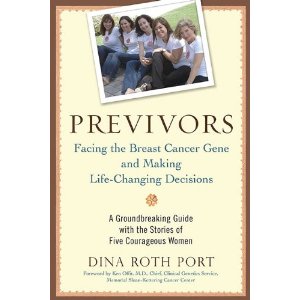 The Jewish Week reviews a new book called Previvors: Facing the Breast Cancer Gene and Making Life-Changing Decisions, by Dina Roth Port. The book documents 5 high-risk women who take extreme precautionary health measures to prevent breast cancer. The article notes that breast cancer is more prevalent among Jewish women because, “Ashkenazi Jews have a 10 times greater chance of carrying either mutated BRCA gene than the general population.” [The Jewish Week]
–Jillian Finkelstein
- No Comments
October 27, 2010 by Amy Kronish
Feminists in Focus: The Launch of Lilith’s Film Blog!
 We are so excited to announce the launch of something new, special, and unique to Lilith online: our new feature column on the Lilith blog, Feminists In Focus: Film News and Reviews. In this series, we’ll be bringing you incisive film commentary and context from fabulous (and feminist!) film critics. You’ll get a fresh perspective on films playing right in your area, and leads to movies so rare–or so new–that they haven’t even been screened yet at your local indie film festival.
For our inaugural post, we present a thought-provoking review from Amy Kronish, who writes and lectures widely on Israeli cinema. She served for 15 years as the Curator of Jewish and Israel Film at the Jerusalem Cinematheque – Israeli Film Archive, and more recently directed coexistence programs at the Jerusalem International YMCA. She is the author of two books on Israeli Film– World Cinema: Israel (1996) and Israeli Film-A Reference Guide (2003). Born and bred in the United States, she has an MA in Communications from NYU and has lived in Jerusalem since 1979. She blogs at www.israelfilm.blogspot.com.
Read on, enjoy, and talk back! We’re eager to know what you’re focusing on in the world of film.
The Human Resources Manager
Directed by Eran Riklis (Israel, 2010)
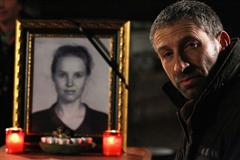
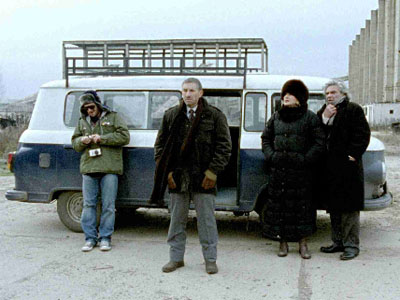 At a time when we’re seeing many films about dislocation and migrant labor, along comes a new film on the subject that is actually an atonement for society’s treatment of the migrant workers in our midst. The Human Resources Manager, directed by Eran Riklis, is not the ordinary migrant worker story. From the opening sequence we know Yulia has been murdered by a suicide bomber, and her life is now proof that migrant workers are just as human as anyone else; in fact, they can even be just as “Israeli” as any other Israeli, when it comes to the ever-present threat of death. (more…)
- No Comments
October 26, 2010 by admin
Back Home in my New Home
 These past few months, I’ve been alternately migrating and nesting. We, my husband Yosef and I, taped up boxes, zipped up luggage and flew from the Middle East to the Northeast. From the crowded corridors of the shuk to the tight aisles of (the) Fairway. From Jerusalem’s alleys to New York’s avenues.
Yosef and I just got married in August, the day after Chelsea Clinton, in the Jersey synagogue where I grew up. Now, we’re both back in rabbinical school at JTS. I’m still playing with head-coverings (see my letter from Jerusalem for more on that) — a striped spandex wrap, a brown herringbone cap and the absence of accessories above. Here is some of my writing about coming into a new space and a new self:
Threshold
לֶךְ-לְךָ מֵאַרְצְךָ וּמִמּוֹלַדְתְּךָ וּמִבֵּית אָבִיךָ, אֶל-הָאָרֶץ, אֲשֶׁר אַרְאֶךָּ
Get going, from your land, from your birthplace,
from your parents’ home to the place I will show you. . .
“Hi Manny,” I say to the doorman. He and Yosef are standing under the scaffolding, talking about El Salvador and how fierce the soldiers are there. “You don’t want to mess with them cause they’re like.” (Manny slants his eyebrows and furrows his lips, in an imitation of the no-nonsense, no-negotiation stance of the soldiers of his homeland.) Manny tells me I have a package at the desk. (more…)
- No Comments
October 21, 2010 by Liz Lawler
One Step Forward, Two Steps Back: A Two-Act Conversion Story
So where did we leave off? Was I up to my waist in the mikvah? Yes. But let me back-track to the conversion process itself.

I chose the “easy” way in, so to speak. Faced with the multiple schools of Judaism, I panicked and went with the one that seemed the least dogmatic. I chose a Reform rabbi to initiate me. But while it was non-threatening in many ways, it also left me with the anguish of choice and agency. It gave me the responsibility of co-creating my own sense of Jewishness. My rabbi never claimed to have any definitive answers, refused to impose too many rules. There was a decent amount of structure: I got the usual crash course in Jewish literacy, took a class called Judaism 101. And, at the rabbi’s insistence, this started out as a joint-process. My then fiancé had to attend the classes, and private sessions with the rabbi. We also went to services semi-faithfully. Ostensibly, this was so that we would be on the same religious page, as a family. But really, I felt like it was only fair, that he should have to sit through these interminable services with me. He could barely disguise his boredom. As for me, it was overwhelming, all of this Hebrew, the up and down, the repetition and the singing. So there we were: side by side, both of us terribly awkward about the whole thing, but for different reasons. (more…)
- 1 Comment
October 18, 2010 by Amanda Walgrove
At the Theater: Abraham's Daughters

Abraham’s Daughters, written by Elissa Lerner and directed by Niccolo Aeed, premiered at the New York International Fringe Festival this year along with over 200 other talent-filled plays. Lerner, currently a graduate student at NYU, penned the script as a thesis for her double major in Religion and Theater Studies at Duke University. After reading a great deal of text about Abraham’s Biblical sons, the playwright pondered, “Even to provoke half of a thought: What if? How would things be different? How would women tell the story of their religious experiences?” Lerner, as the female pseudo-Abraham, scribed the lives of the Jewish Sarah (Rebecca LaChance), her Muslim roommate Ranya (Dea Julien), and their Christian friend Kate (Keely Flaherty). Additionally, Lerner cleverly throws Will (Aryeh Lappin) into the mix, representing a belief that is becoming increasingly contagious throughout American youth. He is an atheist who repeatedly insists on being called a rationalist. In a contemporary and relatable context, these four friends come to understand that religious values can be as fragile as budding friendships. (more…)
- No Comments