 Please wait...
October 11, 2011 by Sonia Isard
Paint Yourself Out

Eva Hesse, No Title (detail), 1960. http://www.brooklynmuseum.org
“The hell with them all. Paint yourself out, through and through, it will come by you alone. You must come to terms with your own work not with any other being.” You tell ’em! Read this excellent piece about the new Eva Hesse exhibit (and about her family’s escape from Europe in 1938), and then go right away to see the show at the Brooklyn Museum.
- No Comments
October 4, 2011 by Sonia Isard
Lilith Intern Takes the Stage!
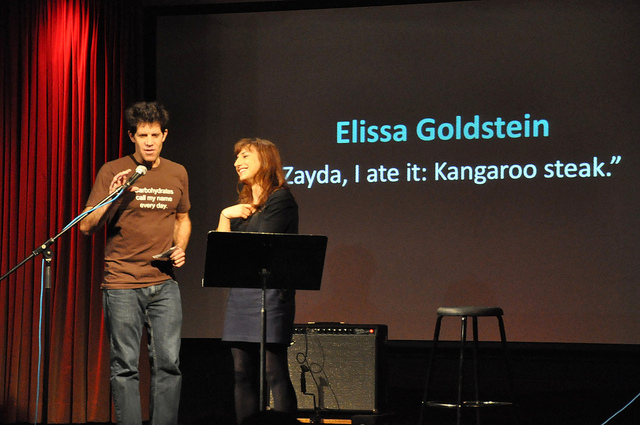
92YTribeca
Elissa Goldstein emerged victorious! Her six-word story was a winner at the recent Jewish memoir competition run by Tablet magazine and Smith magazine. See below for more pics from the occasion, which also featured Deborah Copaken Kogan and Walter Mosley! Congratulations, Elissa!
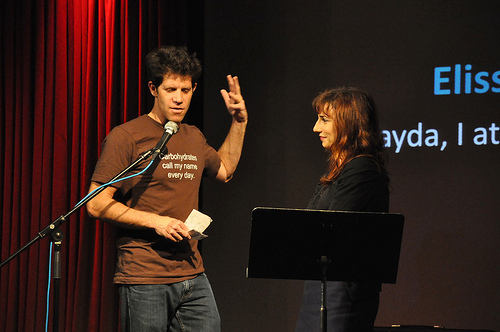
92YTribeca
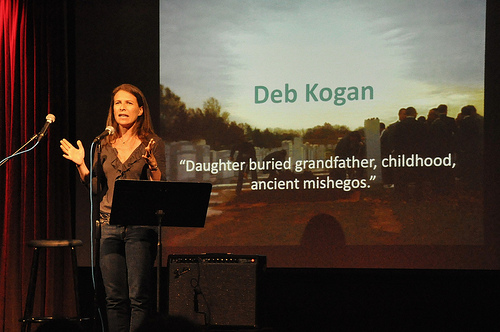
92YTribeca
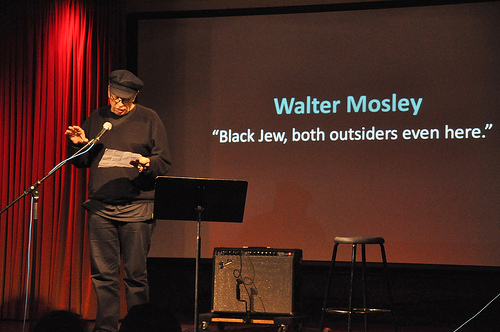
92YTribeca
- No Comments
October 3, 2011 by Susan Weidman Schneider
Are Jewish Sororities an Untapped Opportunity?
Cross-posted with eJewish Philanthropy.
 I’ve been revisiting a 1997 article in Lilith entitled “Jewish Latency,” featured on the cover as “The Jews We Lose.” It’s all about a project Lilith created with the help of a grant from New York UJA-Federation to engage New York Jews in their 20s, just out of college, who found no niche in the Jewish world after having felt very empowered in their campus years.
David Cygielman, CEO of Moishe House, writing in eJP earlier this month declared that the Jewish community too often thinks of people this age as tools for solving “problems” in Jewish life; he noted that this approach “places young adults as unknowing subjects in an experiment they never signed up for.”
But ownership is the key to engaging this cohort, concluded that Lilith article.
The project the “Jewish Latency” article described started out as an idea germinated by Lilith interns, who’d been rebuffed when they approached several Manhattan synagogues wanting seats for the High Holy Days. (This was in an era predating the wonderful services offered by Rabbi Judith Hauptman and others expressly for Jews in their 20s and 30s.) Under Lilith’s mentoring, our interns and their friends decided to create their own Jewish experiences.
Themsleves just out of college, this cohort realized that in addition to finding again the kinds of Jewish leadership opportunities they’d had on campus, they wanted autonomy and agency. They wanted to own what they were willing to invest themselves in creating. The Lilith staff suggested catered Shabbat dinners. Unh unh. Instead, they did DIY potluck vegetarian. We suggested Passover programming. Instead, they hosted a baked-potato third-night seder, announcing that baked potatoes met everyone’s standards of observance. We suggested that the project be called VOICES, an acronym for I-can’t-even-remember-what. The participants renamed themselves “A Tribe Called Jews.” You get the idea.
A Tribe Called Jews came to my mind again this month as I was editing an article on Jewish sororities for Lilith’s fall issue. Lilith is now marking its 35th anniversary, and despite the huge range of subjects the magazine has covered, we’ve never before reported on Jewish women in the Greek system. It turns out that like those Jewish activists – male and female – who germinated A Tribe Called Jews, many young Jewish women in sororities feel empowered in their campus roles, then feel they’ve fallen off the Jewish map after they graduate.
The author of the forthcoming article, Shira Kohn of the Jewish Theological Seminary, spent a decade and a Ph.D. dissertation exploring what goes on in Jewish sororities. She suggests that the organized Jewish community is missing an opportunity to keep these women connected once their college years are behind them. (Here’s an advance look at the article)
Some of Kohn’s insights took me by surprise. Much of what I perceive about sororities is derived from their less-than-flattering images in popular culture. In some circles, every Jewish sorority woman falls under the shadow of the dreadful, evergreen JAP stereotype, as we discovered when Lilith ran a brief report on a newer iteration of this slur – the phenomenon of “Coasties.”
In reality, many sorority members carry out a range of Jewish social-service projects which Kohn’s duly notes. Their campus experiences – for some, a crash course in competency and community leadership – prepare them to assume roles in the wider Jewish world once they’re living out in that universe. But is anyone recruiting these young educated women? Are Jewish women’s organizations and Jewish social justice organizations flooding campuses with suggestions as to how they can stay connected and engaged after graduation? Hardly at all.
- No Comments
September 28, 2011 by Barbara Gingold
Vivian Silver: An Anglo in Israel
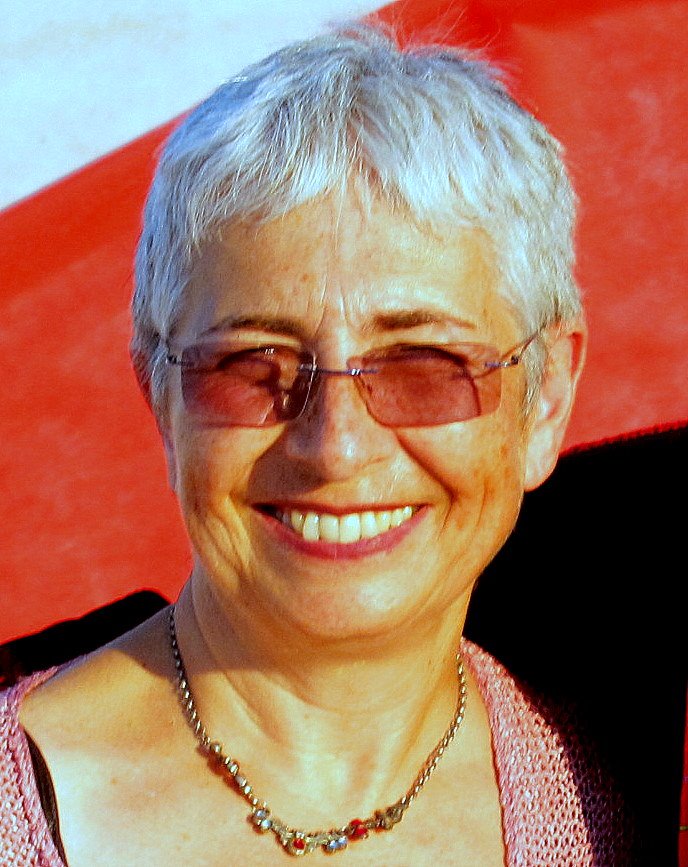 Usually operating modestly behind the scenes, Vivian Silver is making headlines this year. A native of Winnipeg, she moved to Israel in 1974 as a member of the newly reestablished Kibbutz Gezer, where she became one of the few women who had ever served as kibbutz secretary. As an activist in the Jewish “student revolution” of the late 1960s and early 70s, she confronted head-on the glaring women’s issues in Israel and the ever-widening discrepancies between the lives of its Jewish and Arab citizens. Making these the subject of her professional life, she founded the United Kibbutz Movement’s Department to Advance Gender Equality and joined the Knesset sub-committee for the Advancement of Women in Work and the Economy.
When she moved to Kibbutz Be’eri, Vivian came face to face with Bedouin society in the Negev — a community virtually in her front yard living, in large numbers, in third-world conditions. “They could have been subsisting in poverty-stricken villages in India or Africa,” she recalls. Moved to 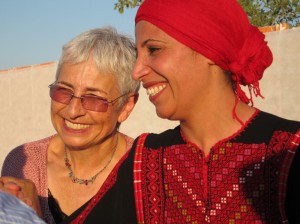 action, she became executive director of the Negev Institute of Strategies of Peace and Development (NISPED), a non-profit dedicated to peace building and sustainable development through people-to-people peace processes.. Through AJEEC, NISPED’s Arab-Jewish Center for Equality, Empowerment and Cooperation, Vivian and her co-director, Amal Elsana Alh’jooj, have literally affected the daily lives of thousands of people — chief among them Bedouin women, who with AJEEC’s help have been making extraordinary leaps of educational, economic and political empowerment.
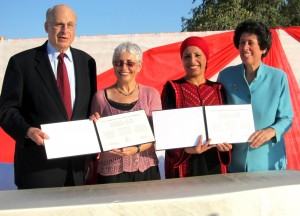 Last June, in a huge tent in the Bedouin town of Rahat, Vivian Silver and Amal Elsana Alh’jooj were the first pair of women to be granted the prestigious Victor J. Goldberg Prize for Peace in the Middle East, which is awarded annually by the Institute of International Education (IIE) for outstanding joint work by an Arab and an Israel to advance the cause of peace. And today, on the eve of Rosh Hashana, 5772, Israel’s leading newspaper, Ha’aretz, chose Vivian Silver as one of “the year’s 10 most influential Anglo immigrants,” noting that: “While Bedouin leaders fume at the government’s recent decision to relocate tens of thousands of their brethren from unrecognized villages in the south into communities with an official status,” Vivian Silver and NISPED help to build bridges in the Negev between Bedouin and Jewish communities — neighbors and co-fighters in the struggle for equality and peace.
Stay tuned for an article about the work of Vivian Silver and Amal Elsana Alh’jooj in a forthcoming issue of LILITH.
-Barbara Gingold
- 1 Comment
September 26, 2011 by admin
Sneak Peek! A Reconsideration of Jewish Sororities

Remember the opening scene of Legally Blonde? Or the Saturday Night Live salutation “Delta, Delta, Delta, can I help ya, help ya, help ya?” To many observers, sororities look like the embodiment of values you’d love to hate – elitism, conformity, traditionalism, and perhaps even “inauthentic” or “superficial” expressions of Jewish identity. Cinematic representations aside, there’s an alternative narrative. Here’s a tip: watch for a hidden proto-feminist agenda in Jewish sorority life. Read the rest here!
- 2 Comments
September 23, 2011 by Merissa Nathan Gerson
America is wonderful during the week
 “America is wonderful during the week, but painful on Shabbat.” This is what my friend Malika wrote me after her first Shabbat back in America. I am a Shabbat nut. I love everything about it, the slowness, the meals, the niggunim. I love remembering my grandmother and finding my people and feeling part of something beyond me, above me, something huge that might carry my entire week to come towards peace.
But Shabbat, this version of intense, gung ho Shabbat is harder to come by in the secular world. At yeshiva in Jerusalem I was the odd one, the resister, the girl who in America was always finding a way to light candles, and in Israel was always desperate to break a biblical law. Over time my resistance subsided and I submitted, full throttle, to the systems that bind. I went to synagogue, I cooked Kosher, I turned off my computer, I walked everywhere, made a dish for the first, second, and sometimes third meal. I did Havdalah when I could, knew the portion of the week, sang loud Jewish songs into the night.
They were horrible, all of those rules, until they became romantic. Obligation, when unable to submit, was torture. And when I submit to the order of Modern Orthodoxy, the obligation became a sweet pleasure. There was a city cloaked in silence, a collective thrust towards peace, a sense of community that drove itself through every obscure Jewish corner. They said jump, so I jumped. And it was that simple. I was a good girl if I followed. But when resisting or unable to adhere I was met with internal and external conflict. There was a psychiatric twist to everything, moments upon moments upon moments where I felt like a sinner when I could not adhere to Jewish law. But the moments I didn’t “sin,” were priceless.
Back in America Shabbat is a whole different story. I long for that system, the checks and balances that a community of observers creates. I miss cleaning on Fridays and shopping for fresh Challah and groceries at the Shuk. I miss potluck dinners with close observant friends and I miss ecstatic prayer and long night walks in carless streets. It was not the law that got me going, as much as a community following the law, friendship and collective an incentive to piety. (more…)
- No Comments
September 22, 2011 by Amy Stone
Out and Ordained – An Update
 Before updating Lilith readers on the story “Out and Ordained,” in Lilith’s current issue, a few corrections to the published piece:
–While Rachel Isaacs is the first openly gay rabbinical student to be ordained by the Jewish Theological Seminary, the seminary’s first openly gay rabbinical student is Aaron Weininger. He entered as a first-year rabbinical student in the fall of 2007. Isaacs entered as a third-year student in 2008.
–Rabbinical School Dean Rabbi Daniel Nevins’ comment that gay and lesbians number no more than “a good minyan” referred to the JTS Rabbinical School, not to the Conservative rabbinate as a whole.
–American Jewish University is an independent institution not affiliated with any one branch of Judaism, although the Ziegler School of Rabbinic Studies, housed within AJU, is Conservative.
As fate would have it, New York State’s legalizing same-sex marriage came shortly after the Jewish Theological Seminary’s ordination of its first openly gay rabbinical student – putting New York’s Conservative rabbis on the line on performing gay and lesbian marriages.
The 2006 Conservative movement law committee responsum allowing gay/lesbian rabbis and cantors within Conservative Judaism also permits Conservative rabbis to perform same-sex commitment ceremonies – if they want to. Proof that homophobia is alive and well, The New York Times article on Conservative rabbis featured one New York rabbi as shamelessly saying he’s never performed a same-sex marriage in his nearly 40 years in the pulpit and is not about to start now. Overtly sexist and racist actions are now taboo, not to mention illegal, but homophobic leaders can still exercise their prejudices.
A measure of the homophobic atmosphere within the Jewish Theological Seminary and beyond during the Conservative movement law committee’s 1991-92 hearings on homosexuality is the 1992 responsum clause against “instigating witch hunts” authored by Rabbi Elliot Dorff, AJU rector and current chairman of the law committee. Meant to protect gays as part of the responsum forbidding homosexual rabbis, Dorff said he “came to regret it – a lot.” He explained the wording was meant as “a flourish” to avoid “any kind of super investigative commission,” but the result was that gay and lesbian rabbinical students and rabbis were the victims of witch hunts instigated by outsiders. (more…)
- 4 Comments
September 21, 2011 by Bonnie Beth Chernin
Rosh Hashanah Dishes of Wishes
 For the new year I’ll have a new congressman. He’s anti-choice and wants cuts that threaten our social welfare. That’s just the tip of the iceberg for Bob Turner, who won the special election for Anthony Weiner’s seat, which includes the New York City district where I live.
And that’s the kicker. One of the key reasons I put up with living in this exhilarating but exhausting city with its bad air, crowded subways, concrete backyards, constant sirens, and exorbitant expense is that this metropolis breeds acceptance of liberal ideas. That here I will find like-minded people who believe government exists to provide a safety net for our communities and public services that protect the most vulnerable among us. I trusted that I lived in a place where my elected representatives thought likewise. This is no longer true and residing in my part of Queens has now upped the ante for bearing life in this city.
As I turn to the new year of 5772, I draw sustenance from a Sephardic tradition that uses symbolic foods accompanied by prayers with wishes for the new year. Rabbi Jill Jacobs explains that many of the prayers incorporate Hebrew puns with the food mentioned. She encourages us to develop our own English puns as we prepare our Rosh Hashanah menu.
So for erev Rosh Hashanah when I am hosting guests for dinner, I decided to serve beet soup to “beet” the blues away that have followed this special election. I plan to get a raisin challah so I can start “raisin’” my energy for Obama’s 2012 election, and I will offer a small bowl of dates, to mark the date when redistricting starts in New York state and with it the loss of two congressional seats, one I hope in my neighborhood.
These are my dishes of wishes I look forward to serving.
May this year be filled with all you hope for in a world at peace. Shana Tova.
- No Comments
September 18, 2011 by Jill Finkelstein
Link Roundup: Remembering 9/11
Welcome to this week’s installment of Lilith’s Link Roundup. Each week we post Jewish and feminist highlights from around the web. If there’s anything you want to be sure we know about, email us or leave a message in the comments section below.
 10 years later, Lilith looks back at Ruth Messinger’s words about September 11th, reminding us what we learned in the aftermath. [Lilith Magazine]
In his new book Contending With Catastrophe: Jewish Perspectives on September 11th, author Rabbi Michael J. Broyde revealed the Jewish dilemma that resulted from the 9/11 attacks. Many Jewish widows became agunot and were not permitted to remarry because they couldn’t prove that their husbands had been killed. [JTA] & [The Forward]
On Thursday, the state of Virginia passed the strictest abortion provider regulations to date in the United States, putting the state’s 22 abortion clinics at risk of being shut down. [Huffington Post]
The U.S. Labor Department has begun cracking down on gender discrimination in wages by examining the pay practices of government contractors. [Capital Business]
The American Civil Liberties Union of North Carolina filed a lawsuit against the state for authorizing a “Choose Life” license plate, while refusing to issue a pro-choice alternative. Katherine Lewis Parker, the organization’s Legal Director, stated, “It is a fundamental tenet of the First Amendment that the state cannot use its authority to promote one side of a debate while denying the same opportunity to the other side.” [Mother Jones]
For the first time ever, the city of Chicago will now offer its employees paid maternity leave. [Huffington Post]
Four religious cadets were dismissed from the army’s officer course after walking out of an IDF event because they refused to listen to female soldiers singing. [Haaretz]
This isn’t the only gender issue that the IDF has faced. This summer, a debate broke out after Avi Zamir, the former head of the Israel Defense Forces’ Personnel Directorate, released a statement calling for the curtailment of the army’s religious extremism because of its threat to the advancement of women in the IDF. [Arutz Sheva] & [Ynet] (more…)
- No Comments
August 30, 2011 by Jill Finkelstein
Link Roundup: Women's Equality Day
Welcome to this week’s installment of Lilith’s Link Roundup. Each week we post Jewish and feminist highlights from around the web. If there’s anything you want to be sure we know about, email us or leave a message in the comments section below.
The cover story from Lilith’s summer 2011 “Swimsuit Issue” was featured in Tablet Magazine and the New York Times opinion section in a letter from Deborah Lipstadt. [NY Times] & [Tablet Magazine]
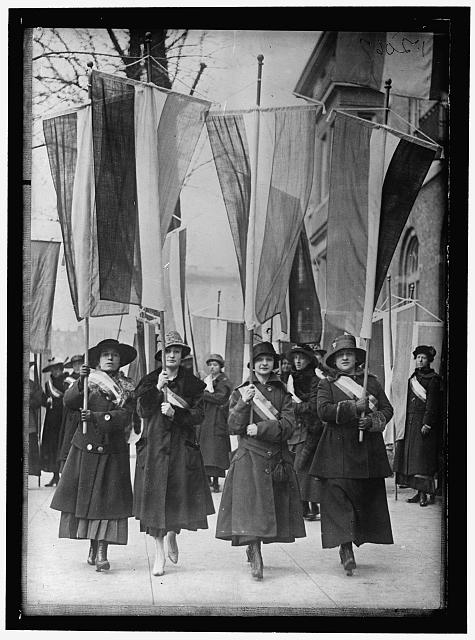 In honor of Women’s Equality Day on August 26th, a coalition of women’s groups have launched #HERvotes, a new campaign to “mobilize women voters in 2012 around preserving women’s Health and Economic Rights (HER rights).” The campaign kicked off by releasing a list of the Top Ten Historic Advances for Women Now at Risk. [Ms. Magazine]
On August 18th, in honor of the 91st anniversary of the passage of the 19th amendment to the U.S. Constitution, JWA recognized the Jewish leaders of the women’s suffrage movement. [Jewesses With Attitude]
Writer Eryn Loeb explained why Gloria Steinem and so many other second-wave feminists were Jewish. [Tablet Magazine]
A new study from Georgetown University’s Center on Education and the Workforce revealed that women have to earn a Ph.D. in order to obtain the same lifetime earnings as men with a Bachelor’s Degree. [Feministing]
Shana Strauch Schick became the first woman to receive a doctorate in Talmud from Yeshiva University. Schick also holds both a bachelor’s and a master’s degree from Stern College for Women, however Stern does not currently have a doctoral program. [YU News]
Last week, TIME magazine featured a profile on Areleh Harel, the West Bank Orthodox rabbi who serves as a matchmaker between gay men and lesbians. Harlel began matchmaking to allow Orthodox homosexual Jews to fulfill their desires to start families and remain in the religious community, while also keeping their sexual orientation a secret. Rabbi Andrea Myers criticized the process, stating, “The key problem with these matches is coercion, people feeling forced into marriage because they see no viable alternative.” [Huffington Post] (more…)
- No Comments