 Please wait...
October 24, 2011 by Merissa Nathan Gerson
The Satin Kippah
 Recently at a gas station I saw a kippah on the security camera. It struck me as odd and exciting to see not only a kippah but a woman with a kippah at a Berkeley, CA gas station. It took a moment to register the black dress, the pink belt, and a wave of fear arrived when I realized the woman in the security camera was me.
I took a job at a Masorti Conservative congregation’s Hebrew School earlier this year. Part of the job description included a clause that I was to wear a kippah while teaching Torah, while in the synagogue sanctuary, or while eating. The expectation was welcome after a year in a Modern Orthodox community where my sporadic use of a kippah never failed to garner laughter and shock, and sometimes a feminist nod.
On the contrary, at this Masorti synagogue I am obliged to wear one and fit in just fine. But when I exit the building, almost immediately, I make a point to remove the kippah. The only outside of synagogue kippah wearing occurs when I help the students cross the street to the park. And for even just that there is always a self-conscious awareness. I imagine the thoughts of the on looking cars and park dwellers like I did helping my wheelchair-bound friend cross the street in high school. Their imagined thoughts, like “look at the Jewess and her flock,” or “wow, poor guy, look at this woman helping him,” both bothered and affirmed me.
- 3 Comments
October 19, 2011 by Danica Davidson
A Conversation with Gloria Feldt
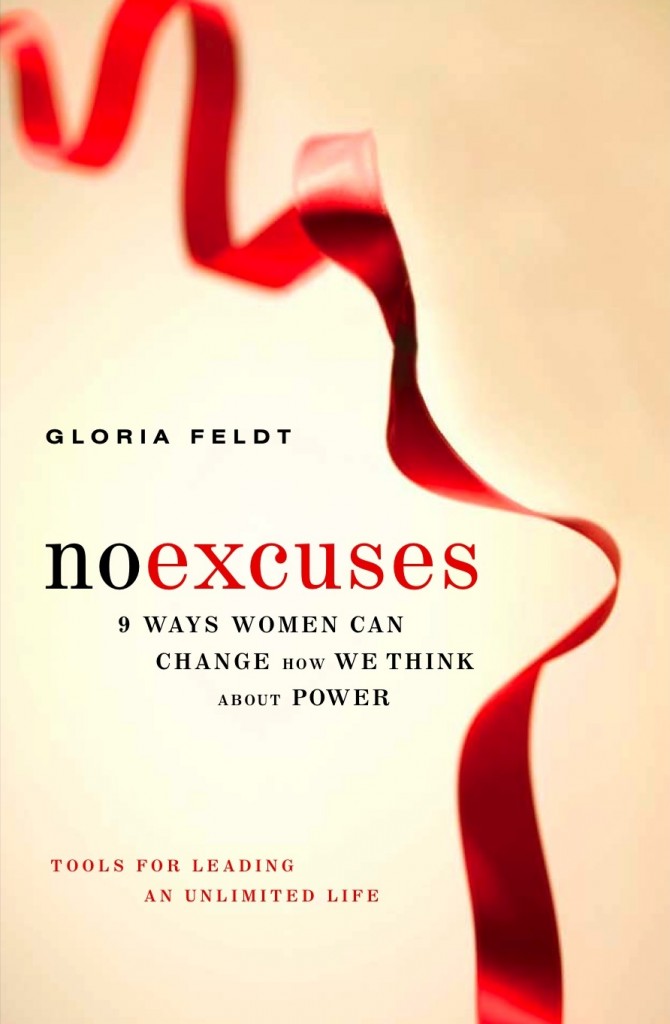 Right-wing challenges to women’s access to safe and legal abortion, and to other reproductive rights, are being mounted in many locations. Gloria Feldt (www.gloriafeldt.com), former president and CEO of Planned Parenthood, is a leading activist for women’s rights. Author of No Excuses: 9 Ways Women Can Change How We Think About Power, Feldt has some ideas about how we can seize back this important agenda.
How did your background as a Jewish teen mother get you where you are today?
When I was young, I felt different for being Jewish in a small town in Texas. I think that that feeling of differentness made me want to be the all-American girl when I was a teenager. And being the all-American girl in rural West Texas in the 1950s meant getting the boy, getting married, having babies, packing your husband’s lunch, having a picket fence.
I became pregnant. On one level, it was unintentional. On another, I think it was intended. I was conforming to the role society was telling me I should play.
As I became more mature, I began to reflect on my upbringing. I began to work to help other people get their civil rights, people who’d been treated as different. Fighting for other oppressed people began to give me strength. I became grateful for knowing what it was like to be different. I was also informed by the Jewish ethic, tikkun olam, even though those words were never uttered in our house, as far as I can remember. But once I came to understand that concept, I understood the Jewish imperative for social justice had influenced me.
- No Comments
October 18, 2011 by Andi Arnovitz
Synchronicity: On the Rescue of Gilad Shalit
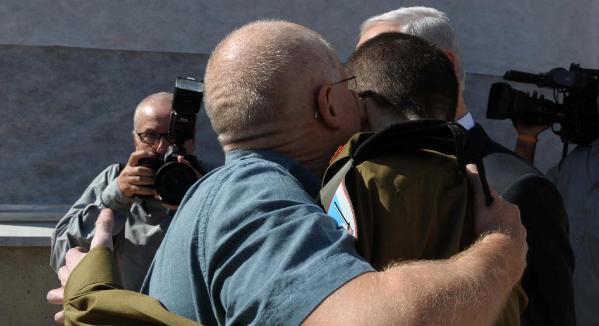 There is much too much synchronicity in the air right now. It’s hard to breathe. I am desperate for a mundane randomness in events but I find everywhere I turn there is a plethora of parallels, of metaphors; an abundance of symbols. There is no escaping the weight of the times in which we are living: one too many coincidences are no longer coincidences.
Tuesday Gilad Shalit is due to return home.
Being an artist, with a vivid imagination, I have spun many moments for him in my head:
The cacophony of Hebrew pummeling his ears for the first time in five years.
The physical pain of daylight.
The peculiar and personal smell of his father’s neck.
More of something. Anything.
Music.
Privacy
Eating his favorite cake, a cake which surely Aviva is baking for him, measuring slowly, carefully, sifting the flour and sugar, crying, the salt from her tears a just substitute for the table salt the recipe requires. Wondering, as she stirs and mixes, what she will find, what sort of son is being handed back to her now, and where in the book of mothering are the directions for what lies ahead?
- 1 Comment
October 18, 2011 by Naomi Danis
Waiting for Gilad
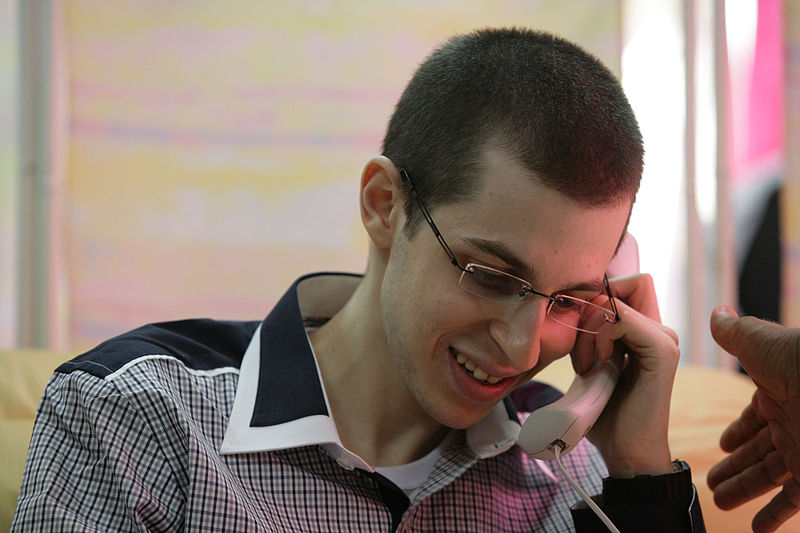 I took my laptop to bed last night tuned to Ynet to wait and watch with the people of Israel for the release of Gilad Shalit, and it seemed to take forever. The logistics were complicated, the politics complex–I was reminded of Blu Greenberg’s comment that when there is a rabbinic will there is a halakhic way. Waiting, we were all suspended in a mix of longing, fear, hope, and sadness too. I love the barely restrained affectionate intrusive sense that everyone cares about each other in this still very young country. I believe that Aviva and Noam Shalit’s devoted tent dwelling and mobilization of others for an important cause should be an inspiration for other tent dwellers all over the world, whose efforts, will, I hope, bring about good. I pray for Gilad’s fulfillment in his freedom after captivity, and for peace among Israel and its neighbors.
Naomi Danis is Lilith’s managing editor.
- No Comments
October 18, 2011 by Sonia Isard
Occupy Your Mind
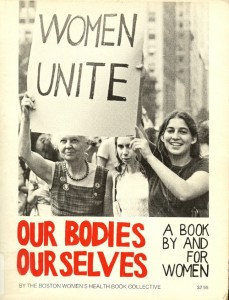
http://www.ourbodiesourselves.org
Looking for a little light reading as you Occupy [Wall Street/Judaism/what have you]? You’re not alone. Elizabeth Gumport reports back on “the missing—or lost!—link between health class and internet pornography” that is Our Bodies, Ourselves. Thank you, People’s Library, for reminding us to find new meaning in the classics!
- No Comments
October 18, 2011 by Amy Stone
Occupy Sukkot/Occupy Judaism – Would you go to jail for this?
Down at Zuccotti Park (aka Liberty Plaza) we had the choice of the sukkah we go to and the sukkah we don’t go to. It was the day after the Occupy Wall Street protesters refused to move out of the park for a sanitation department cleanup. The occupiers cleaned up the park and the establishment backed down, at least for the moment. What better place to celebrate Shabbat-Sukkot.
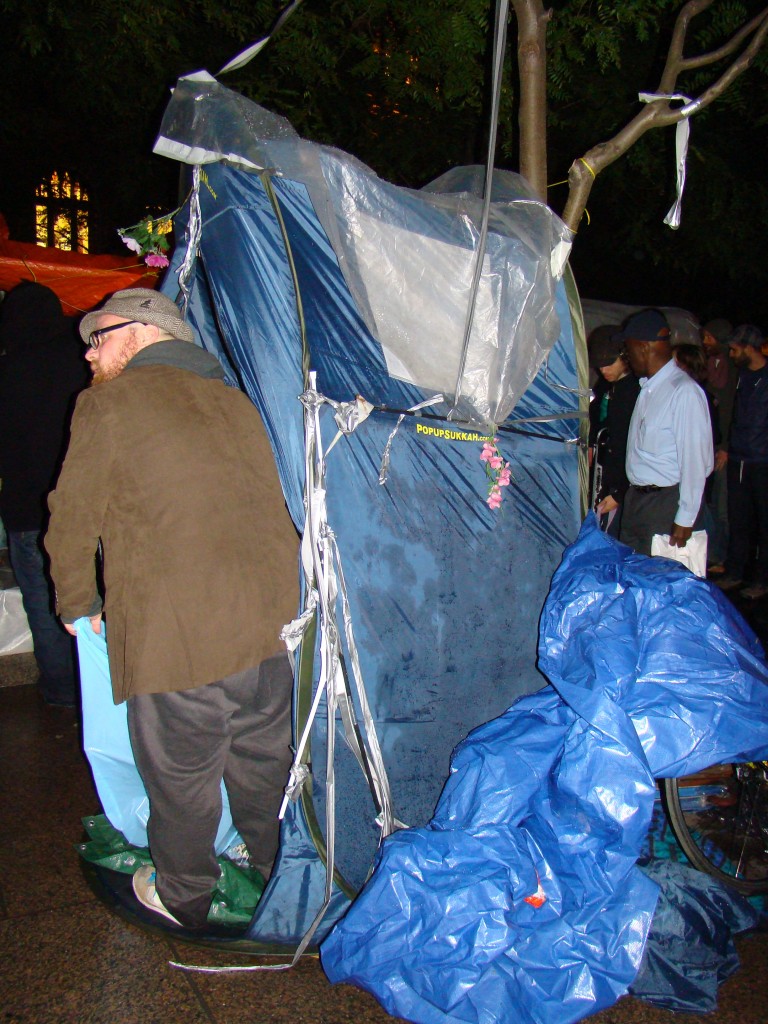
Photo by Amy Stone
Before the cleanup showdown, Daniel J. Sieradski, the “post-Orthodox” organizer behind the Kol Nidre service next to the park, had assembled a Chabbad popup sukkah in Zuccotti Park. The halachic hovel was unfit for man or beast – especially in high winds and rain. Friday evening Sieradski was vacating, while a few yards away, Jews for Racial and Economic Justice (JFREJ) were getting ready to celebrate Shabbat and Sukkot under a sturdy non-halachic shelter. “Shake, shake, sniffy, sniffy” Participants were instructed to shake the lulav and sniff the etrog.
Then the cops moved in. No tents allowed. What is this, anti-Semitism? (Just joking – haha.) What about that tent over there? Policewoman explains that the huge tarp attached to a few trees is “not a tent. It’s an umbrella.” The guidelines are obviously in flux. The head of JFREJ, Marjorie Dove Kent, takes a hands up/hands down vote (fingers wiggling OWS vote style) on whether we want to risk arrest.
We barely have our Judaism or our politics together but the majority definitely does not want to risk arrest on this issue at this time.
- 1 Comment
October 17, 2011 by Maya Bernstein
The Train: New Poetry
Each week, I travel to and from work by train. My children cling to my legs and wave their arms and shout farewells, as I board my bike and pedal towards the train station, feeling a tight-throated yearning for their sweet presence, and a gravitational pull towards freedom, possibility, self. The train has become a powerful metaphor for my life. As soon as I board, I am acutely aware that I have made a decision and put myself in motion, and then, of a sudden, am not in control, am barreling toward a destination, watching the world beyond the window, wondering. It has become a space of poetry, a liminal space of possibility, and, in its own way, a space of prayer. Below are two poems I wrote during the month of Ellul and the period of the High Holy Days.
- No Comments
October 17, 2011 by Sonia Isard
What's the Impact of Praying in Public?
 Forward editor Jane Eisner’s incisive commentary on Occupy Judaism: She says Kol Nidre at OWS marked “a small but significant turning point for both Jews and progressive causes, a sign of arrival for Jews and a return to the historic place that religion played in the public face of progressive activism.” I’m also interested in (and more ambivalent about) the public face of progressive Judaism — how does the meaning of Jewish practice change when the deeply moving yet sort of raw and untamed Kol Nidre liturgy rings out across Zuccotti Park?
- No Comments
October 12, 2011 by Jill Finkelstein
Link Roundup: High Holidays Edition
Welcome to this week’s installment of Lilith’s Link Roundup. Each week we post Jewish and feminist highlights from around the web. If there’s anything you want to be sure we know about, email us or leave a message in the comments section below.
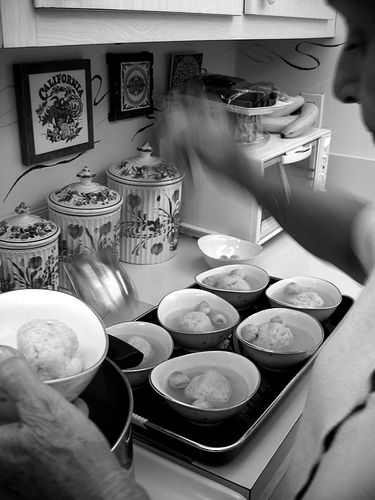
http://www.flickr.com/daniellerose
Writer Ann Brenoff shared why an article in Lilith inspired her to collect trash on her wedding day. [Huffington Post]
In honor of the High Holidays, Dr. Sharon Ufberg commented on why the holidays mean extra work from women, adding that “while the burden is great, the blessings and joy of the cultural connection to ones’ roots and the pride of heritage keep Jewish women… willing to continue to bring the family together to celebrate and remember, year after year.” [Huffington Post]
Chanel Dubofsky encouraged women to be less apologetic this holiday season, especially when it comes to their beliefs about reproductive health. [Jewesses With Attitude]
In honor of National Domestic Violence Awareness month, Jewish Women International created a special Misheberach prayer for victims of domestic abuse. [The Jewish Chronicle]
Women around the world rejoiced after it was announced that this year’s Nobel Peace Prize would be awarded to three women — Tawakkol Karman, Ellen Johnson Sirleaf, and Leymah Gbowee — for their “non-violent struggle for the safety of women and for women’s rights to full participation in peace-building work.” [Washington Post]
- 1 Comment
October 12, 2011 by Amy Stone
Kol Nidre Alongside Occupy Wall Street
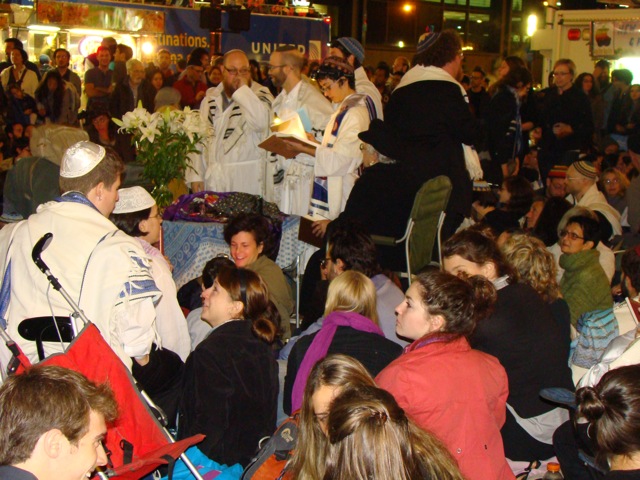
Photo by Amy Stone
You’ve got to be attracted to a call to a Yom Kippur service next to the Occupy Wall Street protesters, especially when the Facebook invite starts with a quote from Rabbi Abraham Joshua Heschel:
“Prayer is meaningless unless it is subversive, unless it seeks to overthrow and to ruin the pyramids of callousness, hatred, opportunism, falsehoods.”
The weather and the police cooperated, and at Friday’s Shabbat Kol Nidre, a crowd estimated at 700 gathered next to Zuccotti Park (aka Liberty Plaza), OWS home base a few blocks from Wall Street.
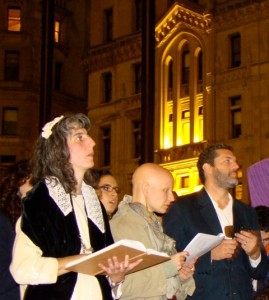
Photo by Amy Stone
The impassioned and knowledgeable leaders (one woman, several men) conducted the egalitarian service using the new Conservative high holiday prayer book, with 100 copies lent by the Rabbinical Assembly (the organization of Conservative rabbis) and numerous photo copies. The service took place on the plaza in front of global financial services firm Brown Brothers Harriman. A large Bank of America presence on one side, smoothie and halal trucks on another, just beside Zuccotti Park. It felt like davening next to the circus with the constant drumming of the OWS musicians.
Same for the Yom Kippur sermon of Getzel Davis, a fourth year rabbinical student at the “transdenominational” Hebrew College outside Boston. Davis opened up with the myth that Yom Kippur is the day we’re forgiven for worshipping the golden calf. Nothing like absorbing the message of a sermon by all assembled repeating every word. (more…)
- 3 Comments