 Please wait...
December 22, 2011 by Bonnie Beth Chernin
Menorahs I Have Known
http://www.flickr.com/bontempscharly
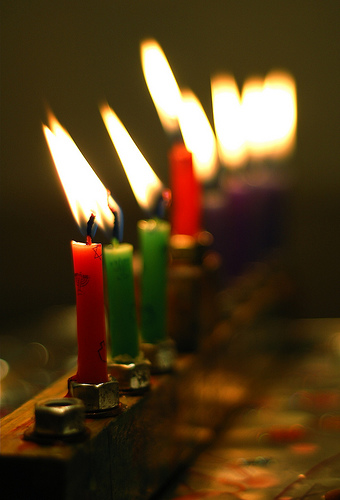
I had only one menorah in my life for my first 18 years. The blue chanukiah with brass candle holders in the shape of simple lamps that belonged to my parents. I don’t know how they came to own this menorah, but I welcomed its reliable appearance that marked our holiday tradition as much as my father’s latkes and my grandmother’s five dollar checks to all of us grandchildren.
But more menorahs have come into my life as I’ve moved through the stages of being a single adult, followed by marriage and motherhood.
A graceful pewter menorah, with purple glass at the base where the candle holders branched out, reminded me of my mother when I began celebrating Chanukah in my own apartment. I fell in love with the menorah at a local Judaica store. My mother adored glass, the lure of light seen in its reflection. When I saw the flickering candles shining in the menorah’s smooth purple disk, it brought back the insight into wonder my mother had shared with me.
That menorah was set aside the first year of my marriage when my husband brought his own, made of stone and lit with oil. Since for years I had faithfully used the blue square box of multicolored candles to bring light into December darkness, I was intrigued to use a menorah that featured a different lighting technique.
- 1 Comment
December 19, 2011 by Julie Sugar
Immerse and Emerge: Revisiting the Mikvah

http://www.flickr.com/rose770
A new year is approaching, and winter is settling in. As we prepare to jump into 2012, and think about what sort of resolutions we will be making, I can’t help but reflect on how the Jewish year began a few months ago, and the specific blessings I sent to myself then—while underwater in a mikvah in Crown Heights, Brooklyn.
When I was married, I struggled with going to the mikvah. I struggled with having the mikvah attendant watch me immerse in the waters of the ritual bath and then deem me kosher. (I realize that she was declaring my dips into the water kosher, and not my actual self, but having someone sing-song “kosher!” over you blurs the lines of how the experience feels.) Why did an outside institution, and another human being, get to have a say in the cycle of my most personal relationship? I resisted the structure. I often wished that I had access to a lake, where I could quietly go by myself under the moonlight, or I half-jokingly wondered if I could just take a really long bath at home.
This particular struggle was over—and others began—when my husband and I split up over the summer. Right before Rosh Hashanah, I received the get, the Jewish bill of divorce. I barely observed Rosh Hashanah this year; I had a meal with a friend with honey and figs on the table; I bought a ticket in advance but didn’t go to shul. I napped, a lot. I felt guilty and thrilled and guilty I felt thrilled.
- 3 Comments
December 15, 2011 by Maya Bernstein
Shine
Hashomer Hatzair Archives Yad Yaari
My oldest daughter recently performed in her kindergarten’s annual Thanksgiving Extravaganza. What is it about watching your kid in a school performance that turns a parent into dripping, slobbering mush? There is something so visceral about seeing your kid “up there,” shirt tucked in, braids in place, belting out songs and moving like a turkey and reciting her two lines. As the child stands there, hands stiff at her side, telling the i-phoned face audience of grandparents and parents and siblings, “our next song is ‘Run Turkey Run,’” the parent has a moment of meaning and purpose. I have made a difference in the world. My child is doing something; she is active, she is a participant, she is a contributor. It is invaluable to see your child represent something greater than herself, participate in creating meaning with others, and share that meaning with her world. That is where children shine, and that, in turn, re-connects their parents to what is valuable and important in their lives.
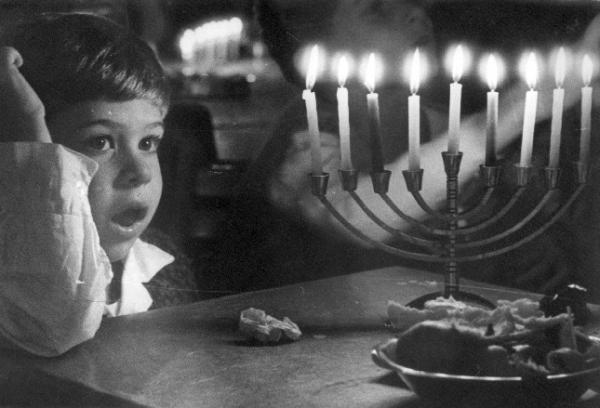
The winter holiday season is upon us, and it is an opportunity to shine. Chanukah, probably the most celebrated and public of all Jewish holidays, has two core components to its celebration. The first is lighting Chanukah candles, one candle on the first night, two on the second, three on the third, increasing the light and the candles until eight burn bright on the last night. The second, as important as the first, is publicizing the celebration of the holiday. That is why it is customary to light candles in the windows or doorframes, so that passer-bys can see, and say, “Look! The lights of Chanukah!” As we remind ourselves as a Jewish community of our story of survival, we share that story with others.
- 1 Comment
December 9, 2011 by Jill Finkelstein
Link Roundup: Sexism & The Morning-After Pill
Welcome to this week’s installment of Lilith’s Link Roundup. Each week we post Jewish and feminist highlights from around the web. If there’s anything you want to be sure we know about, email us or leave a message in the comments section below.

Plan B One-Step®
In a surprising move which left many women–and women’s reproductive rights organizations–outraged, the U.S. Department of Health and Human Services Secretary Kathleen Sebelius overruled the Food and Drug Administration’s recommendation to make the “morning-after pill” available to anyone, including young teens, without a prescription. Sebelius defended her decision against removing the age restriction, citing that because Teva Pharmaceuticals had not included 11-year-old girls in its study, it had failed to “conclusively establish that Plan B One-Step should be made available over the counter for all girls of reproductive age.” [NY Times]
U.S. Secretary of State Hillary Clinton came under fire after criticizing Israel’s treatment of women. During a Washington, D.C. forum on Saturday, Clinton noted that Israel’s gender bus segregation and the Orthodox boycott of women’s voices were reminiscent of Rosa Parks and Iran. Israeli Finance Minister Yuval Steinitz struck back, calling Clinton’s comments “completely exaggerated.” [Ha’aretz]
On Tuesday, an FBI advisory board voted unanimously to broaden the definition of “rape.” The new definition is currently awaiting final approval from FBI Director Robert Mueller. [NY Daily News]
- No Comments
December 4, 2011 by Maya Bernstein
Farmer’s Market

http://www.flickr.com/pollyann
It happened, and then it was over.
There was nothing much to talk about, and I have mostly forgotten the details. The images are somehow fuzzy, remembered in strange slow motion, as if I am still distracted, surprised that I am in the center of the memory, rather than standing on the side, looking in.
It was a cloudy gray Sunday, late morning. I was in my Super-Mom role; my husband was at the library drinking coffee and reading educational philosophy (on Sundays, he assumes his Super-PhD-Man role), and I was in the park, with our three kids, and my cousin’s two daughters. When my cousin dropped off his girls, his nine year old ran off with my three year old, who promptly fell and skinned her knee and started crying; his seven year old ran off with my six year old, who fell off her scooter and started crying; and the baby started screaming for the swing. My cousin gave me a look. I smiled my Super-Mom smile, answering his unspoken ‘are you sure you can handle this’ question, told my girls to tough it out, and carried the baby over to the swing. And I was fine, and so were the kids, as long as I didn’t think too much about what could happen. I let the girls climb and swing high and jump off and pushed the “what-ifs” aside, because otherwise my husband couldn’t ever work on his PhD, and my cousin’s kids couldn’t slip seamlessly into our family, and that wasn’t the family I wanted.
- 4 Comments
December 3, 2011 by Jill Finkelstein
Link Roundup:Remembering Paula Hyman
Welcome to this week’s installment of Lilith’s Link Roundup. Each week we post Jewish and feminist highlights from around the web. If there’s anything you want to be sure we know about, email us or leave a message in the comments section below.
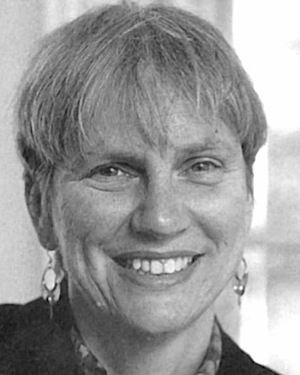 Groundbreaking Jewish feminist historian and activist Paula Hyman passed away on Thursday at the age of 65. [Forward] To read some of her early pieces in Lilith click here and here.
Yeshiva University’s newspaper, the Beacon, faced a backlash after publishing an anonymous female student’s story on premarital sex. Because of the “controversial” nature of the article, the university made the decision to sever ties with the newspaper, and two of the paper’s editors resigned. [New Voices] & [Jezebel]
A new survey, conducted by the U.S. Centers for Disease Control and Prevention, revealed that nearly 1 in 5 of the women surveyed had been raped in their lifetime. In addition, 1 in 4 women reported being physically assaulted by an intimate partner. [New York Times]
On Tuesday, the Ministerial Committee for the Advancement of the Status of Women in Israeli Society met to discuss the exclusion of women in the public sphere. Only two ministers showed up: Education Minister Gideon Sa’ar and Culture and Sports Minister and committee head Limor Livnat. [Haaretz]
Rabbi Tamar Elad-Appelbaum has resigned from her position as assistant dean at the Schechter Rabbinical Seminary in Jerusalem because the school has not fulfilled its promise to ordain LGBT students. [JTA]
For more coverage on the latest news stories, follow us on Twitter at @LilithMagazine.
- No Comments
December 2, 2011 by Jill Finkelstein
Link Roundup: 16 Days of Activism Against Gender Violence
Welcome to this week’s installment of Lilith’s Link Roundup. Each week we post Jewish and feminist highlights from around the web. If there’s anything you want to be sure we know about, email us or leave a message in the comments section below.

16 Days of Activism Against Gender Violence
To mark 16 Days of Activism Against Gender Violence, Lilith shared some of our articles on domestic violence in the Jewish community, including “He Beat Me Black and Blue: Yiddish Songs of Family Violence” from the Spring 2011 issue and “Wife Abuse, Drugs, and Silence” from the Summer 1998 issue.
Yesterday, U.S. Senators Patrick Leahy and Mike Crapo introduced a bipartisan bill to reauthorize the Violence Against Women Act (VAWA). Though the new bill cuts the current law’s funding by 19%, it features new measures to reduce violence against women, including “improved training for law enforcement, victim service providers and court personnel; strengthening of tribal jurisdiction over crimes committed on Native land; expansion of federal housing protections and improved means of tracking funds.” [Ms. Magazine]
A new study, conducted by the Tel Aviv-Jaffa Municipality’s committee for advancing the status of women, revealed that 83% of Tel Aviv women report being sexually harassed at least once in their lifetimes. In addition, the Association of Rape Crisis Centers in Israel reported a dramatic increase in sexual assault complaints following former President Moshe Katsav’s rape trial. [Haaretz] & [Ynet]
- No Comments
November 21, 2011 by Jill Finkelstein
Link Roundup: Redefining Rape and the Feminist Blogosphere
Welcome to this week’s installment of Lilith’s Link Roundup. Each week we post Jewish and feminist highlights from around the web. If there’s anything you want to be sure we know about, email us or leave a message in the comments section below.

Ms. Magazine
In a historic move, the Uniform Crime Report Subcommittee voted unanimously to update the FBI’s definition of rape. The previous definition, which has remained the same since 1929, was limited to forcible rape committed against women. [GOOD]
In a recent issue of New York Magazine, Emily Nussbaum explained how the blogosphere has transformed the feminist conversation. She wrote, “Freed from the boundaries of print, writers could blur the lines between formal and casual writing; between a call to arms, a confession, and a stand-up routine—and this new looseness of form in turn emboldened readers to join in, to take risks in the safety of the shared spotlight.” [New York Magazine]
Following last year’s revelations about the significant gender pay gap and lack of female leadership among Jewish communal professionals, Dan Klein highlighted the advancements made by Jewish Federations over the past year and the problems that still remain for women working in the Jewish community. [JTA]
According to a report from NARAL Pro-Choice America, a Jewish undercover investigator who posed as a pregnant woman was told by five taxpayer-funded “crisis pregnancy centers” that she would go to hell unless she converted to Christianity. [ThinkProgress]
Last week, the Anti-Defamation League criticized the film “180” for comparing abortion to the Holocaust. [Salon]
- No Comments
November 17, 2011 by Tara Bognar
Gangs of Meah She’arim
http://www.flickr.com/38440152@N06
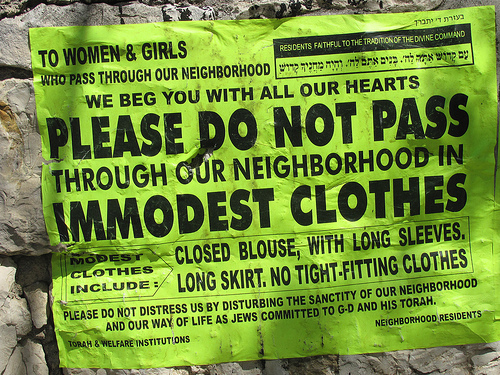
Last week, a Meah She’arim gang that calls itself the Sikrikim assaulted a small group of Haredi girls, yelling and spitting at them for not being quite modestly dressed enough. (Helpfully, Yeshiva World lets us know that the “females” were appropriately dressed and thus, “the attack was without provocation and without justification.”)
A couple of hours later, relatives of the girls returned to the scene and beat up the young men responsible for the harassment. It turned into a brawl involving dozens of people.
Earlier this year, at the end of Sukkot, the Sikrikim glued shut the door of Gerrer Rebbe David Alter to prevent him from leaving the house for services. In retaliation, a group of Gerrer Hasidim boys and men chased down a Sikrikim leader and beat him bloody.
The Sikrikim named themselves after the Sicarii, an ancient Jewish guerilla organization that sought Jewish independence from the Romans and service to God alone, mostly by committing violence against fellow Jews that it perceived as collaborators. The media coverage I’ve seen (mainly English language orthodox and ultra-orthodox blogs), describes the modern-day Sikrikim as an independent group of somewhere between 20-100 young men.
- 1 Comment
November 15, 2011 by Merissa Nathan Gerson
A-Salaam Alaykoum
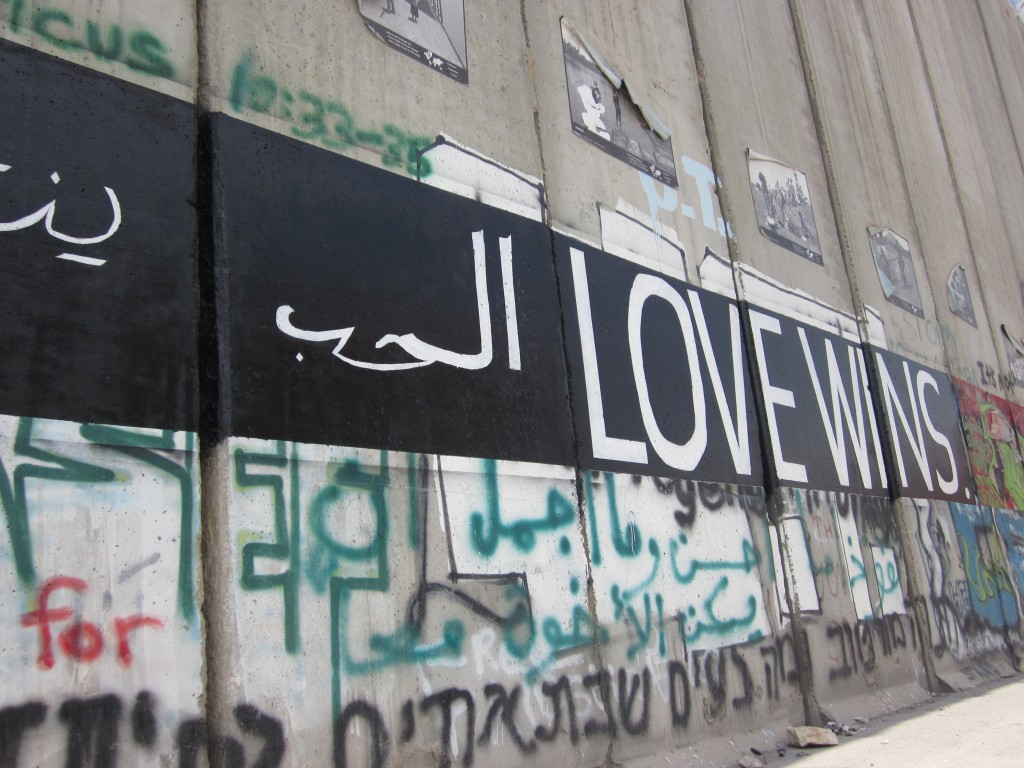 Somewhere between San Francisco and Berkeley I developed a craving for hummus. Not hippie grocery hummus, not coffee shop hummus, not deli hummus but hummus, the real deal. I took a gamble with a Google search on my cell phone and followed it far down San Pablo Avenue all the way to a small place called Zaki Kabob House.
Zaki, of course, was closed upon arrival. I stood outside a bit annoyed and a bit frustrated and then decided to go in anyway, pushed the door, and I was quickly inside the closed restaurant. A young woman in a hair net came out and I said, defeated, “You are closed, aren’t you?” And she answered a curt, “yes.” And then another woman appeared, a beautiful woman in her late 50’s with a full head scarf and warm hazel eyes.
I told her I knew they were closed, but maybe I could just buy some hummus? I smiled and she looked at me like I was her own daughter and said, “of course.”
“You know,” she said, “you look just like my niece. You even talk like her.”
I said, “I miss my mother, I want her hummus.” She said, “Where are you from?” and I answered a hesitant, “I am Jewish.” It went on from there, about my mother’s food and its complex relationship to Jerusalem, to Lebanese food, to food of all walks but for certain, hummus, the homemade, tahini-thick real deal.
She shared with me that she had just come from Jerusalem. “We call it Palestine, you call it Israel.” There was a very un-American recognition of Jewish agency in the equation. “It is G-d’s land,” she said, “When we all die it returns to G-d, it does not belong to anyone.” She had come from East Jerusalem and I said I had never been there, only to Bethlehem, shaking my head at the sadness of that place. “Is it as bad as Bethlehem,” I asked? “No,” she answered, “there is life in East Jerusalem. You can breathe.”
- 1 Comment