 Please wait...
February 17, 2012 Rabbi Mindy Avra Portnoy
Spinoza and Cherry Ames
 Like so many people who harbor secret sins and obsessions, I thought I was alone. And then one day, in the midst of a conversation, no doubt about high-level theological issues (or maybe where to go for lunch), with my friend and rabbinic colleague, Leah, I blurted it out: “did you ever read Cherry Ames when you were young?” She looked startled for a moment, and then responded, “I LOVED Cherry Ames!” Turns out, she and I are not the only ones who did (and do).
When I was a child, Cherry Ames was a favorite. Although I also read the Bobbsey Twins and Anne of Green Gables series, Cherry was the standout. Was it her black curly hair (like mine?) Was it her feisty independence? Was it her ability to solve every problem, not only of the medical variety, but mysteries of every kind? Was it her cute bedroom furniture in her home town of Hilton (Illinois)? Although I never expressed an interest in being a nurse, the Cherry Ames series (23 volumes in all), which portrayed a young woman who seemed to have a new doctor “suitor” in every book, yet always moved on to a new job leaving the would-be boyfriend behind, surely must have had some career-inspiring influence on me.
Somehow, unlike my Pee Wee Reese doll, several of my Cherry Ames books survived through adulthood. And I managed to find the remaining ones in second-hand bookstores and eventually on the Internet.
- 10 Comments
February 14, 2012 by admin
Women’s Roundtable Podcast: Abortion in Israel
Here’s the latest from the Women’s Roundtable Podcast, with Lilith editor in chief Susan Weidman Schneider, Lilith assistant editor Sonia Isard, and the Forward’s Naomi Zeveloff and Gabrielle Birkner. In this installment, we take a look at abortion in Israel and the ways in which Jewish women are shaping American politics. Plus–the ladies tackle the topic of “what Jewish feminism means to me.”
Join the conversation in the comments section below!
- No Comments
February 12, 2012 by Jill Finkelstein
Link Roundup: Prop 8 and the Contraception Compromise
Welcome to this week’s installment of Lilith’s Link Roundup. Each week we post Jewish and feminist highlights from around the web. If there’s anything you want to be sure we know about, email us or leave a message in the comments section below.

http://www.flickr.com/gazeronly
On Tuesday, the U.S. 9th Circuit Court of Appeals declared Proposition 8, California’s law banning same-sex marriage, unconstitutional. The ban will unfortunately remain in effect due to pending appeals. [San Francisco Chronicle]
On Friday, President Obama announced that religiously affiliated institutions would no longer be required to provide contraception coverage in their employer-sponsored insurance plans. Instead, insurance companies will be required to provide women with additional contraception coverage at no additional cost to their premium. [Washington Post]
Due to the recent attacks on women in Israel, the U.S. State Department is now advising American tourists to dress modestly when visiting Old City Jerusalem and ultra-Orthodox neighborhoods. [Huffington Post]
The Women’s International Zionist Organization (WIZO) has called for a boycott on stores selling “sexy” Purim costumes after Israeli retailer Shoshi Zohar featured “near-pornographic” costumes for women in its latest catalog. Concerned about the message that the costumes send, WIZO chairwoman Gila Oshrat stated, “This should not be the way we educate our children. These kinds of sexist ads increase attacks against women and portray us as cheap.” [The Shmooze]
- No Comments
February 10, 2012 by Amy Stone
Feminists in Focus: Yes, There’s Room for More Films on the Holocaust
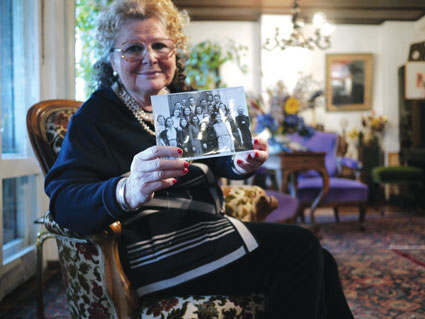
Three Promises
(The New York Jewish Film Festival, presented by The Jewish Museum and the Film Society of Lincoln Center, ended Jan. 26. Look for these films at other festivals and, hopefully, in commercial distribution.)
“Three Promises”
Charm is not a word usually associated with Holocaust remembrances, but take a look at “Three Promises,” the Serbian short with English subtitles that had its world premiere at the New York Jewish Film Festival. It tells the story of Serbian Jewry through beautifully animated collages of black and white photographs from one family’s album. The album survived the Nazis. Most of the family, like almost all of Belgrade’s 10,000 Jews, did not.
The album brings them back to life. It’s a valentine to the past, combined with the horrors.
Almost overloaded with Belgrade’s Sephardic Jewish history, the script by Edward Serotta tells the love story that triggered “Three Promises”: the promise a wife made to her husband to protect their daughters, the promise a priest made to this woman to hide the girls, and the promise one of the daughters made to herself that the priest would be recognized as a Righteous Gentile.
The love story is extraordinary. A Slovene Catholic woman visiting relatives in Belgrade falls in love with a man who is Jewish and crippled. She embraces not only him but his family and his religion. Years later, thanks to a Slovene priest in Belgrade, their two daughters survive to tell the tale.
- No Comments
February 10, 2012 by Tara Bognar
State Funding and Fertility Treatments–In an Israeli Prison

http://www.flickr.com/wesbrowning
How seriously do we take reproductive rights and freedoms?
Israeli Prison Services (IPS) just agreed to fund fertility treatments for two convicted murderers who met and married while incarcerated. The two have the right to conjugal visits and their freedom to procreate is not restricted, but unlike other Israelis, they would not normally be entitled to state funding for fertility treatment. They were prepared to argue, in front of an administrative court, that that restriction violates their right to have children.
Equal access to reproductive freedom is a right long fought for by feminists. Still, reproductive freedom has meant different things to women in different social, economic, and cultural positions. In the United States, poor women, women of color, and women with physical and mental disabilities have fought against forced sterilization and even forced abortion, while other women must fight for access to voluntary contraception, sterilization, and abortions.
The idea that the state should actively decide who may have children touches on core issues of personal autonomy and bodily integrity. In the United States, even people who are convicted of abusing or murdering their children are not legally prevented from having other children.
If everyone else in Israel has the right to state funding for fertility treatments, can it be just, legal, or moral to deny that right to someone just because they are incarcerated? What if their life sentences mean that any children would inevitably become the wards either of the state or another family member? (According to current law, the child may be raised by their mother in prison until two years of age).
Because IPS voluntarily granted funding, no Israeli court had to make that decision.
- No Comments
February 7, 2012 Rabbi Mindy Avra Portnoy
Peach Fuzz Lishma (for its own sake):(“Peaching, Not Preaching”)
 Who picks peaches in August? Certainly not people like me, a rabbi who always anticipated the Jewish High Holidays by beginning to think about writing sermons as early as May. And by August – don’t ask!
But this year is different – now I’m semi-retired (and my husband retired 6 months earlier) and we are out on a weekday (!) in August picking peaches at Larriland Orchard in the countryside not far (but very far psychologically!) from D.C. Perfect sunny day, not humid, breathable air unlike much of the rest of the summer.
The two young women who are handing out the baskets for peach retrieval explain how to select the best peaches. No green on the flesh, a little hard (they’ll ripen in 3-5 days), these rows over here, not the ones farther back. For a born-and-bred city girl like myself, these directions are invaluable. And next to apples (for which I’ll return in a month), peaches are the easiest fruit to pick. The basket fills quickly, long before I’m tired or bored.
As we return to the vending stand to pay for our peaches, we find the two young women (interns? members of the family?) discussing the problem of their sensitivity to peach fuzz, how their constant exposure causes a kind of allergic reaction. Who knew?
Returning to the car, I begin contemplating this phenomenon, heretofore unbeknownst to me. Peach fuzz… the dark side of nature… environmental hazards?.. and suddenly, I realize what I’m doing. I’m thinking “sermon”; how can I possibly use this anecdote in a sermon?
- 7 Comments
February 6, 2012 by Naomi Danis
Feminists in Focus: In Darkness on the Shortlist
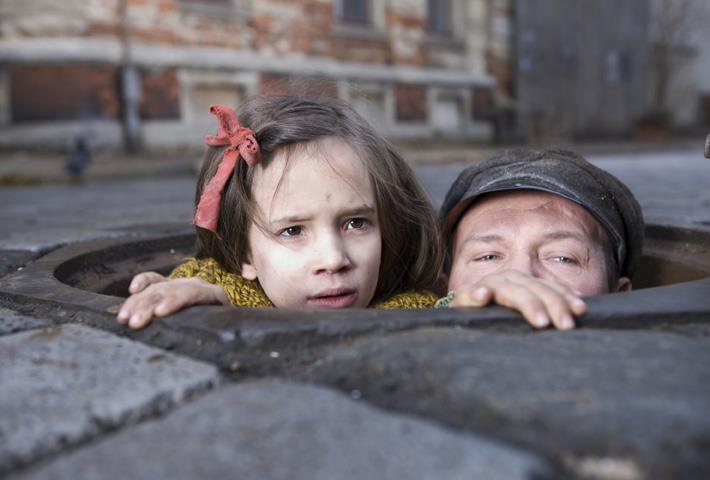 In Darkness, a film by Polish director Agnieszka Holland (Europa, Europa), is based on the true story of Leopold Socha (Robert Wieckiewicz), a Catholic sewer worker and petty thief who, though not especially fond of Jews, is willing to court danger in 1943 Nazi-occupied Lvov in order to make some easy cash, and hides a group of Jews underground for over a year.
Jolanta Dylewska’s startlingly beautiful color cinematography lends a heartbreaking immediacy and vividness to all the lives depicted, and the film’s photographic feat creates a powerful contrast between the above ground light and the underground darkness, conveying more than a metaphorical moral gravitas. Shot in Polish, Ukrainian, Russian, German, Yiddish and even a little Hebrew–all with English subtitles–the film feels thankfully un-Hollywood, and it depicts a humanity replete with kindness and selfishness, cruelty and courage,fortitude and desperation, hope and goodness, with the Jewish characters, too, shown in all their human frailty.
There were moments in the film when I wanted to cover my eyes, like one of the characters who covered her own eyes and her daughter’s, but however troubling and terror-filled, this compelling film tells an important story we may never understand, but ignore at our peril. As the director noted, it continues to echo in different places in the world, from Rwanda to Bosnia.
- No Comments
February 3, 2012 by Jill Finkelstein
Link Roundup: The Susan G Komen Backlash and Workplace Discrimination
Welcome to this week’s installment of Lilith’s Link Roundup. Each week we post Jewish and feminist highlights from around the web. If there’s anything you want to be sure we know about, email us or leave a message in the comments section below.
http://www.flickr.com/branditressler
On Tuesday, Susan G. Komen for the Cure announced that it would no longer be funding Planned Parenthood’s breast cancer screening program due to its new policy that blocks organizations under investigation from receiving grants. Though Susan G. Komen denied that its decision was motivated by a secret political agenda, critics pointed out that the new policy was enacted just a few months after U.S. Rep. Cliff Stearns launched an investigation to determine whether or not Planned Parenthood had used government funds to pay for abortions. In addition, Susan G. Komen’s newly appointed Senior VP for Public Policy Karen Handel is anti-choice and vowed during her run for Governor that she would eliminate funding to Planned Parenthood for breast and cervical cancer screenings. Despite whether or not Komen’s new policy was a cover-up for political motivations, the organization faced a major backlash and announced on Friday that it would be reversing its decision. [The Atlantic]
A new study reported that while women make up 68% of the voluntary sector’s workforce in the U.K., only 43% of the country’s charities are lead by women. In addition, the study found that women are grossly under-represented in the religious sector, as only 15% of religious organizations have female leaders. [eJewish Philanthropy]
- 1 Comment
February 1, 2012 by Amy Stone
Reporting back from the New York Jewish Film Festival: But would you go there? ‘Welcome to Kutsher’s: The Last Catskills Resort’
(The New York Jewish Film Festival, presented by The Jewish Museum and the Film Society of Lincoln Center,ended Jan. 26. Look for these films at other festivals and, hopefully, in commercial distribution.)
 What does it say about the state of American Judaism that the New York Jewish Film Festival’s final offering was the documentary “Welcome to Kutsher’s: The Last Catskills Resort”? Sad to say, we are talking the resort of last resort.
The Kutsher’s story testifies to the drive and determination that made Kutsher’s a piece of Jewish Americana for more than a century. This is the tale of three generations of Kutshers who oversaw the rise and watched the demise of the resort formula they perfected. Three meals a day – all the kosher food you could eat; free, top-flight entertainment; fun for the whole family; and the Kutsher niche – famous athletes on staff.
There was plenty of room for strong women in the Kutsher family. In 1907, Louis and Max Kutsher and Max’s wife, Rebecca, had saved enough money as tailors on the Lower East Side to buy farmland in Sullivan County in upstate New York. Like other Jewish farmers, they took in boarders from the Lower East Side. When guests turned out to be more profitable than chickens and cows, the Jewish resort business was born, responding to working-class Jews finally able to afford vacations but barred from gentile-only resorts.
- No Comments
February 1, 2012 by Tara Bognar
Modesty and Desire

http://www.flickr.com/center_for_jewish_history
Rabbi Dov Linzer, a prominent figure in Open Orthodoxy, recently published Lechery, Immodesty and the Talmud in the New York Times. The article explicitly responds to some recent attempts by ultra-Orthodox leaders in Israel to enforce their standards of “modesty,” (E.g.: Segregated elevators; segregated buses; a newspaper blurring out the mother’s face in the family picture accompanying the article about the murder of the mother and father). Linzer rebukes the ultra-Orthodox for hyper-sexualizing women and calling it “modesty” to police their dress and public presence. He cites Talmudic sources to correct the ultra-Orthodox understanding of Jewish law in this area. Linzer says:
The Talmud tells the religious man, in effect: If you have a problem, you deal with it. It is the male gaze — the way men look at women — that needs to be desexualized, not women in public. The power to make sure men don’t see women as objects of sexual gratification lies within men’s — and only men’s — control.
He concludes:
Jewish tradition teaches men and women alike that they should be modest in their dress. But modesty is not defined by, or even primarily about, how much of one’s body is covered. It is about comportment and behavior. It is about recognizing that one need not be the center of attention. It is about embodying the prophet Micah’s call for modesty: learning “to walk humbly with your God.”
- 7 Comments