 Please wait...
Author Archives: admin
December 7, 2007 by admin
Is Hanukkah the New Christmas?
Did you know that more than 80% of Israelis, the majority of whom are secular, light candles every night of Hanukkah? The practice has apparently become, for many, a cultural act, devoid of religious meaning,much like Hanukkah’s Christian counterpart, Christmas, has become for Americans. We can learn from this phenomenon that people like getting presents, lighting fires and eating foods that are bad for them, whether or not doing so is commanded by God.
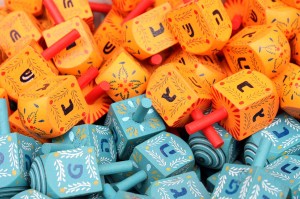
It’s because these particular holidays make us feel like kids again.
On the first night of Hanukkah, my mother threw a Hanukkah party with a mix of family and friends, all adults. I was engaged in a very adult conversation about some boring adult thing or other, when suddenly I heard my mother’s voice call out, with way more enthusiasm than I thought was warranted, “Who wants to play dreidel?”
Dreidel? I had forgotten about that part of the holiday. It seemed secondary to the food and the fire. And the presents. To my surprise, though, a number of attendees joined in enthusiastically. Those not actually playing the game (which is in truth, if played authentically, akin to the very adult activity of gambling), engaged in a competition to see who could get the best spin out of their plastic dreidels. Hanukkah is an excuse to act like children and have fun.
Yet, returning to this interesting phenomenon of secular Israelis lighting candles, it’s about more than just having fun. One or two nights of lighting candles would be fun. But all eight nights? That’s not fun, that takes commitment. By way of contrast, when non-religious Americans celebrate Christmas, they don’t do all twelve days. (Do religious Christians even do all twelve days?)
The actual commandment to light candles on Hanukkah is meant to publicize the miracle of Hanukkah miracle (Maccabees’ victory, enough oil for eight days, yada yada yada). But it’s become more about asserting pride in (or at the very least recognition of) being Jewish. Which is a lot more than most Americans can say about having a Christmas tree.
When my husband and I got back home from the party, we lit our own candles, and sat by the window in our living room looking out at all the other windows with lit candles shining out. It felt like we could play Jewish geography, drawing a map of the Jews in our neighborhood by connecting the flame dots.
But that probably would have caused a fire.
P.S. Here’s a fireless way to light candles this Hanukkah (though not technically a fulfillment of the mitzvah).
–Rebecca Honig Friedman
- 1 Comment

November 30, 2007 by admin
The Future of the Jewish People – Could It Be Unity?
The old Jewish guard — what’s often referred to as the organized Jewish community — has two main concerns: the future of the Jewish people and the future of the Jewish people. Two different senses of the same problem, that is. The first sense is the future generations of Jews, us young’uns who are supposedly being “lost” — assimilating, intermarrying and, perhaps most disturbing to the old guard, not joining the established religious institutions that allow us to be counted as “affiliated” Jews. The second sense is the future of the idea of the Jewish people as one, unified people.
There’s certainly reason to be concerned with the future of the Jewish people in both senses, but there’s also reason to think that problem #1 is actually taking care of problem #2. The young and diffuse next Jewish generation may be comprised largely of individuals doing their own thing, but when doing their own Jewish thing, they are more likely to seek out an accepting community and to eschew the traditional denominational labels that have done much more to divide than to unite the Jewish people.
This point is brought home by the juxtaposition of two recent news items, from the Forward and the New York Times.
This month on the Foward’s Bintel Brief advice column, the Jewish power couple of Blu and Rabbi Yitz Greenberg have been answering readers’ questions on a variety of what might be called halachic ethics issues. (Short aside: I love that the Forward listed Blu’s name and bio first in their intro of the couple.) Their last question comes from a man who underwent a Conservative Jewish conversion, which he claims was done properly according to halacha. He now wonders whether he should tell members of the Orthodox minyan where he prays regularly about his conversion, since they might then no longer consider him eligible to act as one of the ten men required for a minyan by Orthodox standards. In other words, there is a chance that if they knew he had converted under a Conservative rabbi, they might no longer consider him truly Jewish.
The Greenbergs’ response is quite critical of the Orthodox establishment (for those not in the know, Blu Greenberg founded the Jewish Orthodox Feminist Alliance and the couple are among the stalwarts of progressive Modern Orthodoxy) and speaks to the denominational divisiveness that’s threatening Jewish Peoplehood:
We believe that those who have the authority should rule that all denominations give full faith and credit to the halachic acts of others that meet their halachic standards. They should not allow the politics of delegitimization to disqualify the other. Alas, this is not what is happening. The sectarians and the splitters are in the saddle in this generation. You will have to find your place within that reality. We are all the poorer for it.
Interesting, though, that they write “the splitters are in the saddle in this generation. Because, as a recent article in the NY Times points out, the next generation of Jews are building post-denominational prayer groups that choose communal involvement and acceptance over rabbinic authority. While these minyans vary in the strictness with which they observe halacha (some use musical instruments on Shabbat, for example), they all take prayer and the liturgical service very seriously. This seriousness of purpose along with congregational participation are what makes these prayer groups so satisfying to younger people looking for a meaningful spiritual experience that’s more open and engaging than the stuffy synagogues of yesteryear.
But before we go too hard on the old guard, it should be noted that without their vigilance in giving their children and grandchildren a (perhaps stifling) Jewish education, these new and innovative congregations probably would not exist:
The minyanim have attracted young people who are well schooled in Judaism. A flowering of Jewish day schools in the 1980s produced a generation with a strong Jewish education and “the cultural wherewithal to create their own institutions,” said Steven M. Cohen, a professor of sociology at Hebrew Union College-Jewish Institute of Religion.
Cohen is Mr.-Jewish-demographics and a survey he co-authored “indicates that rather than taking young Jews out of the synagogue pews, they are taking them out of their beds on Saturday mornings.”
Rather than forsaking Judaism because of their distaste for tradiitonal Jewish institutions, young people are inventing new institutions that make Judaism fun and meaningful, in ways that fit with their lifestyles and value systems. Jewish life is hardly dead in their hands, but the kind of Jewish life that divides us as one people could be.
–Rebecca Honig Freidman
- 8 Comments
November 29, 2007 by admin
Body Image, and My Bat Mitzvah Video
As I mentioned in a post a few weeks ago, my boyfriend came home with me for Thanksgiving dinner. The meal went smoothly, but as expected there were some sticky moments. Like when my boyfriend and parents agreed it would be just the most wonderful idea to watch my bat-mitzvah video!
We gathered around the television and watched as visions of my painfully pre-teen self flashed across the screen. On the one hand, I enjoyed this trip down Jewish milestone lane. Although I’d love to forget the braces, the awkward limbs, and bad hair-cut of my adolescense, I was also proud. I enjoyed the opportunity to root for this miniature version of myself and imagine that the “little Leah” could sense the loving presence of her future self, watching as she chanted the haftorah. I also loved the way the video made my parents smile and my boyfriend say, “wow, you were really great!”
On the other hand, it turns out there’s nothing like a little backward glance to shake the foundation of your current reality. Like at most bnei mitzvot during my “era,” the videographer walked around to all the dinner tables at my party, taping each guest’s special bat-mitzvah message to me. (Do they still do that??) It was mesmerizing to watch people I’ve completely lost touch with say things like, “Oh my God – I’m so glad we’re friends! Congratulations, and you look amazing in your dress!”
The videographer also taped the speeches – the kind where your parents and favorite aunt tell you how wonderful and amazing you are. The kind where they say you’ve got only the brightest of futures, and will make a big impact on the world.
As a “freshly minted” Jewish woman with all her ambitions still ahead of her, those words made absolute sense. Of course I was going somewhere, that’s what people had told me my whole life! But 12 years later – embarking on a new and vulnerable career as a writer and hovering on the fence of being “just out of college” and a fully-accountable adult – they held a far greater weight. Have I made the big impact everyone promised I would? If not, am I heading in that direction or just floundering about and wasting time?
At everyone’s insistence – I also tried on the dress which still hung in the closet, pressed and waiting. I’d loved that dress – it was my first grown-up halter dress. I loved how it hugged my slender body (I’d recently grown about 6 inches, putting me at 5’8 and about 115 pounds) as I danced the funky chicken and was lifted up on a chair with people dancing around me. 12 years and about 35 pounds later later, I struggled just to get the dress past my hips and was only able to zip it up while holding my breath.
Although eating disorders run in one-half of my family (the Jewish half), I’ve always had a relatively decent body image. There were moments when I agonized over what I thought were zaftig thighs and swore that I’d lose 10 pounds. Still, I never really acted on it – eating frosting out the can and then running to the bathroom the way some of my friends in dance class did.
But all of a sudden in my family’s living room, I felt like Cinderella’s ugly step-sister straining to fit my gnarled foot into the little glass slipper. Rationally I knew I shouldn’t still weigh what I did as a 13-year old. But it was jarring to have such a tangible evidence – a dress, a video – that I was grown up.
–Leah Koenig
- No Comments

November 27, 2007 by admin
The Ethical Traveler: Be Good To Housekeeping
Several progressive Jewish organizations have launched a new campaign this holiday season that’ll make you think twice before you save money by blindly letting Priceline.com choose you the cheapest hotel.
The “Travel Justly” campaign is designed to raise awareness about the lousy working conditions (long hours, low pay, taxing physical labor, and no health insurance) for many hotel housekeepers, the vast majority of whom are female immigrants, or women of color.
Rabbi Jill Jacobs, Rabbi-in-Residence at Jewish FundS for Justice, which is one of the campaign’s spearheaders, explained why this is a Jewish issue: “Hotel housekeepers engage daily in hakhnasat or’chim (hospitality to guests), by cleaning rooms, making beds, and otherwise ensuring that we are comfortable. As travelers, we must reciprocate by advocating for safe working conditions and fair wages for hotel workers.”
Not to mention the many laws governing the way Jews are supposed to treat their workers — very well! (In fact here’s what Rabbi Jacobs has to say on that very subject)
The campaign is the work of JFSJ, the Progressive Jewish Alliance, and the Jewish Labor Committee (we Jews are so organized, aren’t we?). They are asking travelers — Jewish and non-Jewish — to “sign a pledge to be ethical hotel guests this holiday season.” Which means: not staying “in hotels that are in the midst of a labor dispute,” staying in a “union hotel” when possible, not being obnoxiously messy so as to prevent unnecessary strain on housekeeping workers, and tipping housekeepers the suggested amount of $2-5 per day.
You can even buy a luggage tag to remind you of all this.
To read the full text and sign the pledge, or to find out more, visit the campaign’s website at http://ga6.org/campaign/ethical_travel.
–Rebecca Honig Friedman
- 2 Comments
November 21, 2007 by admin
Bye-Bye Buy
Black Friday is almost upon us – the ultimate day of turkey-stuffed, American consumerism that immediately follows Thanksgiving and sounds the holiday shopping season’s starting gun. The stores are ready – a Dunkin’ Donuts ad in this morning’s paper urges readers to “jump start your holiday savings” with a buy-one-get-one-free Latte (of equal or lesser value of course). But the question is, are we ready?
There’s nothing wrong with showing love through gifts, and there are certainly ways to give presents in a meaningful, sustainable way (like baking someone a beautiful loaf of bread, re-gifting gently used books, or buying eco-friendly presents like the ones suggested at The Jew & The Carrot’s Sustainable Chanukah Gift Guide).
But for anyone who prefers not to partake in the frenzied accumulation of plastic bags holding plastic stuff on Black Friday, there’s “Buy Nothing Day” – a concept created by a Vancouver-based artist and promoted by the anti-consumerism magazine Adbusters. Nothing Day advocates abstain from spending any money on Black Friday.
Hmmm…somehow that sounds familiar. Where have I heard of people abstaining from purchasing anything on a given day before? Ah yes, Shabbat.
Shabbat, I think, is the prototype for Buy Nothing Day. It’s Jewish tradition’s weekly antidote to thoughtless over-consumption. Of course not all Jews observe the buy nothing (and for that matter drive nowhere, email no one, and don’t work) aspects of Shabbat. But how profound would it be if everyone – Jew and otherwise – took one day a week to “say no” to the computer, to their errands and to-do lists? How profound to simply celebrate with their friends and family through eating and singing together? My blessing for this Thanksgiving is that we all set aside more opportunities in our lives to truly exist and recharge – without buying the entire sale rack at The Gap.
Happy Thanksgiving!
—Leah Koenig
The views and opinions expressed in this article are the author’s own and do not necessarily reflect those of Lilith Magazine.
- 3 Comments
November 19, 2007 by admin
So Many Faces To Slap: Jewish-Catholic Relations in St. Louis
It is generally taken as a given in our politically correct age that clergy of one religion are supposed to respect the norms of the other religion and not interfere in internal dogmatic affairs. This is the principle that allows for interfaith dialogue, the open expression of religious perspectives without the fear of judgment or ridicule from other religions (at least not in public).
So was it wrong for Rabbi Susan Talve of the Central Reform Congregation (CRC) in St. Louis to allow two Catholic women to be ordained as priests, in direct opposition to established Church doctrine, in her temple’s sanctuary?
Talve has said her decision, unanimously approved by CRC’s board, “was based on its values of providing a sukkat shalom, or shelter of peace to the women seeking a religious venue,” and on hachnasat orchim, hospitality. But welcoming these particular guests was a politically charged action, and we would be naive to not read more into the decision.
What Talve and the CRC did was a huge slap in the face to the established Catholic Church. Disregarding a basic tenet of their faith was a clear violation of the basic respect between clergy of different faiths.
On the other hand, it’s a matter of which clergy they’re choosing to respect. Insomuch as the Catholic women now consider themselves to be priests, and are clearly part of a reform movement within the Church, Talve has chosen to ally herself with that particular group of Catholics rather than with the “orthodox” establishment. And how could she not? As a woman who is a rabbi, she makes her livelihood off of the very same challenge to established religious doctrine that the women-priests are attempting. To deny them aid would be a slap in the face to the cause for women’s equality in religion. It makes sense that, as a Reform rabbi, she would be loyal to the progressive elements within Catholicism rather than to the “orthodox” ones.
What’s more puzzling, to some troubling, about this incident is the fact that Talve allowed a Catholic religious ritual to be conducted in a Jewish sanctuary. Belief in one religion traditionally depends on the belief that the other religions are wrong, or at the very least that one religion operates distinctly from the others. The more subversive part of Talve’s and the women-priests actions is challenging those distinctions. When it comes to traditional notions of religion, that is the biggest slap in the face of all.
–Rebecca Honig Friedman
- 1 Comment
November 16, 2007 by admin
The State of Things: Kosher Fest and the Jewish Community
This past Sunday, I attended Kosher Fest, the yearly gathering of kosher food and beverage purveyors and other food professionals (held in New York City, naturally). Kosher Fest is no informal synagogue social – it’s a two-day mega event that features the newest, best, and flashiest in kosher food. Page 11 of the 84-page Kosher Fest program guide displays some “impressive facts” including the dollar value of kosher produced goods in the US – $10,500,000,000. In other words, if you make kosher food you’re either at Kosher Fest, or you’re missing out.
Precisely because it’s the “see and be seen” event of the Jewish food year, Kosher Fest serves as an annual barometer of the kosher industry – its health, its growth, and its trends. More interestingly, as I ambled down the aisles of shiny displays, I began to notice how the state of kosher food uncannily mirrors the state of today’s Jewish community.
Sponsored by the OU, OK, Kof-K and Star K kosher certifiers (among others), the stands at Kosher Fest was anchored by the big guys – Kedem, Osem, Manischewitz, Agri Processors, and Rokeach. Of the lesser-known brands, the majority of products still fell into the “traditionally kosher” category – foods that feel ersatz, like most Pesach-friendly cookies and the snacks at the Golden Fluff booth, where I watched people dip spongy kosher marshmallows into a bubbling fountain of brown, plastic-like chocolate.
After wading a bit deeper into the stands of Pesach-friendly cookies and jugs of kosher, corn syrup-heavy BBQ sauce, however, it was possible to find some companies bucking the status quo with products that are:
-Organic (e.g Wise Kosher organic poultry, The Simple Kitchen Organic
fruit sparklers)
-Sustainable (e.g. Royal George cheese from grass fed cows)
-Vegan (including Sheese, a non-dairy cheese from Scotland which
unfortunately tasted a bit too much like Play Dough)
I even noticed signs of political resistance in the shape of Eye on Agri Processors literature, surreptitiously scattered about the tables and in the press room.
What could be more indicative of the state of the Jewish community than a stroll through Kosher Fest? Just like in the organizational Jewish world, the money and the influence in the kosher industry sit with the establishment, while inspired and creative ideas are generated by a smaller sub-set of innovative companies/organizations who are willing to try something new.
As someone who works for one of those innovative organizations (Hazon), I know how frustrating it can be to feel like the work we do is a tiny drop in the Jewish organizational bucket. Similarly, I imagine a lot of the smaller, alternative food companies wish the kosher market was more demanding of their products.
Still, the tide seems to be turning. It will not be the Manischewitz’s of the world, but the smaller, forward-thinking companies (and organizations) that redefine what it means to eat and be Jewish in the 21st century.
*While we’re discussing “the state of things,” here’s a fascinating post on Jewschool which highlights large gap between mainstream Jewish funding and the innovative ideas and organizations it hesitates to support.
–Leah Koenig.
- 1 Comment