 Please wait...
Author Archives: admin
July 21, 2010 by admin
Letter from Jerusalem: Listening on the next generation of Conservative women rabbis
“Get yourself a teacher, acquire for yourself a friend.” – Pirkei Avot 1:6
Blessed are You, God, who clothes the naked. My mother’s closet is full of clothing from various eras of her life. Suits hang in every jewel-tone from decades of shul-going. She has even saved her Bat Mitzvah dress, yellowed lace with patches of pastel. When I was younger, I used to love playing dress-up in her closet, awaiting the day I would grow into her clothes.
Among the diverse discussion topics when a group of women rabbinical students gathered in Jerusalem living rooms this past year was the contents of our own closets: how we see ourselves and how we are seen; the ways we choose to cover and uncover; the garments we have inherited and those we have taken upon ourselves. My hevruta (study partner), Kerrith Solomon, and I convened this group of women from the Jewish Theological Seminary and the Ziegler school so we could talk with our peers about things we have not yet had safe space to explore within our schooling, reclaiming and exploring our identities as women on our paths toward the rabbinate in the Conservative Movement. (more…)
- 2 Comments
July 13, 2010 by admin
New Podcast: The Jewish Women's Roundtable!
New podcast from the Jewish Women’s Roundtable, a collaboration between Lilith and the Forward’s Sisterhood blog.
Here, the Forward’s web editor Gabrielle Birkner talks with Lilith editor in chief Susan Weidman Schneider, Lilith assistant editor Sonia Isard, and the Forward’s editor, Jane Eisner. Listen in on our conversation on everything from Jewish anti-choice organizations, to a new pitch for a reality television show, to our own “click” moments.
[display_podcast]
Enjoy! And join in the conversation in the comments section below.
- 3 Comments
July 7, 2010 by admin
Nothing New Under the Sun: Mmmm… Delicious!
What Lilith publishes really has legs! Just look! Check out this item from today’s news, and then read what Lilith said earlier on this very subject.
“Men eat meat, women eat chocolate”—at least, that’s what Riddhi Shah writes at salon.com this week. But what happens when the already complex relationship between food and gender is complicated even further by romance—and religion? Find out what Lilith contributor Cynthia Graber thinks, in her 2009 feature, “When Food and Love Collide.”
- No Comments
July 1, 2010 by admin
Nothing New Under the Sun: The Body Politic
What Lilith publishes really has legs! Just look! Check out this item from today’s news, and then read what Lilith said earlier on this very subject.
ABC’s new family drama, HUGE, has sparked some great out-of-the-box conversations about representations of the body in the mainstream media. As Ginia Bellafante writes in this week’s New York Times, HUGE “stands in some sympathy with a rebellion mounted against so many hours of ‘The Biggest Loser'”–a reality show and weight-loss competition.
Here at Lilith, we’re excited to hear these murmurs circulating because, as Barbara Gingold has written in our pages, “The body itself is a woman’s form of language.” Critical thinking about questions of body image, weight, dieting, and size-ism has long been important to Jewish feminists on the front lines of progressive thought and on the front pages of our magazine. For a sampling of Lilith writing on the subject, check out “Fat Talk” from 2001, and then browse through the treasures in Lilith’s rich archives for related articles. And tell us what you think! What have your own experiences been like?
- No Comments
June 23, 2010 by admin
Nothing New Under the Sun: Now with More Shakespeare!
What Lilith publishes really has legs! Just look! Check out this item from today’s news, and then read what Lilith said earlier on this very subject.
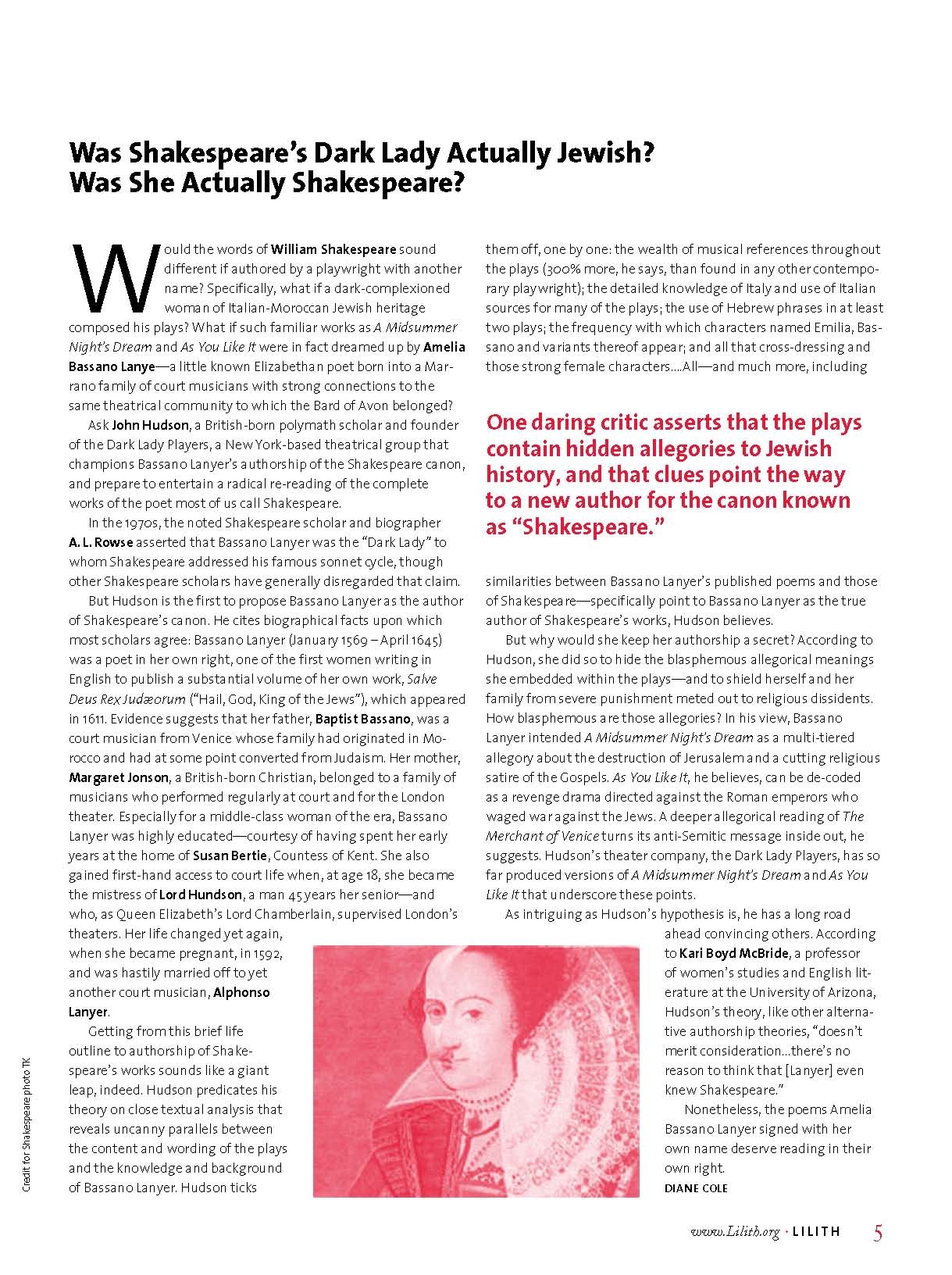
“God has given you one face, and you make yourself another,” quoth he—Hamlet, that is. But who gave Hamlet his face? Michael Posen raises the question this week in “Unmasking Shakespeare.”
Now check out Lilith’s 2008 take on this abiding mystery. “Alas, I am a woman, friendless, hopeless?” Maybe not so hopeless, after all!
- No Comments
June 16, 2010 by admin
The Marriage Train
I’m not exaggerating when I say that if I had tried to get engaged or married while in college, I would have been in some serious trouble with my mother. I can hear her rant (albeit a made-up rant, but nevertheless, the sound of her voice is a stunning likeness) about how we had all worked too hard to get me there for me to blow it on anything other than more hard work, no distractions as crazy as marriage. She knew something about marriage; she was in one for sixteen years that ended unhappily, and she had given up admission to a prestigious nursing program to get married. I was supposed to do other things, and finishing college was only the tip of the iceberg.
The impetus for this post is the recent deluge of marriages I’ve noticed among Jews under the age of 23. My confusion is mostly based on the fact that the folks who are making the mad dash for the chuppah aren’t Orthodox or even Modern Orthodox, where the expectation of marrying and starting a family young is seen as an immediate priority.
I’m struggling to understand why this is happening, and why the Jewish community is so hell-bent on establishing it as a norm. It creates a strange and terrible kind of peer pressure, resulting in panic amongst the not married or partnered, and even resulting in those in committed relationships marrying before they’re ready (if anyone is ever really ready).
Marrying so young places an entirely different lens over the concept of matrimony-it’s no longer about taking years to find the right person and begin a life with them. Rather, it’s about starting out together, and hoping, believing even, that you will be able to overcome the hurdles that are inevitable when two people grow and change together. It seems particularly retro if you’re me, and along with your friends in their early 30’s, are either skeptical at best of the institution of marriage, or just starting to think about the idea.
It’s hard to explain to the newly minted college graduates around you that no, this behavior isn’t normal for most people their age. A marriage license and/or an engagement ring isn’t a requirement to receive a college diploma, although it seems like it might as well be. You can still be a member of a Jewish community without a ketubah on the wall of your apartment and with the last name you were born with. It should go without saying that all this is true, but it’s hard to believe when it seems like everyone else is doing getting married and/or engaged. Who will the role models be for young, single, serious Jews who don’t fit into or buy into this paradigm, especially young women? Only time can really tell us if young folks can resist the peer pressure to hurry and create a family (even if it’s not what’s right for them–now or ever) or if they will seek out other communities who can ultimately be more patient.
-Chanel Dubofsky
- 3 Comments
June 15, 2010 by admin
Nothing New Under the Sun: Women in the Domestic Workplace
What Lilith publishes really has legs! Just look! Check out this item from today’s news, and then read what Lilith said earlier on this very subject.
In this New York Times article from June 2, 2010, “For Nannies, Hope for Workplace Protection,” Russ Buettner reports on workplace rights for domestic workers in New York.
For a Jewish feminist take on the issue, have a look at Lilith’s 2006 article, “Who Cleans Your House?” in which Alice Alexiou writes about acting ethically and responsibly when you hire household help.
And for a slightly different slant on some similar questions, inform yourself with Lilith’s poignant special section from 2002, “Jewish Girls and African-American Nannies.”
And when you’re done with that, how about “Gringa Guilt and Housework,” writer Janice Eidus’s incisive look at the intersection between cross-cultural adoption and “women’s work.”
Tell us what you think in the comments section below! And remember to send us your own suggestions for articles from Lilith’s archives which are a good match for what’s in the news now. We’ll use your suggestions and include your name.
- No Comments
June 9, 2010 by admin
A Voyeur's Garb
I admit it–I’m an Orthodox voyeur (fetishist, you might call it). As in, I am guilty of a certain degree of exoticization of the Orthodox community. For a while, I was convinced that in spite of my relatively non-observant upbringing, I could become part of it (see “Pants Embargo, 2003-2005”). I was wholly unsuccessful at it- I didn’t become more religious, I just didn’t wear pants- although I think on the outside, people bought it. At least, they were quick to comment as soon as the jeans made a reappearance.
Some vestiges have remained, in the form of what I can describe as situations in which I feel like an anthropologist in communities that I am theoretically supposed to be a part of. Example most recent: the JOFA conference (Jewish Orthodox Feminist Alliance). I love this space, every time it comes around, I rearrange things so I can go. It’s a strange place for me to find comfort and inspiration, because I often also feel insanely frustrated by what I perceive as collusion with a system that consistently, actively and aggressively subjugates and invisibilizes women.
I’ve been listening to the recordings of the sessions I didn’t attend while at the conference, and thinking about the creation of space as I do it. I thought a lot about what to wear this year. Ultimately, I wore a skirt, which in hindsight, I shouldn’t have done. I felt like I was in costume, undercover, but also, fake. With the exception of a few people I knew, everyone who saw me that day thought I was an Orthodox woman. In the past, I would have been okay with that, even grateful for the association, but no longer, because it’s not who I am, or who I ever was.
Ultimately, the genius of the JOFA project, whether purposeful or not, is the opportunity for ingathering of all different types of Jewish feminists, the welcoming of the lenses and the narratives. In doing so, we (okay, me) have to confront what we find most disturbing, meaningful and joyful about Judaism, as well as put our heads together to change it. It requires patience and commitment, but it also requires an unpacking of assumption-about Orthodoxy, Jewish women, Jewish communities, and ultimately, what it means to be Jewish ourselves.
-Chanel Dubofsky
- 1 Comment
June 1, 2010 by admin
Reconceiving Jews
Last night, just for fun, I googled “childfree Jewish community.” (To be clear – the term “childless” implies that one wants children but does not have them for some reason, whereas “childfree” alludes to someone who’s happily without children and aspires to stay that way). What I found were feature articles written years ago, an assortment of alarmist opinions from rabbis and other Jewish communal figures on the declining Jewish birthrate, and one recent piece from Frum Satire called “I Don’t Want to Have Kids.”
As another Jewish woman who’s committed to living a childfree life, I was so excited to see this post, especially since it was written by a woman who’s committed to a halachic life. It’s hard to put yourself out there when you know you’re going to get skewered by your own community.
I destroyed my own bliss by reading the comments on Tova’s piece. It’s not like I haven’t heard most of them before-you’re selfish, you’ll figure it out when you’re older, you don’t know what you want yet, you have issues that you’re refusing to deal with. What wasn’t said was that in addition to being angry and frustrated, people are confounded by Tova (and me and every other woman who doesn’t want to be a mother). Who is a Jewish woman if not a nurturer, a creator? What does a Jewish woman look like if she’s not building a family or aspiring to build a family?
I’ve always known I didn’t want to parent, but I admitted it rather early. Now I’m 31 and my friends are on their second babies. I’m watching my avowed childfree life proceed as planned. In the secular world, people are confused and skeptical about my feelings, but in the Jewish world, it’s a different kind of message-a questioning. What are my priorities? How will I be a member of a Jewish community as an adult if I don’t have children? Don’t I feel a responsibility to the Jewish community to create more Jews?
The blogger and author Emily Gould said in a recent interview in New York Magazine, “I do think that people who write honestly about their lives are doing people who won’t or can’t a favor, to put it bluntly.” Part of writing honestly about your life is admitting that you don’t have answers, that everything you think and feel is complicated. This is especially true for women, since we’ve been socialized to not trust our instincts and therefore to dismiss our own emotions, lest we become consumed by them and be labeled hysterical. For me, there aren’t clear answers to the questions about what it means to be in a community that I consider to be mine when I feel at odds with it about so many things. There are only more questions.
–Chanel Dubofsky
- No Comments
May 26, 2010 by admin
Intention
This evening, as I was leaving the building I will be working in for one more day, I ran into Sam, a lovely man whom I don’t see often enough. As we talked, I told him that I’d be leaving the organization, he asked me what I’d be doing next. “I don’t know yet,” I said, “but I’ll be okay.” He looked at me closely for a long moment. “Of course you’ll be okay.”
I’m thinking about that talk with Sam, because he has a remarkable and seemingly unassailable faith in the order of things, but also because of the comfort I was able to take from it. My genetic family has not been a source of support for me, so I’ve found safety and community in other places, odd places.
The process of doing this while working for Hillel has been frustrating, joyful and confusing, a lot like how you might feel about family. We create identity through family-we decide who we are and who we are not, based on the structures and expectations around us. We decide whether or not we want to be part of the family, and what we need to do to make it a place we want to be in.
The point of all this rumination is to say that as long as I’m invested in Jewish communities, they will be the places where I’ll feel the most injured, the most vulnerable, and the most resourceful. As I’ve discussed in earlier posts, the boundaries that Jewish communities create define who is allowed in and who is out. It has to, that’s how you create community, not everyone can be a part of it. Ironically, though, while I attack these boundaries as exclusive and damaging, they have grown me, they’ve constructed my spiritual and moral backbone. Feeling injured has galvanized me, but the same isn’t true for everyone. While it’s led me to activism, it pushes others out the door.
My students over the years have been a feisty, creative, cynical, deeply thoughtful bunch of characters. I want them to exist and flourish inside of a community that they build, that welcomes them because of who they are instead of who they are not.
-Chanel Dubofsky
- No Comments